Category Archives: Shooting

SAR9X — A New 9mm Turkish Delight

In the latter part of 2012, European American Armory (EAA) began importing SAR pistols into the US. I was running a gun store and training academy focused mainly on the Texas Concealed Carry License course. Many of our attendees had never shot a gun and were undecided about what handgun to buy. We provided loaner guns for these people for the shooting proficiency section of the course. Our loaner bag contained a Sig SP2022, an S&W M&P, a Glock 19 and several SAR B6s. The B6s were attractive to us because wholesalers were offering them at discounted prices designed to introduce them to the US market. We had some confidence in the B6 because it was like EAA’s Witness, an Italian gun made by Tanfoglio, with which we had previous experience. Both guns are CZ-75 knockoffs.

We sold a ton of B6s, including one sale of six to an attendee of our class who liked the SAR (and its price) so much, she bought one for herself, one for her husband and one for each of her college-age kids. Colors were available then and there was at least one pink and one purple gun in that mix. Although I added both a B6 and SAR’s second US offering, a K2, to my own collection back then, I didn’t manage to hold onto them. The K2 is internally the same as the B6, but it’s more squared off on the outside. I recently asked my son, who was active with me in the gun store business, what happened to our loaner B6s when we closed our business and he reminded me we gave the loaner bag of guns to one of our instructors who was starting a training business of his own to replace the one we were closing down.

As a bit of background, Sarsilmaz Firearms Corp. is a privately owned small arms manufacturer based in Düzce, Turkey. The company was founded in 1880 and is the largest small arms manufacturer in Turkey. Sarsilmaz produces handguns for the Turkish National Police and the Turkish Armed Forces and exports firearms to over 75 countries. In 2018, Sarsilmaz founded SAR USA to import and distribute Sarsilmaz firearms in the United States. They are headquartered near Auburn, Alabama.

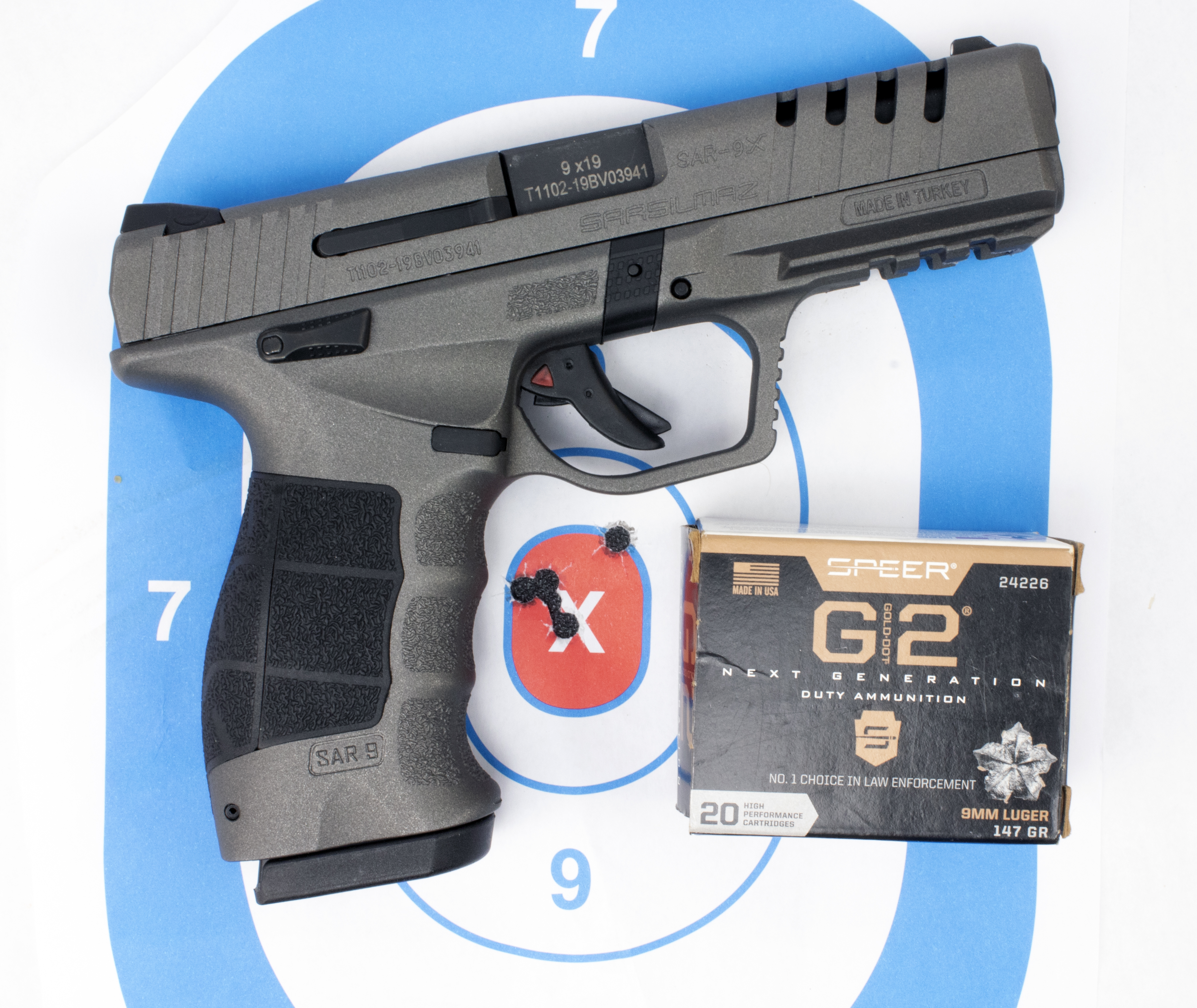
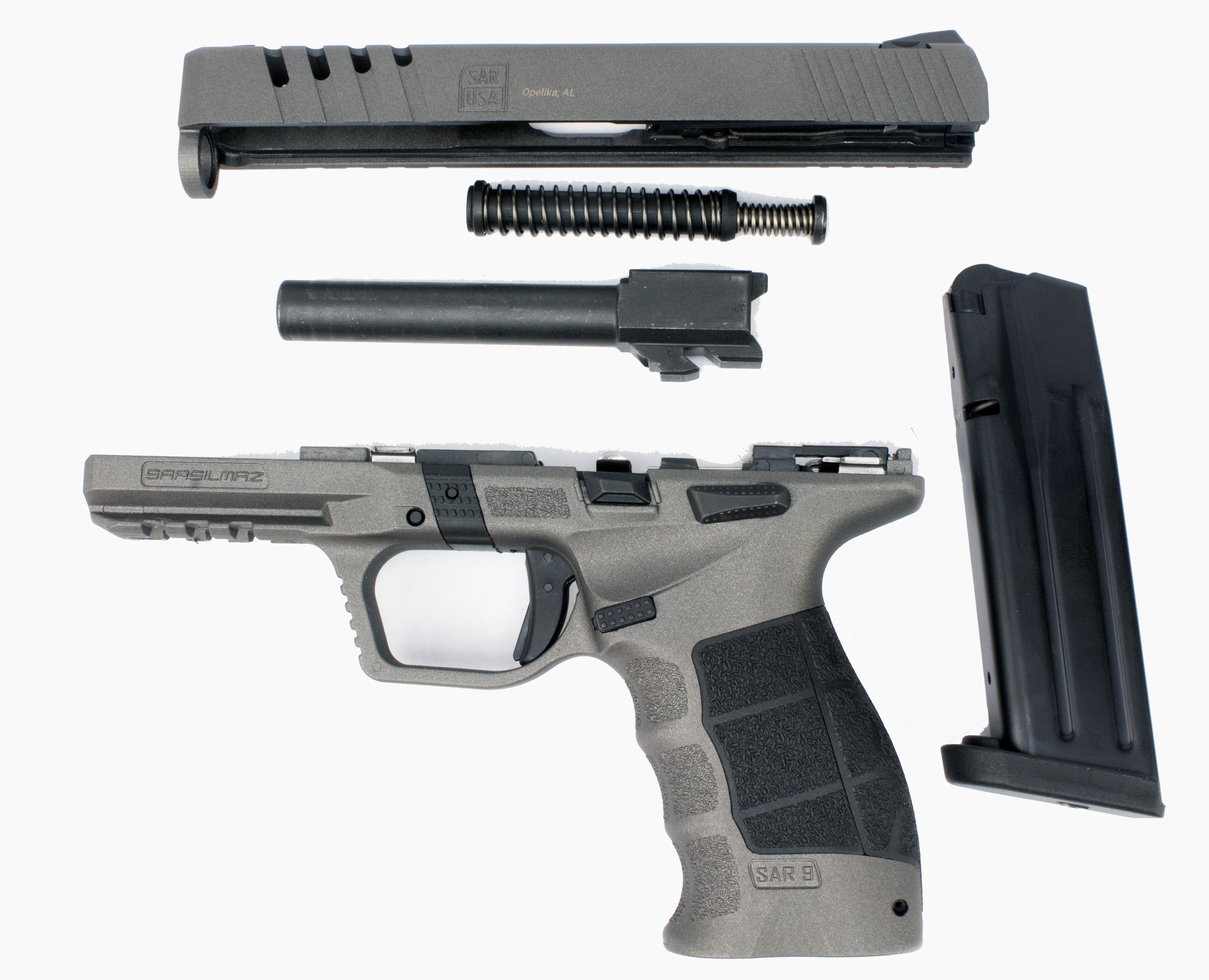
The B6 and K2 are hammer-fired guns. I first saw the striker-fired SAR9 at an NRA Convention in Dallas in May 2016. I found it interesting but didn’t follow up as I was no longer selling guns or doing live training. Now that I’m back in the business as a gunwriter and online instructor, I pay attention to new guns and when the SAR9X was announced, I reached out to SAR’s marketing representative to ask for a test and evaluation sample. I see and handle a lot of guns. Very few create the Red-Ryder-BB-Gun-under-a-nine-year-old’s-Christmas-tree reaction I had to this gun. My example gun has a platinum Cerakote finish with accenting controls and grip panels in black. It looks amazingly like the H&K VP9. In fact, I’ve read some references calling it the “Turkish VP9.” The SAR9X is pre-packaged as a duty gun for a police officer or civilian looking for a carry gun. It arrived in a red plastic case containing a paddle retention holster and matching magazine carrier, both a 17-round and a 19-round magazine, a light to mount on the picatinny rail, extra back straps and grip panels, a magazine loader, a punch for changing out the backstrap, a cleaning brush and rod, a manual, and of course, a gunlock. The packaging was part of my initial reaction at receiving the gun, but the attractiveness of the gun amplified it. Even if we carry concealed, most of us like to have an eye-catching gun when it comes time to show it off to our gun-loving friends.

SAR9X packaging
The SAR9X comes packaged with everything you need to put the gun to work.

There are lightening cuts above the cocking serrations at the front of the slide. Bold, three-dot sights grace the top of the slide as do pre-drilled holes for optics mounting. The frame features textured, replaceable grip side panels and backstrap, a pebbled front strap with mild finger grooves — just deep enough to ease your hand into the proper grip. Further enhancing the grip is a high undercut on the trigger guard which is plenty big for gloved operation and also features serrations on the front to aid the grip for users who like to place the forefinger of their support hand on the front of the trigger guard, something I’ve begun to do lately after years of shooting. It helps steady my grip. The magazine release is just beneath a thumb groove on the grip and is reversible.

The SAR9X closely resemblers H&K’s VP9

There’s an ambidextrous thumb safety, a blade trigger safety and an internal striker block safety that doesn’t release until the trigger is pulled fully to the rear. The striker-cocked indicator is a small red triangle at the base of the trigger. If you see that red indicator, the gun is cocked. If the gun is not cocked, the trigger remains to the rear and the red triangle is not visible. The trigger was a little rough when I first started handling the gun, but after dry-firing it 20–30 times at home and firing a couple of boxes of ammo at the range, it smoothed out. The trigger pull is now consistently a little over 4 lbs. and all the initial grunge is gone.

The SAR9X weighs just 27.5 oz. It’s 7.6″ long, 5.5″ high and 1.4″ wide. That puts it in the size category of the Glock G19 and many other defensive handguns, including ones I carry regularly. I wasn’t sure the paddle holster in the kit would work for me, so I slipped the gun into the leather IWB holster I wear every day and it fit fine. That holster was created for a Sig P226, but I have successfully used it for a variety of guns. Even before shooting the SAR9X I had the feeling it was going to become my regular carry gun.

I’ve already mentioned the trigger was a little grungy when I first started shooting the SAR9X, but it cleared up and when it did, I found it predictable and easy to tune my finger to. I had some issues early on with the gun not cycling and ejecting rounds. My bad. I took it to the range initially dry as a bone. After putting a little oil in all the recommended places, the pistol began to run like you’d expect a VP9 to, only it’s not a VP9. It’s a $500 Turkish-made Sarsilmaz, and those folks know how to make good firearms and are able to do it without having to charge exorbitant prices.
I’ve been fortunate in having ammo to shoot during this time of shortages thanks to Norma entering the handgun ammo market, Hornady offering a new Handgun Hunter round that I figure if it’s good for four-legged animals I would be safe in carrying it for possible use against two-legged mammals that might become a threat, and a new company in Florida — Pilgrim Ammunition. The SARX9 is a delight to shoot. After the early issues with feeding, a result of me not lubricating the gun before shooting it, it just chugged along regardless of the ammo I was using. I only had one box of practice rounds, so it was pretty much all defensive ammo going down the pipe, and to my delight, whenever I did my job with the sight alignment and trigger press, the gun did its part in tightly grouping the rounds on target.

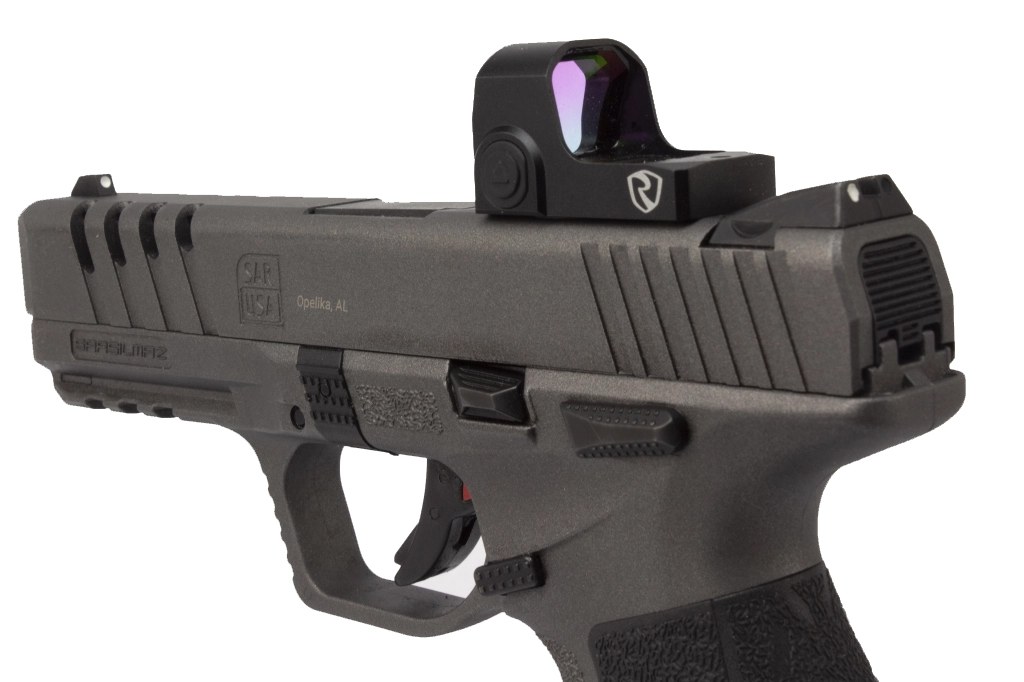
Sarsilmaz apparently has a mounting plate for the SAR9X available from their Turkey operation, but you don’t need a mounting plate for a red dot sight with mounting holes that line up with those cut on the top of the SARX9’s slide. Among those are the Swamp Fox Sentinel, the Shield SMS 2, the Shield RMS C and the Sig Romeo 0. I reached out to the folks at Riton and they sent me one of their mini red dot sights, an X3 TACTIX MPRD. The holes aligned perfectly, the threads on the screws they provided with the sight were correct for the holes in the frame so the sight installation was a breeze.

The slide is predrilled for mounting optics.

Zeroing it in was also a breeze as it was already aligned at 15 yards. I dug through my holster drawer for an IWB holster that would fit the SAR with the red dot sight installed. The one I chose is a Crossbreed SuperTuck Holster that fits the SAR9X perfectly with the red dot installed. So now I’ve entered the brave new world of carrying concealed with a red dot sight installed. The Ridon has a 50,000 hour battery life and no off switch. You turn it on in the morning and it will automatically go off after 12 hours. If you’re still out close to 12 hours, just turn it on again.

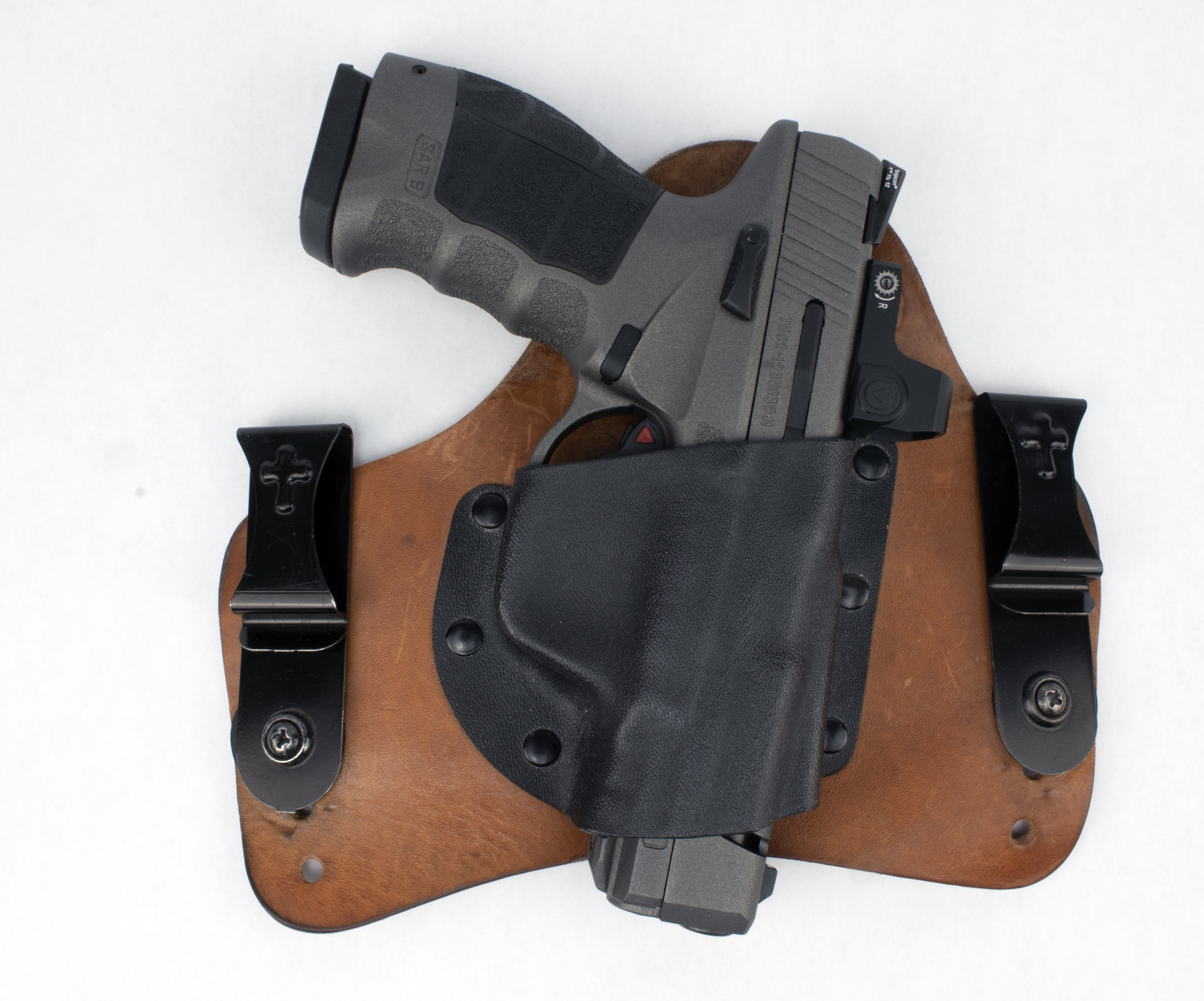
SAR9X with Ridon X3 Red Dot
The SAR9X with Ridon X3 Red Dot Sight
David carries his SAR9X in a Crossbreed SuperTuck holster.

Making the Move to Red Dots

With all the interest in red dot sights these days, I thought I’d share with our readers my journey to learning about and using red dot sights on my handguns. It’s easy enough to get a red dot equipped handgun if money is no object. You can select a pistol with a slide drilled for mounting a red dot and spend $400–$500 to buy one of the recommended brands the pistol is set up for. But for those of us on a limited budget the process can be bit challenging. Even taking the first route, the available choices may leave you wondering which of the recommended brands is the best.

My first experience with a red dot sight was a Bushnell Trophy installed on a Bushmaster Carbon 15 AR I bought in 2011. I’ve done nothing to the sight but change the battery as part of a yearly periodic preventive maintenance schedule. The sight was zeroed in when the gun was new and hasn’t been adjusted since. It’s still right on target.

David’s Bushmaster AR-15 With Bushnell Trophy Red Dot Sight

The second oldest red dot I own is a Pursuit TX30 R/G Dot installed on my Ruger Mark III Hunter. That sight is big for the pistol and I’ve considered replacing it with a much smaller sight such as the Kingwolfox 20mm Rail 4 Reticle Tactical Red/Green Dot Sight I found on Amazon for $32.

Ruger Mark III Hunter With Pursuit TX30 R/G Sight
Kingwolfe Red/Green Dot Sight
Kingwolfe Red/Green Dot Sight With Multiple Reticles

That $32 price for a multiple reticle red/green sight is not unusual for a red/green dot sight that mounts on a picatinny rail. In fact, I have a couple of sights that I purchased for $49 each from a company called My Crisis Gear in Allen, Texas. I don’t find a place to order them. They were apparently an email promotion for a time. But I have found similar products at similar pricing on Amazon.com. If you’ve been shopping for sights like Sig Sauer’s Romeo Zero, Trijicon’s RMR, Leupold’s Delta Point, JP Enterprises’ JPoint, C-More Systems STS’ and  EOTech/Insight Technology’s MRDS, you’re probably used to prices in the $200–$500 range and you’re wondering if an under $50 sight could be useful.

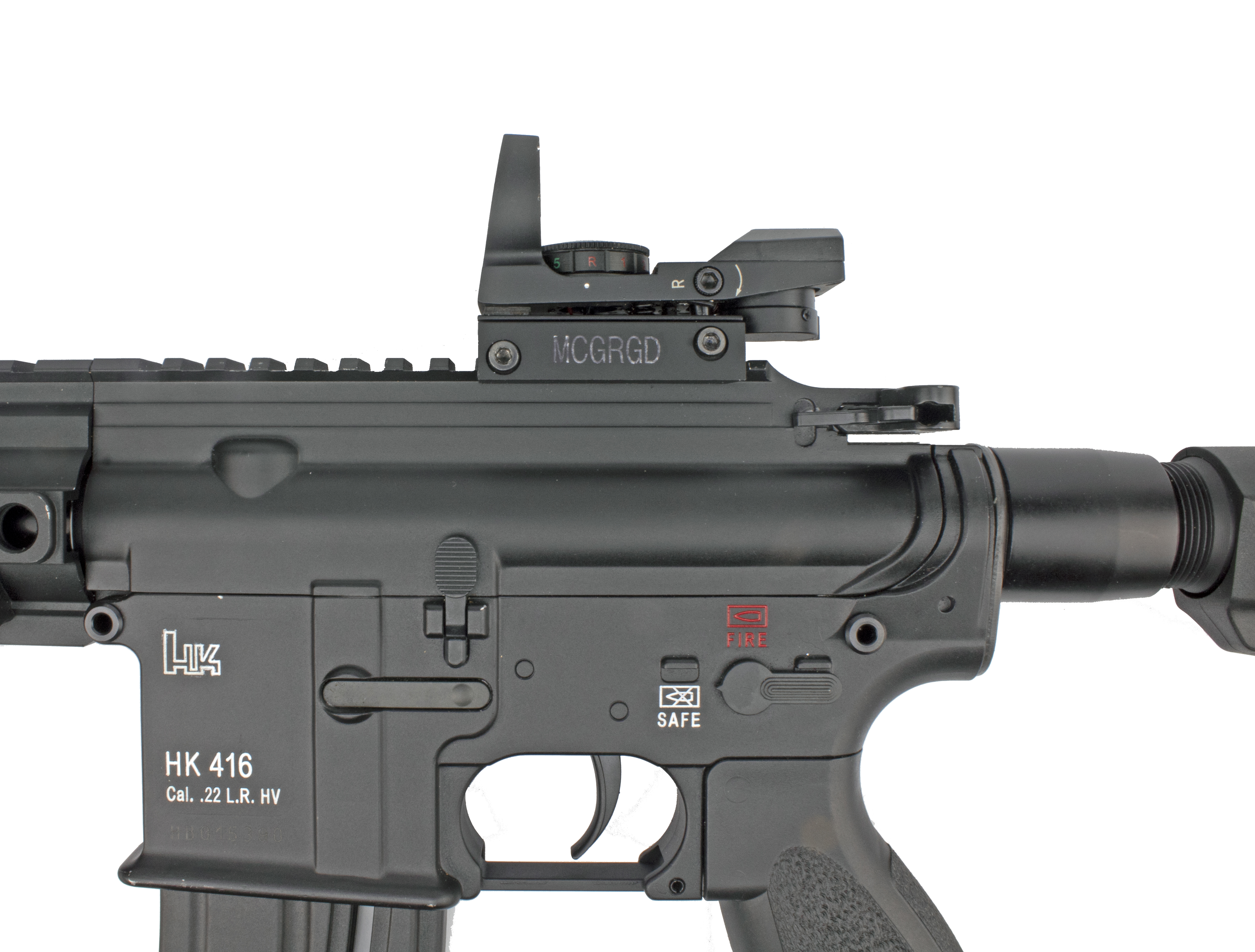
While I can understand the argument that you shouldn’t trust your life to a $50 sight when good optics obviously cost a lot more, these sights are mounted on fun guns and they are fun. One of them is on an HK416 .22 AR style pistol and everyone who shoots it enjoys it. Even some in our family who aren’t really into guns and don’t shoot much enjoy it. These $50 sights have multiple reticles — crosshairs, a dot inside a ring, and a ring with crosshairs — which can be displayed in either red or green and in various levels of brightness varying from 3 MOA to 10 MOA. I mounted another of these to an S&W Victory .22 which we use for plinking and target practice. If they didn’t require a picatinny rail for mounting, I’d probably use them everywhere I wanted a red dot sight.

HK416 .22 With My Crisis Gear R/G Dot Sight

The dot in red dot optics is measured in MOA, or “minutes of angle” which is a unit for angular measurement of a circle. In a sight it refers to the size of the dot and how much it covers at a certain distance. The smallest dot currently available is 1 MOA. Most red dot sights are around 4 MOA which means the dot will cover 4 inches at 100 yards, 2 inches at 50 yards, and about an inch at 25 yards. Larger dot sizes are helpful for fast acquisition while smaller dot sizes are better suited for precision shooting. Red dot sights do not have magnification like a rifle scope, so the size of the dot represents the size of the area in which your shots should impact.

I recently visited with personnel from an optics company based in the community where I live. I asked personnel there why there was such a difference in prices on red dot products and was told most optics sold in the US are built in China using glass made in Japan. The quality and difference in price are based upon the quality of the glass, strength of the housing and features such as number of reticles, battery life, on/off switching, etc. The clarity of the dot is not generally a factor as all dots have a bit of fuzziness. The more expensive red or green sights should take more abuse and last longer, but don’t really have an advantage in the aiming department.

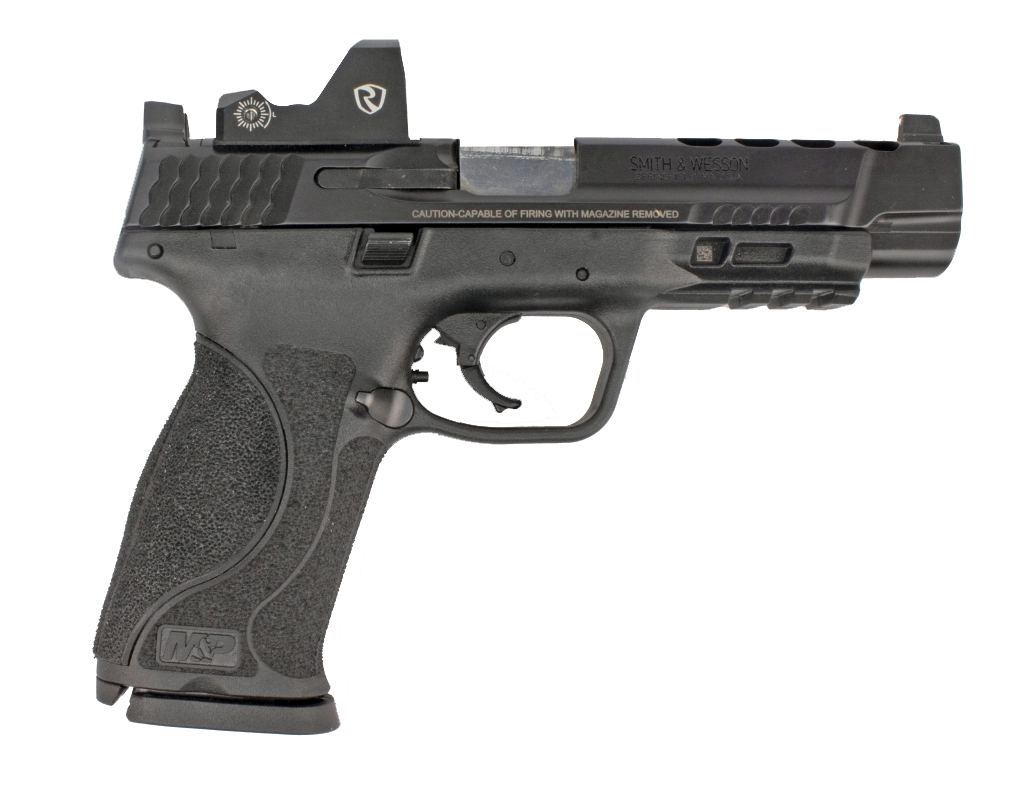
This visit occurred while I was trying to decide upon a sight to mount on a S&W Performance Center M&P C.O.R.E. pistol. This gun has a removable plate on the slide just ahead of the rear sight that is set up for mounting a red dot sight. The gun came with adapters for many common red dot sights. My local gun store had all the recommended sights in stock with prices ranging from $300 to just over $500. During several visits to the store, I eyeballed those optics but having experienced how well the $49 mail order optics were working and being on a rather tight firearms budget, I just couldn’t see springing that kind of money. One of the $49 sights wasn’t an option because it is designed to mount on a picatinny rail and that wasn’t one of the options for the M&P.

Riton X3
Performance Center M&P C.O.R.E. With Riton X3 Tactix PRD Red Dot Sight

The company, Riton, gave me one of their X3 Tactix PRD pistol sights to try. This sight has a 3 MOA dot and mounts on the M&P using the RMR adapter.  This sight features a 5000-hour battery Life, a lens coating that allows use with night vision devices, 4-hour auto shut off, 2 night vision settings and 10 brightness settings all at a price of $199. Mounting it on the M&P and zeroing it in was simple and I’ve been very pleased with the way the sight complements the pistol.

My next red dot sight adventure was with a Ruger-57. The Ruger-57 has predrilled optics mounting holes with mounts available at ShopRuger.com. One of the two mounts available fits the Burris® and Vortex® red dot sights and the other fits the Docter®, Meopta, EOTech® and Insight® Sights. Ruger offers the Viper® and Venom® red dot sights each at a price of $349. Money being no object it would have been a simple matter to have purchased one of these sights and the appropriate mount from Ruger. Money was an object, so I went to Amazon and found an Ade Advanced Optics RD3 Micro Mini Reflex Sight for $62. This sight uses the Venom® red dot footprint so it mounted perfectly to my Ruger-57. My grandson and I used my Firefield Red Laser Universal Boresight to align the red dot at home then took it to the range and enjoyed shooting targets out to 25 yards with amazing accuracy.

Ruger 57 With ADE Optics Red Dot SightTarget is From 25 Yards

I’ve now shot enough with red dot sights that I’m confident in having a red dot sight on my EDC gun. The gun I chose for that purpose is the Sarsilmaz SAR9X, a very capable H&K VP9 knockoff. The SAR9X has predrilled optics mounting holes on the slide. Just as I was beginning my search for a red dot sight to use those holes without an adapter, a Riton X3 TACTIX MPRD arrived in my mailbox. I had requested one of these from Riton’s director of marketing almost two months prior when I met him at a writer’s event. I had almost forgotten about the request, but the timing was perfect. This sight bolted right to the SAR9X and according to my laser boresighter was aligned perfectly. One of the things I really like about the Riton is its auto-off feature. You can turn the sight on when you holster the pistol in the morning and leave it on. It will automatically turn off after 12 hours. The sight promises a 50,000-hour battery life.

SAR9X With Riton X3 MPRD Red Dot Sight

In order to carry the SAR9X with the red dot sight on it I had to find a holster that would accommodate the sight. My favorite leather IWB holster was cut too high for the pistol to fit with the sight on it. A Crossbreed SuperTuck designed for a Sig Sauer P226 worked perfectly with just some minor trimming of the kydex.

SAR9X With Red Dot Sight in Crossbreed SuperTuck Holster

There’s no question that drawing, aiming and shooting accurately with a pistol that has a red dot sight mounted on it is different. It requires some adjustments to your technique and a lot of practice. But with that practice will come better accuracy at distances that may have been a struggle for you with iron sights.

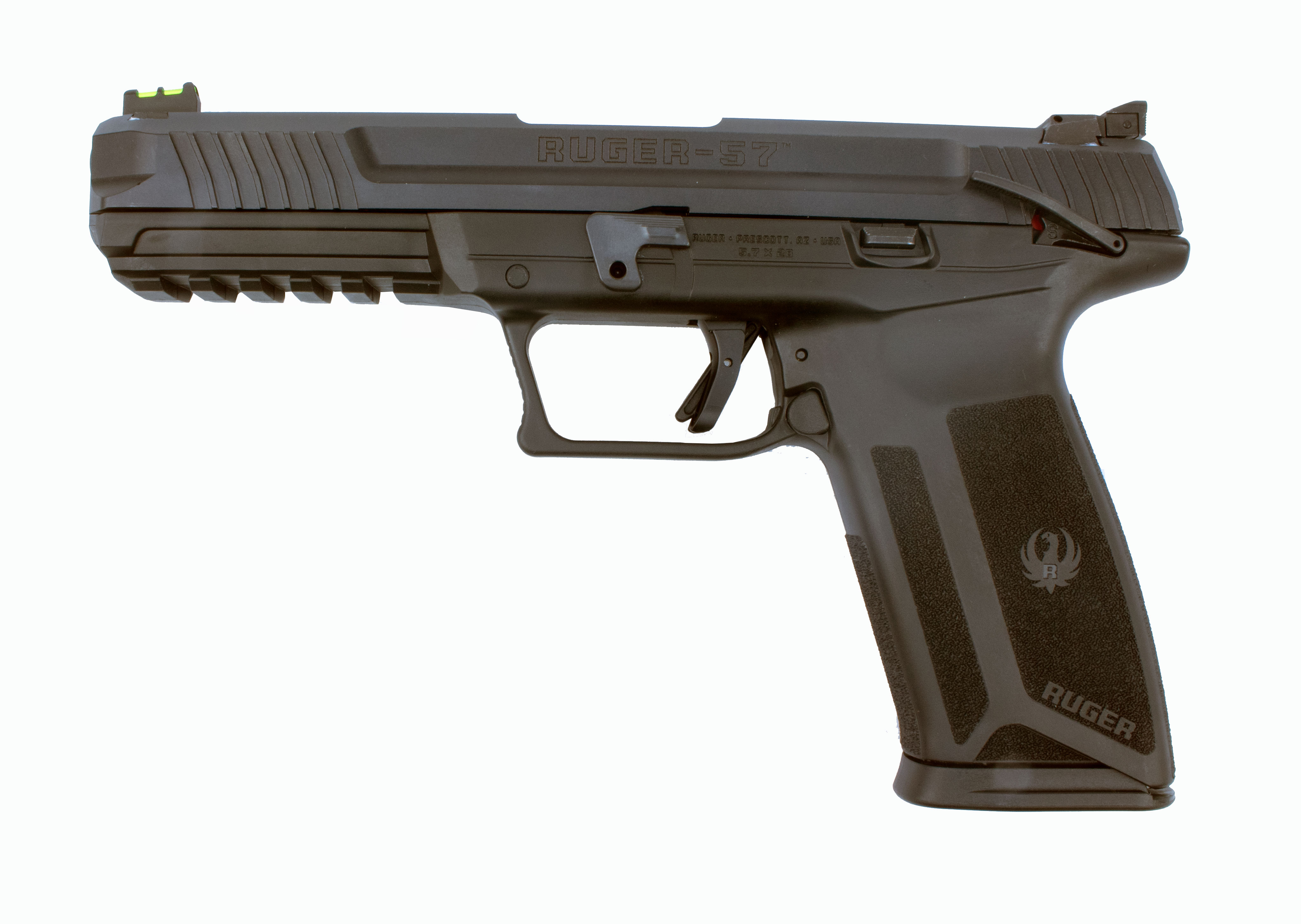
Ruger-57™ — 2020 Handgun of the Year

The day my Ruger-57™arrived in it’s beautiful black box with red trimmings and the Ruger logo in red on its top, a press release announced the Ruger-57™had been awarded the Caliber Award in the Best Overall New Product category by the National Association of Sporting Goods Wholesalers (NASGW) in partnership with the Professional Outdoor Media Association (POMA). I could see why, even though I had not yet shot the gun. The 57 is beautifully made and in a caliber that’s unique and very interesting.

The Case for the Ruger-57 Complements the Looks of the Gun

One of my sons has an FN HERSTAL Five-seveN and we’ve all enjoyed shooting it. He got his when they were in high demand and short supply and has always treasured it as a unique piece of handgun history. Now Ruger has acknowledged the caliber with a handgun that’s more affordable than the FN gun, yet with the typical Ruger ruggedness enhanced with features and handling that make it a standout in any gun collection. When I opened the box, before ever touching the gun, I was impressed. It just looks really cool.

The Ruger-57 has a 5-inch Barrel Making it Long, But it is Not Heavy

I knew it would be light, so picking it up wasn’t a surprise in that category, but the way it felt in my hands was more in keeping with a heavier gun. I think it’s the length of the slide and barrel that give it that feel. It’s a 5″ barrel, with a long slide to match. The slide has a lightening cut at the top, a green fiber-optic sight at the front and a fully adjustable all black sight at the rear. There are cocking serrations front and rear and much to my delight the top of the slide is predrilled for a mounting plate that will accommodate most of the common red dot sights. I wasted no time ordering a mounting plate from ShopRuger.com as I had a red dot sight looking for a home. The slide is also contoured nicely on the front and top to aid in holstering and concealment. This is a gun lots of owners will decide to carry because of it’s capacity, lightweight and overall thinness. The 57 is long, 8.5″ front to rear, and it’s 5.5″ tall. The width is 1.5″ and the weight is 24.5 oz. Sure it’s going to stick down in or outside your pants a little further than most carry guns, but the weight isn’t an issue and carrying 21 lethal rounds is nothing to sneeze at.

The Ruger-57™is internally hammer-fired with a trigger known as the Secure Action fire control system. It’s similar to the action on the LCP II and Security-9 pistols. The Secure Action fire control provides the feel of a short, crisp single-action trigger that consistently breaks around 5.5 lbs.

The Controls are in all the Right Places With an Ambidextrous Thumb Safety Plus a Trigger Safety

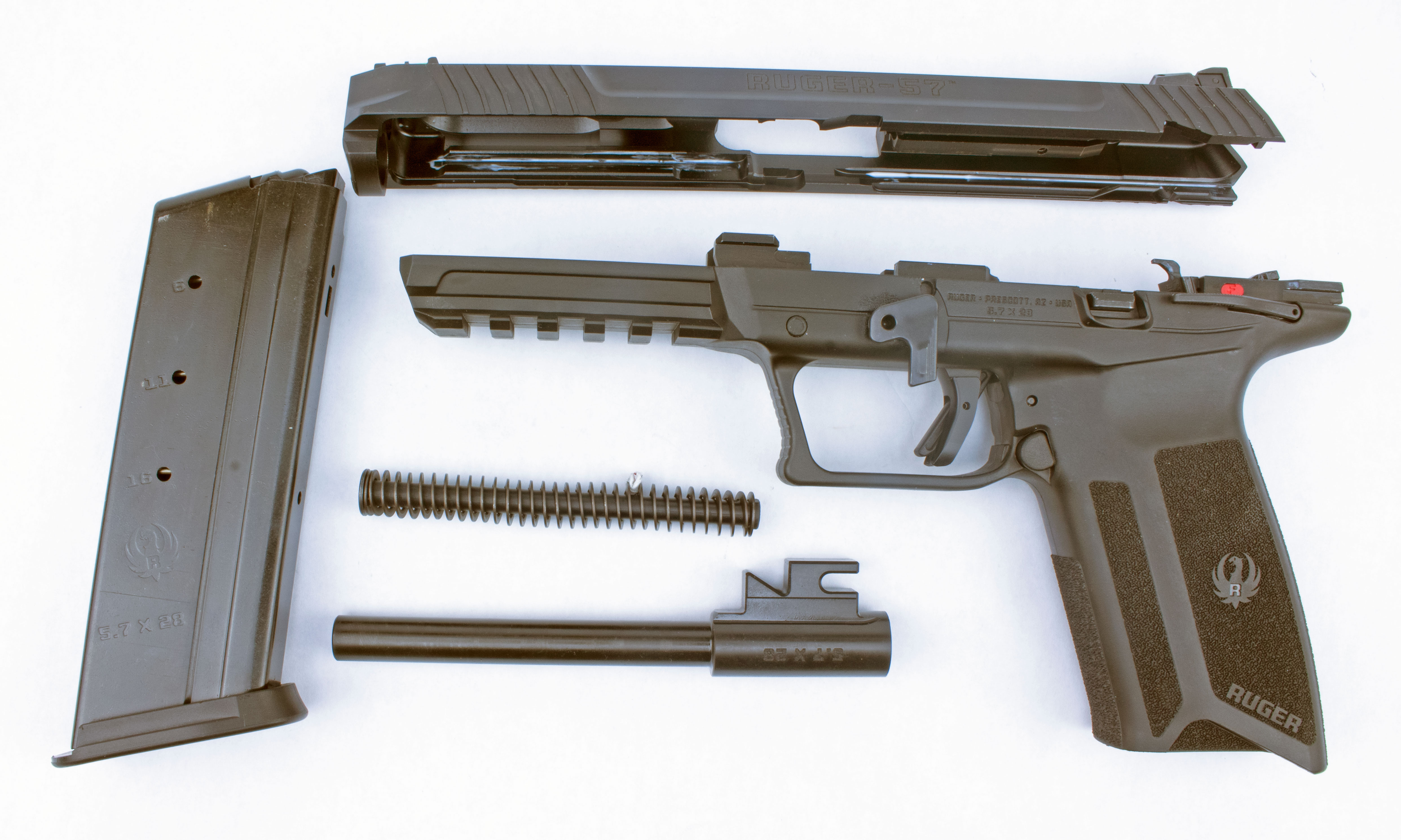
Controls on the Ruger-57™are easy to operate and located where you’d expect to find them. There is an ambidextrous external safety to go along with the blade safety in the trigger. The slide lock is only on the left side, but the magazine release button is easily switched to the right side if that’s that you’d like. The ejection port is rather long to accommodate the length of the 5.7x28mm brass. The takedown lever rotates 90 degrees counter-clockwise after being pushed out slightly by pressing a button on the right side of the frame. I found the button a little difficult to press, but the manual recommends using the bottom of one of the magazines or some other non-marring surface to push on the button, rather than your fingers. Once you’ve rotated the lever, takedown on this pistol is different. You move the slide forward about 1/4″ then just lift it off. Removal of the recoil spring and barrel is then done just like you’d do on any other centerfire semi-automatic pistol.

Takedown is a Little Different for the Ruger-57 But Easy Following Instructions in the Manual

The grip is textured and fills the hand more front-to-rear than side-to-side. That nicely shaped and textured grip makes handling the long slide and barrel seem natural. It’s a hoot to shoot. When my mounting plate arrived from Ruger I installed an Ade Advanced Optics RD3 that I bought on Amazon. Mounting the optic with Ruger’s mounting plate was an easy task. Before going to shoot, I used my Firefield Red Laser Universal Boresight to get a starting alignment, which turned out to be right on target when I got to the range.

After Installing an ADE Red Dot Sight I Played around With it at Targets Up to 25-yards (shown here)

I’d love to tell you about all the different types of ammo I tried but the real story in this time of unprecedented gun buying and ammo shortages I was lucky to find any 5.7 x 28mm ammunition at all.  Palmetto State Armory had some American Eagle 40 grain FMJ in 50 round boxes for $50 so that’s what I shot. The gun seemed to like it and shooting it was pure delight. My friend and fellow gunwriter, Will Dabbs M.D., who beat me to posting a Ruger-57™ review in both GUNS and American Handgunner magazines wrote about a love affair with the gun. I don’t know that I’d go that far, but when you’ve got a Ruger that spits fire, makes a loud boom, puts the holes where you want them every time you pull the trigger and doesn’t have much recoil, it would be dang near impossible not to really like the gun.

Is it the right gun for concealed carry or home defense? I could be. It’s light, though kind of big, especially with the red dot sight on it. The bullets travel really fast, like 2250 fps, so there’s no doubt they’ll wreak havoc on a flesh and blood target. Compared to its only real competitor, the FN HERSTAL Five-seveN, The Ruger-57™ is a real bargain. Ruger set the MSRP for their 57 at $799 while the FN HERSTAL Five-seveN’s MSRP is $1,199.

GSG Firefly — A Fun .22 Pistol

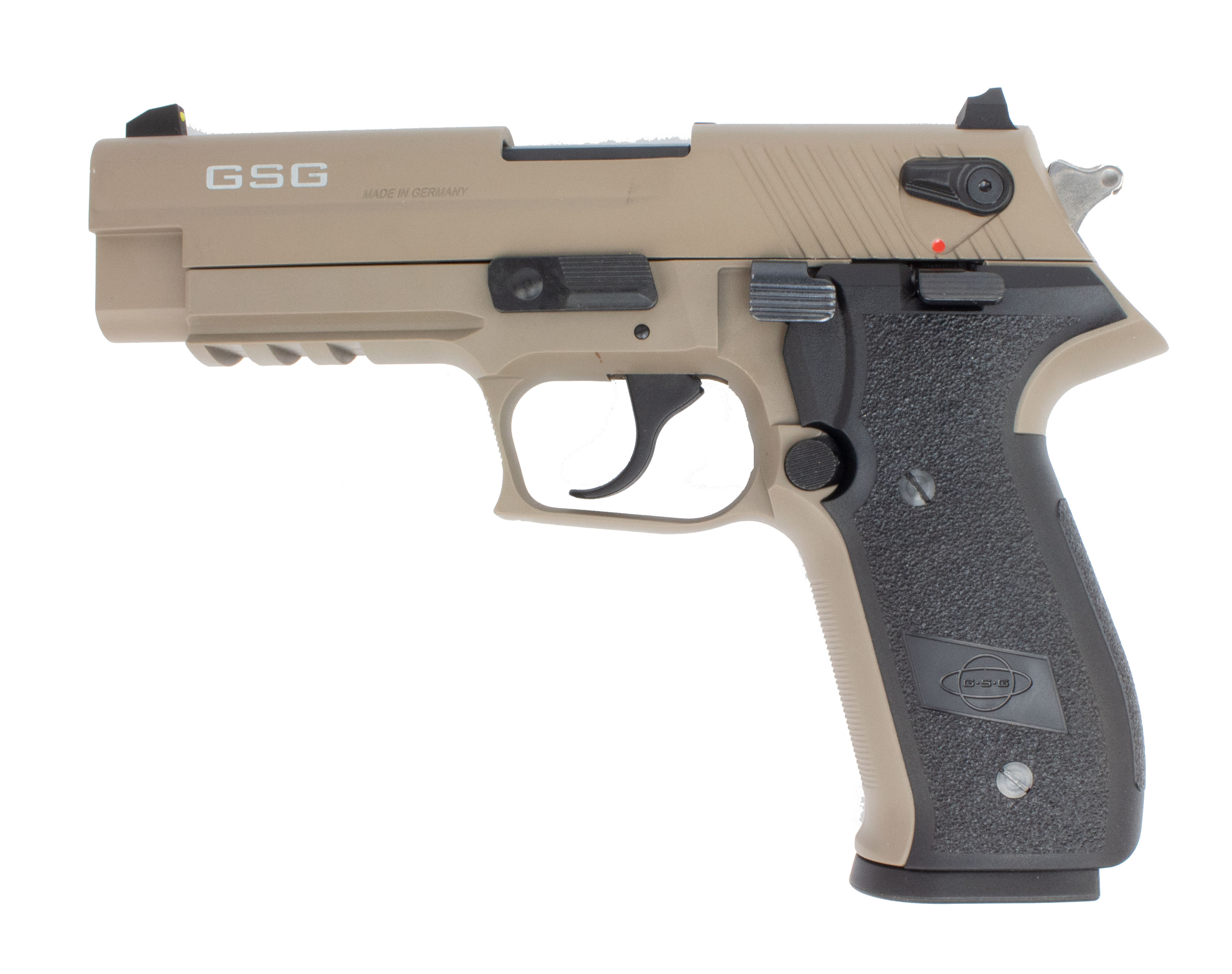
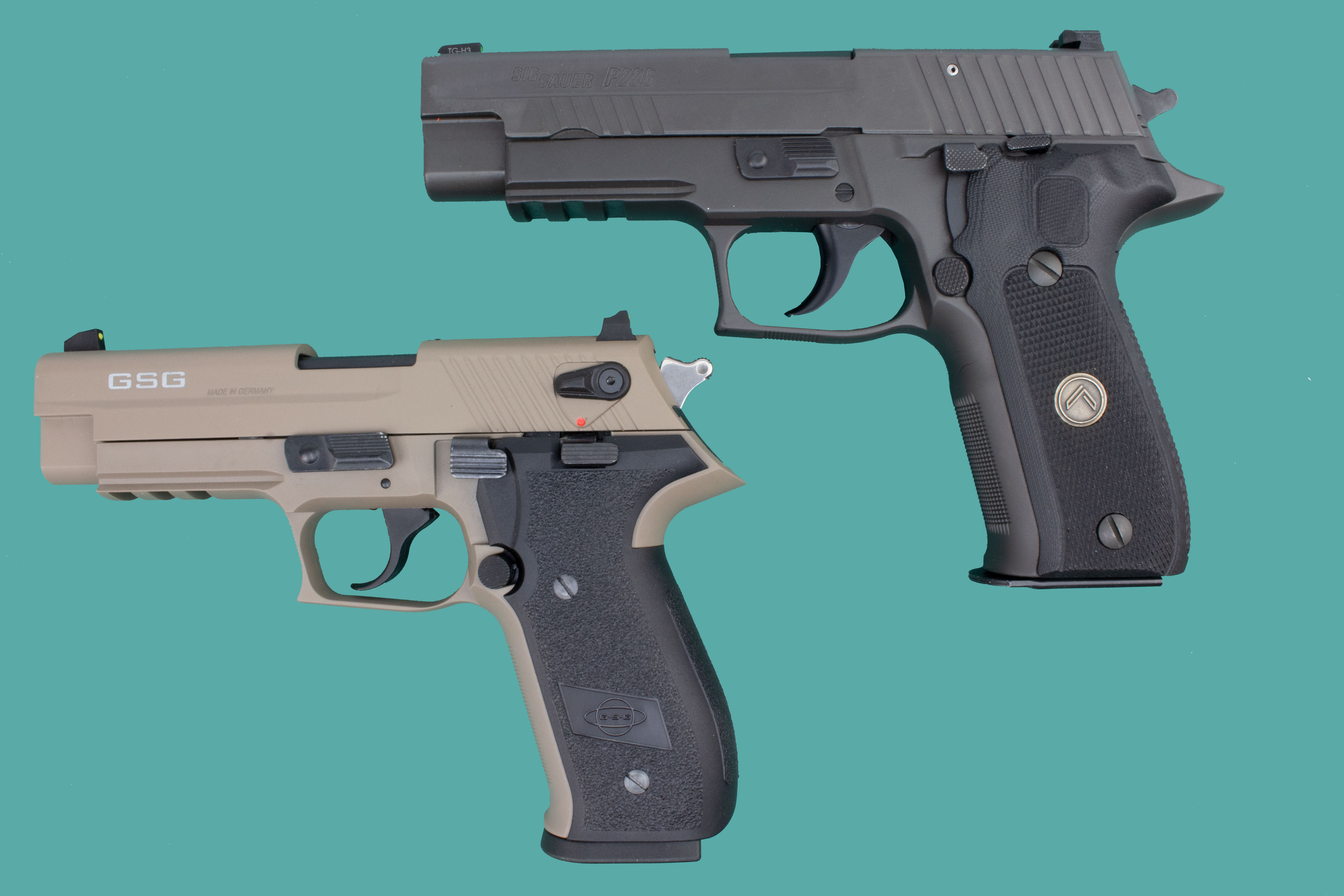
Several years ago, Sig Sauer had a .22 pistol called the Mosquito in its product line. The Mosquito was very similar in appearance and operation to the P226. Sig no longer produces the Mosquito, choosing instead to concentrate on the Law Enforcement and Personal Protection markets. However; the enjoyment found in shooting the Mosquito is not lost as German Sports Guns and American Tactical, Inc. have brought it back. GSG’s relationship with Sig involves creating realistic licensed air gun replicas of several Sig Sauer pistols, including the P226. After working with Sig on the specs, GSG developed a Mosquito knock-off called the FireFly. Still an insect, but with a little more spark. American Tactical, Inc. imports the FireFly with several color schemes, with and without threaded barrel and with an optional Bridgemounted Duosight Red/Green Dot sight.

The FireFly is Built by German Sports Guns and Imported to the US by American Tactical, Inc.

I’m a sucker for .22 pistols, especially ones that emulate my centerfire pistols. Lots of cheap shooting helps me maintain my proficiency, plus it’s just plain fun to go plinkin’ with a .22. Right now anything that qualifies as a handgun is scarce, but I was able to get my hands on a tan, non-threaded barrel version of the FireFly. In normal times the other colors available are: black, green, pink and purple. I probably would have chosen tan regardless of the other colors being available.

The Controls on the FireFly Mimic Those of the Sig Sauer P226

The FireFly has an alloy-frame with an integrated accessory rail. The slide features adjustable sights, cocking serrations and a slide mounted ambidextrous thumb safety. The three-dot sights look like Trijicon night sights, but they don’t glow in the dark. The frame has a fixed barrel that operates with a blowback system. It also has an ergonomic grip that feels excellent in my medium-sized hands. Like the Sig P226 it emulates, the FireFly is a DA/SA hammer-fired pistol with a decocking lever. It is equipped with a magazine safety which means with a magazine removed the trigger won’t operate. The single-action trigger pull is slightly over 8 lbs. and the double-action pull a little over 12 lbs. There’s a clean break for either one. There’s almost no slack before the double-action trigger is engaged and the stacking distance works out to about .5″. The single-action trigger moves almost .5″ before engaging but the break is immediate. None of this is out-of-line for a .22 caliber semi-automatic pistol. The FireFly is a 95% scale of the P226 but weighs considerably less — 24.6 oz. compared to the P226’s 34.4 oz. The alloy frame overmolded with polymer makes the difference.

The FireFly is Designed to Look and Feel Like a Sig Sauer P226
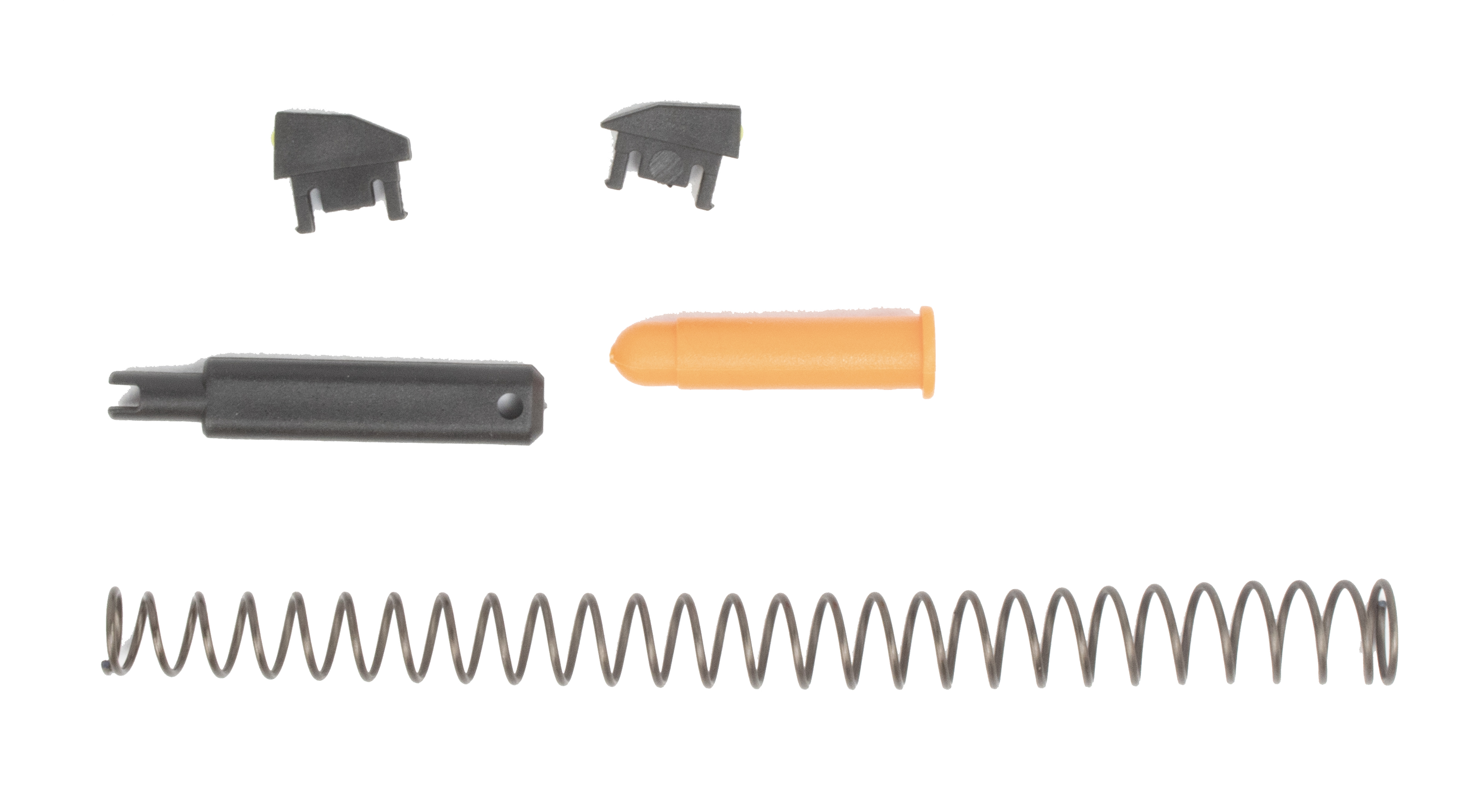
The FireFly Ships With a 2nd Recoil Spring for Using Standard Velocity Ammo, Extra Front Sight Posts for Raising or Lowering the Front Sight, a Tool for Removing and Installing the Sight Posts and a Dummy Cartridge to Allow to Facilitate Dry Fire Practice

The key to making this gun run is choosing the right ammo. The printed manual that came with my sample gun only warned about using good factory ammo and did not mention the two recoil springs that shipped with the gun. Having had previous experience with the Sig Mosquito, I knew there had to be more to it. I went to the ATI website (americantactical.us) and located the FireFly manual that was online and it included the following information, obviously translated from German:

According to updated knowledge of modern gun manufacturing for caliber .22. We have therefore decided to make an adjustment to the loads that have priority for use with the FireFly, which are the two major groups, utility and high-speed rounds. So to increase the round compatibility, we provide two slide springs for every pistol. The bigger bored version is designed for high-speed loads and is fitted in the pistol with delivery. The simple coiled smaller spring (marked white) is for standard loads and is supplied with the pistol. Tip: It has been proven that many types of utility rounds function more smoothly if the rounds are lightly oiled.

Take a tip from this old gunwriter and longtime shooter of .22s. Stick with the recoil spring that was in the gun when you got it (should be the larger one) and shoot only high-velocity ammo (1200 fps and above) and you’ll have a grand time with the FireFly. High velocity ammo is as easy to find and generally cost no more than standard. My favorites are Aguila Super Extra HPs, Blazer 22 Long Rifle, CCI Stingers, CCI Mini-Mag High Velocity, Eley High Velocity Hollow Points, Federal Game Shok, Federal Premium HV Match, Remington Yellow Jackets, Remington Golden Bullets and Winchester Super X High Velocity. I was having so much fun shooting the FireFly I tried all of these and had zero issues with feeding and ejecting ammo.

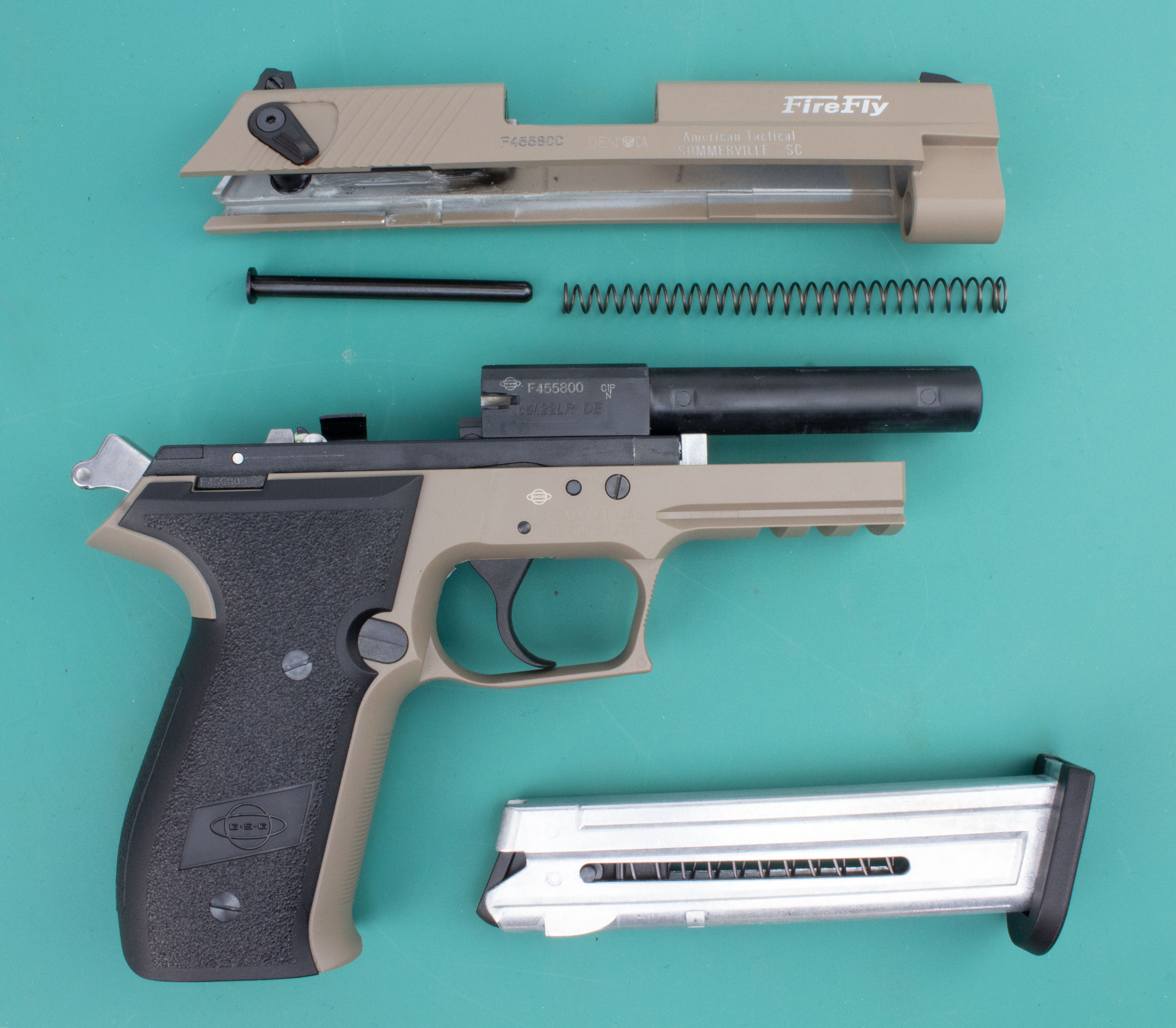
Disassembling the FireFly for cleaning is simple, but not like a centerfire handgun. Remove the magazine and lock the slide back. Rotate the takedown lever on the left side of the slide 180 degrees. Pull the slide back slightly and lift the back of it before pushing the slide forward off the barrel. Be careful to remove the recoil spring and guide rod so you can get them in the right place before reassembly. After cleaning and oiling make sure the guide rod and spring are seated then reinstall the slide. The slide needs to be in the forward position before rotating the takedown lever back to its operating position.

The FireFly is Easily Disassembled for Cleaning

The FireFly can provide hours of enjoyment, whether popping aluminum cans or putting holes in paper. I didn’t do any accuracy comparisons between different rounds as I was mostly checking to see if there were any high velocity rounds that didn’t work in the gun. I didn’t find any. My shots pretty much went where I wanted them to, but I was shooting at close ranges, typically ten yards.

This is a Typical Target at a Distance of 10-Yards

I haven’t found anything not to like about the Firefly and at an MSRP of $349 for the base model, you’re likely to find them priced around or just under $300 when supplies are once again available. I think you would enjoy the FireFly and certainly get a lot of utility out of it you own or plan to own a Sig Sauer P226 or P229 pistol.

Taurus G3 – A Real Winner

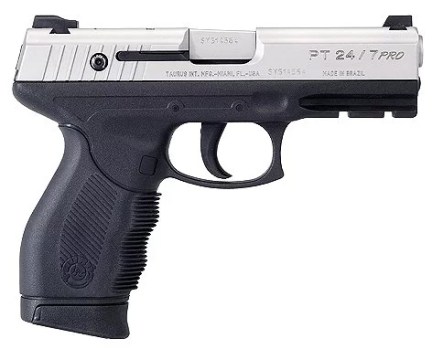
A value proposition caused me to buy my first Taurus semi-automatic pistol, a 9mm PT 24/7 Pro. That was at least fifteen years ago. Sometime thereafter I bought one in .40 S&W, and later I picked up a .45ACP PT 24/7 Pro DS. These guns have always been among my favorites. I’ve watched the YouTube videos and read the rants on forums about problems and issues with these earlier semi-automatics while mine have continued to perform flawlessly. There was a recall and a settlement of a class action lawsuit regarding the PT-111 Millennium. With that all in the past, I’ve been comfortable for years recommending the Taurus Millennium series as a carry gun to budget-minded customers.

Current reports from wholesalers and Gunbroker indicate the Millennium G2 is one of the top selling concealed carry handguns. That makes sense as it typically sells for around $200 and is very close in size to the popular single stack nines that hold six or seven rounds and cost more than twice as much. The G2’s capacity is 13 rounds. Even though I own more expensive guns in brands that everyone stands up and applauds, I keep a G2 handy in a Nate Squared IWB holster for whenever I have reason to leave the house on short notice. I know some of you reading this have concerns about Taurus quality due to publicity and recalls, but I personally have been a heavy and consistent Taurus user for years and haven’t experienced any of the reported problems, nor have any of my customers. Taurus has faced those earlier problems and apparently fixed them. They also offer a lifetime guarantee on their firearms.

Now Taurus has released an upgraded, larger version of the Millennium G2, calling it simply the G3. Before my pre-release evaluation copy of the G3 arrived, I found myself hoping it would be a 9mm version of the Taurus TX22. I recently reviewed the TX22 and called it a .22 in 9mm clothing. The G3 is not configured like the TX22 and I think the Taurus engineers missed an opportunity there. But it’s close and they did what they set out to do—make a G2 big brother.  

The Taurus G3

The G3 has a lot to offer, starting with the grip. Aggressively stippled grip patches on the side panels, the front strap and the back strap provide a no-slip grip that does not become uncomfortable during extended shooting sessions. The stippling is little bit finer, more sandpapery, than what’s on the G2. Further defining ergonomics of the grip is a palm swell located high on the backstrap. The palm swell, along with thumb shelves on either side of the frame, help the shooter obtain a fast, secure grip that orients the muzzle. The combination makes the G3 a natural pointing machine. Integrated into the frame above the trigger are what Taurus calls Taurus Memory Pads, which are small recesses that offer a natural location for indexing of the trigger finger when not actively engaging the target. The thumb shelves and memory pads are on both sides of the frame to accommodate left- and right-hand shooters. These features are carryovers from the Taurus PT 24/7 Pro.

Ambidextrous Thumb Shelves and Memory Pads help provide a secure grip for the shooter

A version of the PT 24/7 dubbed OSS was designed as an entrant when The United States Special Operations Command (USSOCOM) issued requirements in 2005 for a new .45 ACP service pistol. That USSOCOM request was at first delayed, later cancelled, leaving Taurus with an excellent candidate for the concealed carry market. Not long after I bought my first one, a friend who is a Texas State Trooper told me the Texas Department of Public Safety had seriously considered the Taurus PT 24/7 before the decision was made to outfit the troopers with Sig Sauer P226s in .357 Sig. Many of the troopers preferred the Taurus, but politics apparently intervened.

The lineup at Taurus changes from year to year. The PT 24/7 pistols were in the 2017 lineup but dropped for 2018. It’s refreshing to see a full-size, striker-fired Taurus back on the market with the G3. The MSRP is $345.23 in all black and $360.70 with a stainless-steel slide, which will translate to around $300–$325 at gun stores when the guns are readily available. Taurus wanted to give its customers a lot of gun for that $300–$350 price tag and it appears they did just that.

The G3 weighs 25 oz. and has a 4″ barrel. The pre-release gun I received for evaluation has one 15-round magazine and one extended 17-round magazine. The slide is rounded and tapered in the front making it easy to holster and snag free around clothing. It has standard 3-dot white sights, which are a little smaller than on my G2, making them harder for these old eyes to see. The rear sight is adjustable. Mildly cut serrations front and rear make slide operation easy and the Picatinny rail for lights and lasers is present. A small viewport at the back of the chamber serves as an indicator to see if the gun is loaded.

The G3’s trigger is much improved over earlier Taurus pistols. I measured it at a consistent 6 lbs. Once a cartridge is chambered, the G3 utilizes a single-action firing system. A feature you’ll only find on Taurus handguns as far as I am aware is the second-strike capability. In the event of a failure-to-fire, you can reset and pull the trigger again to restrike the primer. You can do it again and again and again if you want to, but of course somewhere along the line you should probably stop and get a new cartridge in the chamber.

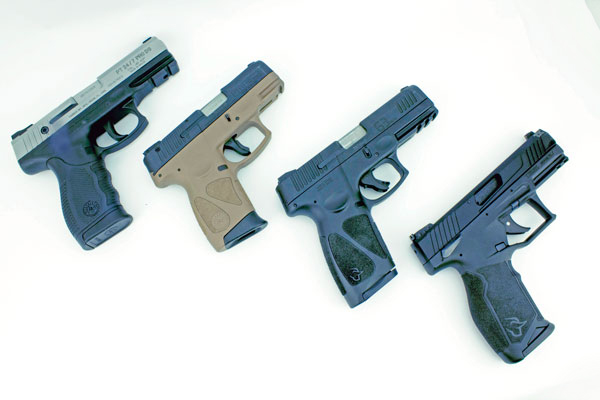
David compared these different Taurus models at the range and liked them all

Since the G3 is both a new gun and an evolution of other Taurus products, I decided having some of those other products at the range for some comparison shooting would be a good idea. I took a 9mm G2, a .45ACP 24/7 Pro DS and the .22 Caliber TX22. I started the session by shooting the TX22 which is a delight to shoot and closely matches the ergonomics of the G3 test pistol. Then I shot a few groups with the G2. They were tight and set the bar. The 24/7 has great sights, a smooth trigger and ergonomics very close to those of the G3. But I didn’t shoot it much because it’s a .45, and for some reason I was a little extra sensitive to recoil that day.

I had several brands of 9mm ammo on hand and expected to shoot the G3 for a while before settling down and concentrating on getting a nice grouping for a photo. But I was in for a surprise. The first ten rounds I fired was from an old box of Winchester White Box FMJ and darned if they didn’t produce a group I figured would be hard to beat. I marked that one for my target photo, but as I continued shooting at other targets with various types of ammo, any one of several resulting targets could have been used to show off the G3’s accuracy. Naturally I had some flyers, but whenever I settled down on the sights and operated the trigger correctly, the G3 sent the rounds straight and true.

Let’s be honest. Not everybody has a six-figure income. For many of us, a $300–$350 gun that carries well, shoots well and has a lifetime warranty is exactly what we need for self-defense. It’s a good gun to use when introducing a friend or family member to the shooting fraternity. It can be an addition to any gun collection with a non-painful acquisition cost. And just wait. I bet Team Taurus will make owners of this gun proud by making it a winner in competition.

Taurus Gets it Right With New Semi-Automatic Offerings

Fifteen years ago when this old shotgun and revolver guy decided to jump into the concealed carry world, the first semi-automatic handgun I bought was a Taurus PT 24/7 Pro DS. The DS stands for double-strike, which I’ll elaborate on later in this post. Pro was in the name because the gun had been created to compete for selection by the United States Special Operations Command (USSOCOM). It turns out the request for which Taurus and other manufacturers were competing was later shelved. Working toward that potentially lucrative contract, Taurus developed a gun with lots of features that made it attractive to the civilian personal defense and concealed carry market.

I didn’t know beans about semi-automatics in those days, but my friend Jerry Colliver did and this was the gun he recommended. It was a great choice. I used that PT 24/7 to qualify for the Texas Concealed Carry License, NRA Basic Pistol Instructor and Texas License to Carry Instructor License. When I got in the gun store business, I “upgraded” to something more expensive because I could. The lure of wholesale prices and “extra” income from selling guns set me on the trail of building a collection. The Taurus was forgotten—for a while.
Cost is a factor for many just entering the concealed carry world. I found myself recommending the Taurus PT-111 often. Then it went through a marketing  challenge when there were claims of accidental discharges happening when the gun was dropped. A class action lawsuit was settled without Taurus admitting liability, but one of the results was a G2 version of the gun, a model which I’ve come to trust.

In 2012 S&W released the single-stack Shield, followed over the next few years by similar offerings from Springfield, Glock, Sig Sauer and others. These guns all cost $400–$500 and up with capacities in the 6-7 round range. Meanwhile the Taurus G2 was available for $200 with a 13-round capacity. I sold a ton of them and got one myself. It’s an easy carry gun with great reliability and accuracy.

I no longer conduct the License to Carry courses nor own a gun store, but I’m still in a position to let folks know about a good value in a firearm. Recently I reviewed two new offerings from Taurus for American Handgunner and GUNS Magazines. The first was the TX22, a really neat .22 that has operational features which make it a great practice tool for shooting a 9mm. I could shoot that gun all day. I’ve taken my grandson Josh and one of his friends shooting with the TX22, including shooting it with a sound suppressor added, and we all agree it’s a hoot to shoot. You can read the review here in American Handgunner Magazine.

I’m not sure when my stories on the new Taurus G3 will be published, but I wanted to let my blog readers know about this new $300 gun. It has all the features that made the PT 24/7 popular, several of them unique to the Taurus handguns. The grip has a palm swell that more or less forces your hand high on the grip frame. Indents that Taurus calls shelves are on both sides of the frame to align your trigger finger properly. And when your trigger finger is indexed as it should be when your you’re not on target ready to shoot, Taurus Memory Pads™ are there to facilitate finger placement. The texture on the grip helps provide an excellent hold, even with sweaty palms. All of this together makes the G3 a very comfortable gun to shoot. The PT Millennium G2 and the new G3 share the double-strike capability with their older brother the PT 24/7. What this means is when you pull the trigger, if for some reason the gun doesn’t fire, you can pull it again for a second chance. Actually, you can pull it again and again. These guns are constructed so the sear essentially rotates around an axis and is back, ready to fire again as the trigger is released. This happens whether or not the slide cycles as it does when a round is fired.

I’ve put quite a few rounds downrange with the new G3 and have encouraged others to shoot it as well. I’m so confident in it I’ve been carrying the G3 for three weeks now and will probably continue. Funny, how this almost takes me back to the roots of my concealed carry days! If you’re looking for an economical carry gun these Tauruses should be considered. They are hard not to like.

Update August 7, 2021: Taurus has now released a GX4 and when I saw the announcement I thought it was just going to be an upgrade to the GS3 Compact. It’s not. With the GX4 Taurus has created a serious competitor to the Springfield Hellcat and other Micro Nine pistols. I’ll do a full review on it, but I just wanted to let you know here Taurus continues to impress.

Military and Police for Civilians

M&P could stand for “Mom” and “Pop” and at our house that could be true since Mom has one on her bedside table and Pop has one on his bedside table. Since you’re reading a gun blog you will know I’m talking about Smith & Wesson’s Military and Police branded firearms. Mom’s happens to be a 9mm trade-in from the Colorado Springs police department. Mine happens to be a .40 S&W trade-in from the Atlanta police department. I’ll come back to the trade-in story, but first a little background on why there are M&Ps in my family.

S&W Model 10

My first encounter with an M&P came in the form of a snub nosed .38 Special Model 10 revolver. The Model 10 wasn’t being called an M&P at the time we got it in the mid-1950s, but it came from a line of guns that had been called M&P since 1899. In recent years those revolvers have once again become identified with the Military & Police designation.

My dad acquired this revolver when I was in my early teens and kept it in his sock drawer. Since he was frequently out of town on business and only changed his socks before I got up in the mornings when he was in town, he never missed the times I took the little revolver along when hunting, fishing, or just out rambling, at times on horseback, at times on a Honda Scrambler and at times on foot. Having the little revolver along in its Bucheimer & Clark FBI holster came in handy when encountering snakes or other varmints while on the trail. When Dad was moved to a VA Home in the last few months of his life, I told him I was taking his revolver home for safekeeping. “Son, I never shot that gun,” he told me, his voice made gravelly by recent breathing tube invasions. “Don’t worry, Dad,” I told him. “I shot it a lot!”

I carried a similar Army issued Model 10 in my survival vest when flying a medevac helicopter in Vietnam. I figured it’s primary purpose if we were shot down would be to destroy our encrypted KY-38 radio. The other crewmembers and I had a variety of rifles and even shotguns hanging on the backs of our seats for defending ourselves against Viet Cong or NVA should that need arise.

Forty years after Vietnam I began attending classes to obtain the instructor ratings necessary to teach basic and advanced handgun courses as well as the Texas Concealed Carry (now called License to Carry) Instructor rating. In my thirst for knowledge I asked the other attendees in these courses why they chose the particular handgun they were shooting. There was the expected scattering of Glocks, but the Smith & Wesson M&P was also well represented. The answers for why people chose the M&P were usually along the lines of “less felt recoil” or “it doesn’t kick as much.”

Having fallen in with the commonly spread belief at the time that if it didn’t start with a ‘4’ it wasn’t enough cartridge for the job, I obtained a .45 ACP M&P to see for myself if the recoil was noticeably different. After firing the M&P alongside the a Springfield XDm and a Taurus 24/7 in .45ACP I came to the conclusion the S&W was a little easier on the hand and wrist. Some of that I attributed to the texture of the grip. Smith & Wesson claims it’s the angle of the grip, and I have to admit the M&P does feel good in the hand.

When you start teaching is when you really start learning. Having obtained the necessary ratings, I hit the ground running with two classes a week, each averaging 30 attendees. Week after week of watching what people were shooting and how they shooting, I gained considerable insight into what works and what doesn’t. In the years before the introduction of the modern single-stack nines, the M&P became one of my most recommended handguns for new shooters. A ton of experienced shooters already trusted the full-size or compact M&P  as easy-to-carry, easy-to-shoot, reliable and accurate handguns.

I tend to think of Glock, S&W, and Springfield—as being like Toyota, Honda & Nissan. They’re all excellent, affordable and reliable handguns so pick the brand you like. I’m not a Glock fan, but I’m not against them any more than I’m against a Toyota. I just like the Smith & Wesson, much like I might prefer a Honda over a Toyota.

Handguns are a little less expensive than cars, so if you like a brand, you can have more than one, right? Maybe a lot more than one. I’ve gone through a number of them while helping family and friends find the right firearm and we have several in our family ready to perform m defensive duty should the need arise.

Colorado Springs M & P

M&P 9mm – Colorado Springs Police Dept. Trade-in

I’ve already mentioned our by-the-bed-guns. Joyce’s Colorado Springs PD trade-in has a known story. Colorado Springs first purchased M&Ps with a magazine disconnect safety thinking conservatively in case a gun got ripped out of one of their officers’ hands. But after some experience they decided they preferred a smoother trigger pull than what they were getting with the disconnect safety. Smith & Wesson accommodated them with an even trade for models without the magazine disconnect safety. The previous guns were reconditioned and put on the block by a major online retailer. After learning about the availability of police trade-ins, I found myself checking online from time to time, even though I prefer buying from a local gun dealer. Over the past five years I’ve acquired several M&P trade-ins, all at very reasonable used-gun prices.

I wish I knew the story behind all of them. Atlanta switched to Glocks in 2013, with the .40 Caliber G22 being the primary side-arm. Supposedly they were dissatisfied with their M&Ps, but I suspect Glock being located in nearby Smyrna, GA, and contributing considerably to the Georgia economy had something to do with it.

Whether the Atlanta PD liked my M&P or not, I sure do. It’s my upstairs bedroom gun equipped with a Surefire combination light and laser to help me determine if friend or foe is coming down the hallway towards my bedroom when things go bump in the night.


AtlantaHouseGun

Atlanta Police Department Trade-In House Gun With Light & Laser

I keep another former police gun, this one compliments of the West Palm Beach police department, in the console of my Jeep. I’m always personally armed when driving the Jeep, but you never know when a backup might be needed.

Two additional former police M&P trade-ins I keep around are one from the Vermont State Police and a never-issued example from the Detroit PD. These two are both .40s. All of the trade-ins came with 3 magazines and night sights and were purchased for less than $400, a good value in my book. Police may be bailing from the .40 in droves because of the FBI decision to go to 9mm, but all of the original reasons for choosing a .40 caliber handgun are still valid. And with Polycase/Ruger ARX cartridges, as my go to defensive round I’ve discovered their lighter weight and decreased powder load lessen the recoil enough for my arthritic hands and shoulders.

Detroit PD M&P 40

Detroit PD – Never Issued M&P .40

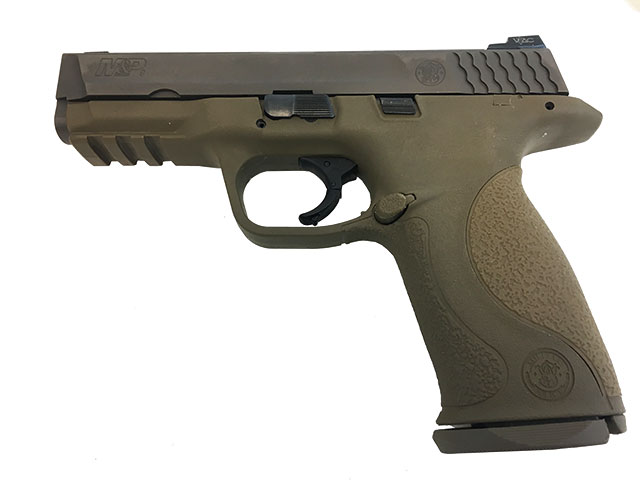
One of my regular carry guns is a 9mm VTAC M&P. Several features differentiate this gun from its brothers. First is the FDE finish. Is it just me or does Flat Dark Earth look like OD to the rest of you, as well? Next is the Viking Tactics sights, which is really where this model get its name. Both front and rear sights are serrated to cut down on glare and best yet they have fiber optics sights front and rear on top of Tritium Night Sights. Awesome!

VTAC 9mm M&P

VTAC 9mm M&P

You can see these sights very well in all kinds of lighting conditions and my eyes have no problem picking up the right sights for the conditions. Either set aligned with the target will put your rounds where you want them, assuming you do your part with the trigger. And speaking of the trigger, I put an Apex Tactical Action Enhancement Trigger and Duty Kit in my VTAC M&P. This has resulted in a smoother trigger pull, reduced pre-travel and overtravel, reduced reset length and a consistent 5.5 lb. trigger pull.

TwentyTwo

M&P .22

When S&W released the full-size M&P in .22 caliber, I just had to have one. The ads promised practicing with something similar to your full-size carry gun but with lower ammo cost and no recoil. Their promise was nullified by an extended shortage of .22 ammunition during which the cost of .22 rounds went from a penny apiece to something close to a dime. I beat that rap, however, due to my ammo hoarding tendency and continued begin shooting one of the most fun guns around. Load the .22 S&W M&P with CCI Stinger ammo and you get a loud bang, a lot of muzzle flash, so you feel like you’re shooting a large caliber gun, except there is no recoil.

Near the end of 2014 the company introduced the M&P Compact .22. The ads for this one said something like, “Shooting .22s is fun! Ours is funner!” and I believe they are right. The compact is a delight to shoot and just the right size for my granddaughters to enjoy.

9_TotalWinnersChoice2

Fun With Silencers

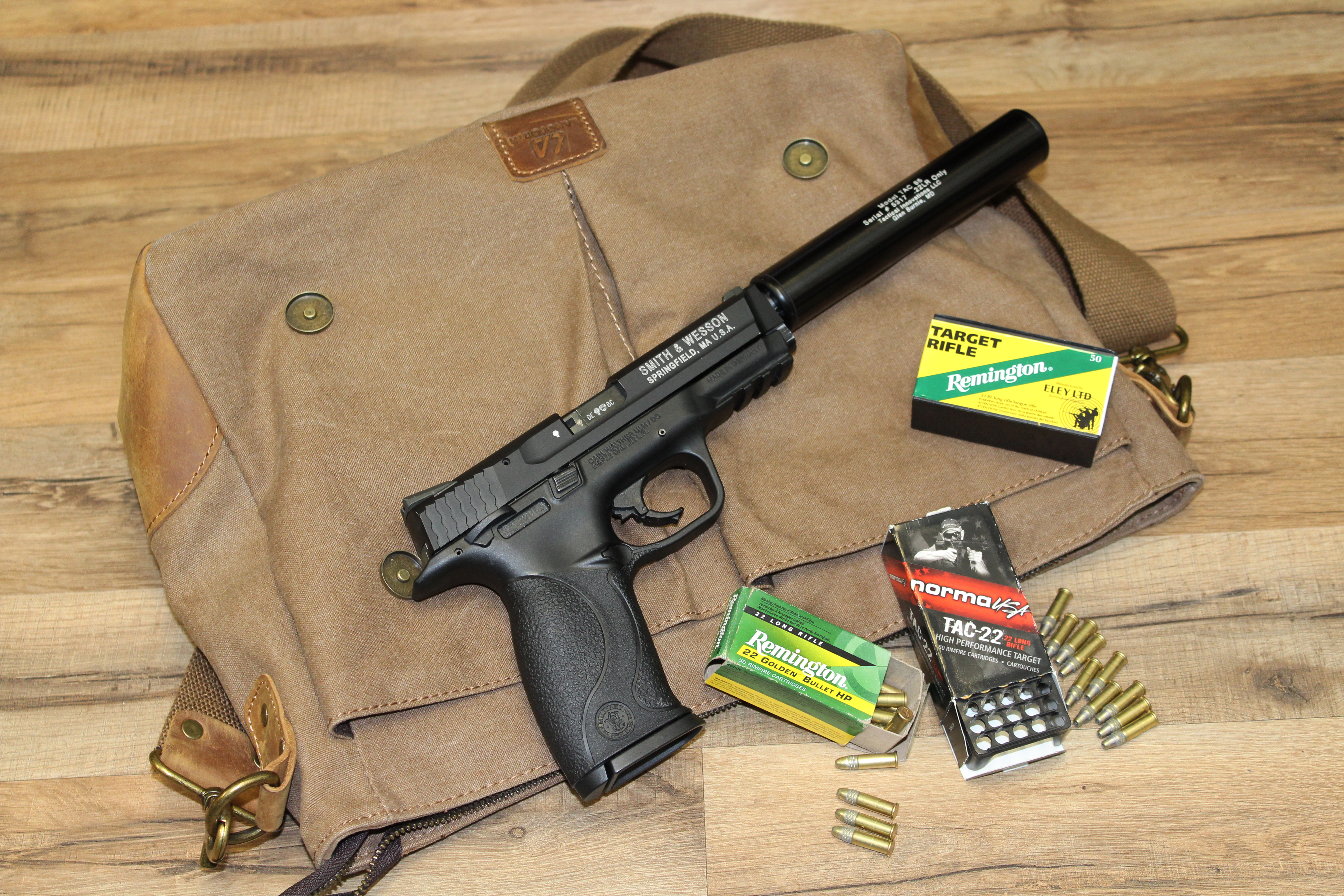
My .45ACP M&P has a threaded barrel and we often shoot it with a suppressor attached. My .22 M&P, the full-size one, also has a threaded barrel and it, too, is often shot with a suppressor. The little .22s work consistently with almost any ammunition on the market, so I consider them both to be top value for plinking and pest control.

I’ve bragged on the M&P line without even mentioning the compacts, Shields and the AR rifles, the latter available in both rimfire and centerfire AR versions. Smith & Wesson has done an amazing job at providing excellent equipment for law enforcement and making that same equipment available to the rest of us for personal protection, hunting, training and just plain fun.

Sometimes One Holster Will Work for a Variety of Guns

Most people I know who have been around handguns for long, especially those committed to daily carry, admit to having a drawer (or drawers) filled with holsters they’ve tried but just weren’t up to their expectations. I’ve got a different story! Being fortunate enough to have acquired a number of excellent handguns, any one of which are suitable for a daily carry gun, I feel guilty if I don’t rotate them some.

crossbreed1For me, having a bunch of guns has not equaled having a bunch of holsters. Guess I’ve just been lucky and chosen well up front. My first concealed carry holster was a Crossbreed SuperTuck, purchased a little more than eight years ago for a Taurus 24/7. There it is right there, with that original 24/7 in it. It has held up well.
The Taurus got replaced with a Beretta PX-4 Storm 9mm. Okay, not replaced as in traded. I kept the Taurus, but carried the Storm a while. It fit the same holster, just fine. Then I got a Springfield XDm .45 ACP and was pleasantly surprised to find it worked in that same Crossbreed Holster. So did a Smith & Wesson M&P and a FNX 40 and a Sig P226.

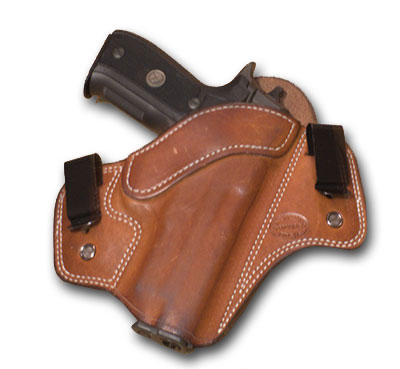
bullard1When we started carrying D.M. Bullard Leather Holsters in our store, I figured I’d give the local company a try. I’d become a 1911 person by then so I got one of their 1911 holsters for a 5 inch gun with a rail. Works fine with my Colt and Springfield 1911s, but it also works fine with any of the 4.25 inch barrelled 1911 Commanders.

I liked that holster so much I decided to get one for my double stack 9s and 40s, but hmm, let’s see, which one. The biggest and heaviest of the bunch was a Sig P226, so I ordered a custom D.M. Bullard leather holster custom made for a Sig P226. It was no surprise that it also fit the Sig P229, but guess what else fits in that holster?bullardmix

That original Taurus 24/7 fits it. The Springfield XDm fits it, All of my M&Ps (9, 40 and 45) fit it. The FNX-40 fits it. The gun you see in it here is a CZ-P07. They all fit with what’s commonly called Level 1 retention. That’s enough friction to hold the gun snugly in the holster so there is no danger in it falling out as you move about. These guns a all draw easily from the holster, as well.

So don’t go getting all antsy about having to have a bunch of holsters on hand if you want to grow your gun collection. Get a custom holster for something like the Sig P226 and chances are it will work just fine for many of the other guns you may want to try that are of similar size and capability.

Tell you a secret. I’ve been known to carry a 1911 Commander in my D.M. Bullard Sig P226 holster without realizing I’d put on the wrong holster that morning. Heck I might could have gotten by with just one of their wonderful holsters! Just kidding. The 1911, being a single stack, was just a little loose, if I’m honest about it.

Typical Gun Store Visit

A young lady comes into the gun store alone and timidly approaches the counter. “I want to buy a gun,” she says to the salesman who approaches her.

“What kind of gun, ma’am? Shotgun, rifle, handgun”

“A pistol,” she replies. “A Glock, the little one, I think it’s a 42 or something . . .”

The fact that her voice trails off signals the salesman he needs to ask some questions. “A Glock, that’s what you want? Do you know why that’s what you want?”

“Well, my brother-in-law is a policeman and that’s what he carries.”

“Oh,” our helpful salesman replies. “What does he drive?”

Lady Buying a Gun“You mean his police car?”

“That’s probably a Dodge Charger, would be my guess. No, what’s his personal car?

“I think it’s a Toyota . . . maybe a Camry?” She’s not sure, but the salesman has the information he needs to help her with her gun purchase.

“Is that what you drive?” he asks her.

“No, I drive a Lexus coupe. You know the IS 250?”

“Nice car,” our salesman replies, then challenges our new gun buyer. Now remember, he could have turned around, picked up a Glock 43 and he would have had a sale. I’d would have been proud of him for making a sale, because we sure need to make sales, but I’m more proud of him for what he did next.

“If you don’t drive the same kind, or even brand of car, your brother-in-law drives, could it be possible you may prefer a different kind of gun than the kind he uses?”

“Well, I’ve always heard that Glocks are good guns,” she says, just a little defensively.

“They are,” our salesman replies as he puts a Glock 19 in her hands. “But so are Smith & Wesson, Sig Sauer, CZ, Beretta, Bersa, Springfield and lots of other brands.” As he says this, he gestures to the counter where various 9mm handguns are on display. “Why don’t you pick up some of these, see how they fit your hand. See how they feel when you cycle the slide. Try the trigger. You may find the Glock is the one you like best, but you may find others you like better.

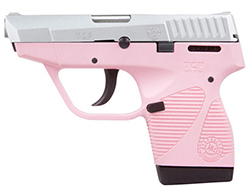
Taurus 738“Oh, I like this,” she says, heading away from the 9’s and over to a pink Taurus 738. “And it fits in my hands so well and I could hide it easily . . . ” and on and on with the arguments that sound so right for picking a self-defense handgun, especially for a small-framed woman, but which in reality aren’t really right.

“It’s a pretty gun,” our salesman agrees, then asks her, “What is your primary purpose for buying a gun today?”

“Self defense,” she replies. “I want some protection the way society is going today.”

We had a sure sale with the Glock 43. The Taurus cost less than the Glock and it’s pink so it could easily be a sale right now.

BUT . . . is this the right gun for the lady. Probably not. Our professionals will hopefully coach her a little by explaining in terms that you don’t have to be a gun guru to understand about how bigger is better when it comes to protection . . . bigger bullets . . . a bigger gun to hold onto . . . more weight to absorb recoil . . . and perhaps encourage her to get a little training and some range experience before plunking down her dollars. Is this a lost sale for our gun store? I hope not. I hope it’s just a delayed sale. Or if she really wants to get a gun today, I’ll bet my guys can steer her into something that feels good in her hands, she can manipulate all the features on and would provide some decent firepower for her protection.

What someone’s brother-in-law, brother, boyfriend, father, husband . . . whatever . . . would choose for a gun is not necessarily the right gun for you to choose, whether you’re a man or a woman. A handgun is a personal thing and there are lots of very fine handguns from which to choose. A little research, a little time at the gun store or at the firing range and some bonding should go into picking your perfect packing gun. And if you don’t get it right the first time, you’ll have gained some experience to help you make a better choice the second time.