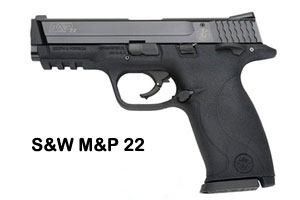
Hi-Standard Double 9 vs. Ruger Single 10

In my previous post “Fifty Years of Plinkin’ I mentioned that I had recently purchased a .22 caliber Ruger Single 10 revolver in memory of the Hi-Standard Double 9 revolver I had in my youth. My friend and business partner, Jerry Colliver, knowing I would love to have a Double 9 again, found one for me. And boy was it a find. The gun is in practically new condition and still in its original box with a price sticker on it from 1968 from Bud and Jim’s Sporting Goods. The price was $64.98.

High Standard Double 9I paid a little more than that for this excellent Double 9, but have no regrets.  It came with three sets of grips:  staghorn, pearl and black. Although my previous Double 9 had the staghorn grips on it, I like the black ones better, so put them on this gun. One day last week during my lunch hour I took the two guns shooting — the Double 9 and the Single 10.

I had some .22 Long Rifle cartridges and some sub-sonic .22 shorts.  I shot a box of the Long Rifles in each gun and about 30 of the .22 shorts in each gun. Accuracy was about the same for either gun. Shooting the shorts was a hoot because the sort of make a “psst” sound rather than a bang.

The Double 9 has cool feature that I didn’t remember from my previous gun. When shooting it in the double-action mode, you can just pull the trigger all the way back, but if you’re squeezing it like we’ve all been taught to do, you’ll feel a definite stopping point just as the hammer reaches it’s full-back position. You can actually pause there and realign your sights before continuing the trigger pull through until the gun fires. With a little practice, you can stop at this point every time. It’s sort of like having the inherent accuracy of a cocked single-action built into a double-action gun.

There is no question the Ruger is built better. The Double 9 has an aluminum frame while the Beretta is all steel. But with reasonable care, I believe this Double 9 will provide me a lot of plinkin’ fun during the rest of my life and will still be around for the grandkids to enjoy.  Thank you, Jerry!

Fifty (50) Years of Plinkin’

Somewhere around 14 years of age — 50 years ago — I acquired a 22 revolver, a High Standard Double Nine. If I remember right, I bought it at a Western Auto store and the price had to have been less than $50 or I wouldn’t have been able to afford it. Even though there were some differences between it and a sho ’nuff cowboy gun, i.e. double-action instead of single action and swing-out cylinder rather than a loading gate, it was close enough for me to be satisfied. And nine shots without reloading lead to some serious plinkin’.

For you city folks, plinkin’ is shooting at tin cans or bottles or other items found in a junk pile, just for fun. I think the name comes from the sound of a bullet hitting a tin can, which is always a favorite plinkn’ target. It’s a fascinating pastime, even more fun than shooting at bullseye targets. Tin cans tumble. Bottles chatter. Jugs full of water go “thunk.” Cans shot at as they pass under a bridge sink. I know, many of us don’t live where we can do that kind of shooting anymore, but we can always hope for someone to invite us to the farm every now and then.

When I had my double-nine it was always with me, at least in my truck. But somewhere along the way, I traded it off for something. I think it was a stereo. Dumb move. I’ve missed that pistol for years. Trying to buy one like it now is not easy. You can find listings for Double Nines at some of the online auctions, but the good ones are gone before I even discover them. The ones that remain always leave something to be desired.

It’s not that I have a lot of plinkin’ opportunities. I get to the shooting range fairly often, but roaming the countryside looking for plinkin’ targets just isn’t something I’m readily able to do. Still, I can dream.

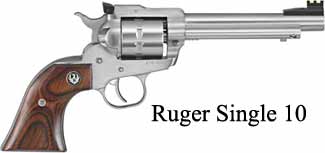
That dreaming, plus a number of upcoming NRA Basic Pistol classes to teach, lead me to acquire a modern-day counterpart to the old Double 9. My new gun is a Ruger’s Single 10. It’s the classic Single Six, but with a 10-round cylinder instead of 6. It’s a very pretty gun, reflective of Ruger’s quality workmanship.

Ruger Single 10That the Single 10 is a single-action makes absolutely no difference to me. The best I remember I always cocked the High Standard before pulling the trigger. I’m a much better shot that way. A couple of added features really make the Single 10 a better gun. Walnut gunfighter grips fit the hand easily and the Hi-Viz target sights really suit my 64 year-old eyes.

One of the joys of using this revolver to introduce new shooters to the art of pistolcraft is that it’s very accurate. If we properly teach them sight alignment and sight picture plus how to stand, grip, breath and pull the trigger, they will be rewarded with holes in the target where they want them. And they’ll have the added benefit of experiencing a finely-crafted firearm for their initial shooting experience.

I don’t know that I’ll ever throw this gun in the truck and haul it around the country, but you can bet I’ll be on the lookout for plinkin’ opportunities!

Enjoying Cowboy Style Single Actions

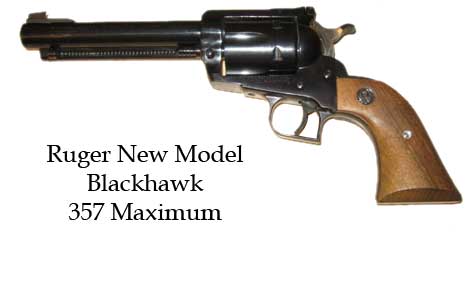
I grew up playing Cowboys and Indians, watching Roy Rogers and Gene Autrey movies on TV and viewing westerns at the theater with stars like John Wayne, Randolph Scott and later Clint Eastwood. It’s natural for me to be attracted to old cowboy guns like the Colt 45 Single Action Army and it’s variants. Colt knows people like their guns and they’re priced accordingly. A genuine Colt SAA is way out of range of my gun budget.Ruger Blackhawk - 357 Maximum

That doesn’t meant I have to do without, however. In a previous article I’ve described my Ruger Blackhawk 357 Maximum. This is a gun I honestly purchased because of the way it looked and the price. It was $300. I didn’t know at the time that Ruger had recalled and discontinued it’s line of 357 Maximums, supposedly because of top-strap burning due to the heavy loads of the 357 Maximum cartridge. Evidence later emerged that the only incidents of the top-strap buring were the result of reloaders loading excessive charges. My gun  has absolutely no evidence of any damage whatsoever. In fact, it’s nearly pristine.

Even with the Ruger, I’ve had a hankering for a true SAA clone for sometime and last year decided on a beautiful stainless steel Beretta Stampede. I was debating between a Ruger Vaquero and the Stampede and settled on the Stampede for two reasons:  I’ve already got a Ruger revolver and the Stampede was available for less money than the particular Vaquero I would have wanted. It turns out the Stampede is made by the Italian Company Uberti, known for its authentic clones of Old West guns. The action was smoothed at the factory and this is one pistol I’m proud to own.

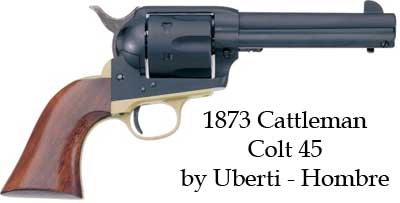
You’d think I’d have been satisfied, and I guess I was until cruising by the gun counter at Outdoor World and seeing an under $300 price tag on a new Uberti Hombre in 45 Colt. In fact, with a little inquiry I learned that I could apply a discount and get this particualar 45 Colt Cowboy pistol for $270. So I did. Then I went shooting.

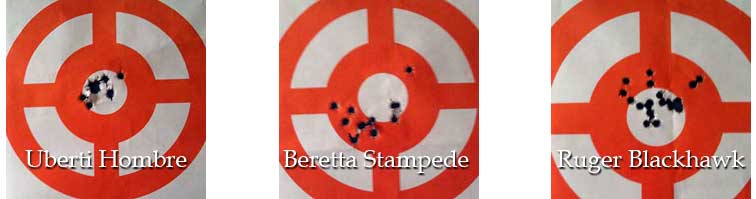
It was a fun day at the range with a box of 45 Colt cartridges from Black Hills ammo and some Winchester 38 Specials for the Ruger Blackhawk. First I shot the Uberti. I’m going to show you the targets below, but I’ll be honest, this gun really surprised me. I had the targets out about 15 feet. I took a steady aim and the first shot went almost dead center of the target. I fired another one that touched the first one, and honestly the third shot went into one of the first two holes so that I was three shots in with only two holes in the target. I was impressed. The action was smooth, the gun well balanced. Nothing wrong with the workmanship. Wow. I fired a couple of cylinders full, then put up another target for the Beretta.

The Beretta Stampede grouped well, but slighlty left of point of aim. Recoil on either of these two guns was minimal. I found myself curling my right pinky under the grip for support. I didn’t think much about it, until later at another gun range I heard an old Cowboy Action Shooter tell his buddy that was his secret for shooting Cowboy guns accurately. Interesting. I’d just stumbled across something that worked for me and later found out it’s a secret of the experts.

I had recently adjusted the sights on the Blackhawk and boresighted it at the office. This was its first trip to the range after that adjustment. I fired part of a box of 38 specials and was pleased with the results. Experience has proven the Blackhawk is just as accurate with 357 or 357 Maximums as with the 38 Specials, just a lot louder.

Here are the targets for all three guns. You can see for yourself, the old Six Shooters are pretty darn accurate, even with their minimal iron sights.

Time constraints and bum knees may prevent me from it, but I’m getting a hankering for some Cowboy Action Shooting as sponsored by the Single Action Shooters Society (SSAS.org). Even if I don’t do the SASS thing, I’ll enjoy plinking with these guns and someday they’ll get passed along to the kids and/or grandkids. I’ll probably add a couple of .22 caliber models to the collection within the next year. Both Ruger and Uberti are making 10 shot 22’s. Ubertis can be converted to 22 Magnum. Now that’s really cool!

The Myth of Gun Registration

“My father has this gun he wants to give me, but it’s unregistered.”  or “Is it okay if I bring an unregistered gun to use during my CHL class?” It is amazing how often we hear something like that from one of our students. THERE IS NO GUN REGISTRATION IN TEXAS! That is also true of most of the states except for a few on the East Coast or West Coast.  The ones on a political map we typically call “blue” states.

Since most of our movies and television originate in either New York or Hollywood and those places do have gun registration, the movie makers don’t know any better and apparently neither do movie watchers. As a result, throughout our society ordinary folks believe that if they have a gun that’s unregistered, they’re committing some sort of crime. The anti-gun crowd loves it that people believe this. In fact, the anti-gun crowd wishes it were true. But, it’s not.

Both the Gun Control Act of 1968 and the National Firerams Act imposed a number of restrictions upon the ownership and transfer of firearms. However the Firearm Owners Protection Act of 1986 specifically states:

No such rule or regulation prescribed after the date of the enactment of the Firearms Owners Protection Act may require that records required to be maintained under this chapter or any portion of the contents of such records, be recorded at or transferred to a facility owned, managed, or controlled by the United States or any State or any political subdivision thereof, nor that any system of registration of firearms, firearms owners, or firearms transactions or disposition be established. Nothing in this section expands or restricts the Secretary’s authority to inquire into the disposition of any firearm in the course of a criminal investigation.

In short, they really wish your firearms were registered, but the law prevents it.

One thing that confuses the issue is the transfer form that is completed whenever you buy or otherwise acquire a firearm from a dealer or holder of a Federal Firearms License (FFL). Let me explain what happens here. If you buy a gun from us, or Academy Sports, Cabelas, Bass Pro, Cheaper Than Dirt, etc. you must complete a Form 4473 that attests to the fact that you’re legal to own a firearm. The dealer must add the make, model and serial number of the firearm to the form and, unless you have a Texas Concealed Handgun License, we have to get a clearance from the FBI’s National Instant Criminal Background Check System (NICS) before transferring the firearm into your possession.

That 4473 form goes into our files. The information does not go into a database and is not transmitted to any local, state or federal government. It simply goes in our files. We must keep it for 20 years. What you do with the gun after you buy it, is your business. You can decide you don’t like it and sell it to an individual a day, week or month later and there is no requirement that you do any kind of background check on the purchaser or even record the sale.

If law enforcement recovers a firearm from a crime scene in New York City, they run a records check, find out whose gun it is and show up at the owner’s door within the 50 minutes allowed for the TV detectives to solve the crime.  In the real world, they can run a trace that starts with the manufacturer. If it is a firearm manufacturered since 1968, the manufacturer has a record indicating which wholesale distributor orginally acquired the gun. The distributor will have a record of which dealer the gun was sent to and the dealer will have a record of who they originally sold the gun to. A typical firearm trace can take up to 90 days, because in most cases these records are not automated.

I am a law-abiding citizen and I own a few guns. Some were inherited, some I bought from a dealer, some I acquired from individuals. As an individual, I’ve sold a number of firearms and I have no record of the sale. The Federal government has no record of the firearms I own and no reason to have such a record. Neither does the State of Texas or the City of Keller. It’s none of their business. We need to make sure we elect individuals to office who understand why it’s important to keep it that way.

The Family That Shoots Together . . .

We spent the past week in Charlotte, NC visiting family. The occasion was to celebrate my father-in-law’s 90th birthday. Family came in from all over. An amazing number of them are, or have become in recent years, gun people. Besides my wife and the two of my three sons who were there for the occasion, there were four others who carry. One is a nephew from Florida, who some years back had a pistol stuck in face during a robbery. After my nephew handed over his wallet, the guy pulled the trigger. The gun, which was pressed up against my nephew’s nose, didn’t fire. Whether it was not loaded or it was a case of divine intervention, he never found out. But now he carries a Springfield XD and is very uncomfortable if the gun isn’t with him at all times. He flew to Charlotte and didn’t bring his gun, but we fixed him up with one of ours for the week.

A sister-in-law and a close friend of hers asked me to take them shooting. I located a gun range nearby–Firepower, Inc. in Matthews, NC and we took a couple of 9mm’s and my mother-in-law’s 22 Caliber Colt 1911 and went shooting. The online reviews of Firepower, Inc. were mixed, with some alleging bad attitudes behind the counter, poor customer service, etc. Our experience was fine. We were treated courteously and professionally. The range was a nice one, with equipment very similar to my favorite range in Fort Worth–The Shooting Gallery. Firepower, Inc. is a gun store with a fairly good selection of firearms, all priced at what appeared to be MSRP.

The girls did well with their shooting. I was a little surprised at their lack of experience since one of them was a farmer’s widow and the other has been married to a Vietnam era Army Special Forces guy for years. He has lots of guns, but for some reason she hasn’t done much shooting.

22 Caliber Colt 1911The 22 caliber Colt 1911 is an interesting firearm. My father-in-law described it as a “22 on a 45 frame.” He bought it in 1946 for home protection. I looked it up in the Blue Book of Gun values and if I’m reading everything correctly, its current value is somewhere around $4500. He probably paid less than $100 for it back then.

Like all the Colts I’ve seen, this is a well-made firearm. The magazine is strong and solid, with a spring that made difficult to load. We fired some Winchester White Box through the gun and it handled it superbly.

I asked my mother-in-law to pencil me into her will for that gun when she’s gone. I don’t know any other relatives that would be that interested in it. For me it would be to keep, not to turn into cash.

This trip added some additional confirmation that people all over who didn’t previously think much about guns are thinking about owning some now. We sure do enjoy teaching them to use them safely and proficiently.

Magnum Days

I have a couple of magnums I like – a Rossi .357 revolver for general use, plus a Ruger Blackhawk .357 Maximum, which is somewhat unique. I’ve never owned a .44 magnum, but I’m not in the woods much and unlike Dirty Harry, I’d rather have 14 rounds of .45 in my belt than 5 rounds of .44 magnum.

Taurus 44 Magnum TrackerBut one day this past week a coworker stuck his head in my door and asked if I’d be interested in a .44 Magnum Taurus Tracker for what I thought was more than a reasonable price. I asked about it’s condition and he said “like new.” I said, sure, thinking at that price I could resell it and make a little profit.

He brought it in the next day. It was a little dirty from being fired, but otherwise in excellent condition. I bought it, then went Bass Pro and bought a box of .44 magnums and a box of .44 specials. The next day I was scheduled to conduct a CHL qualification course at the range at 6:00 p.m. I went early with the .44 and my .357 Max along with some reloads I’d done for it.

I shot the .357 first. It’s a handful with the Maximum cartridge. I had loaded these at the bottom end of the powder recommendation for what I thought was a similar bullet, but it exhibited enough power, I don’t think I’d want to go any higher.

Then I shot 5 rounds of magnum through the .44. It’s ported and the amount of fire coming out of those ports was amazing. Would have been blinding at night. The recoil was pretty strong, too. And the boom. It was loud, kind of like when we shoot Jerry’s .50 caliber Desert Eagle.

I next tried some .44 specials. I could shoot those all day long. Although they appear similar to the .44 magnums on the outside, they have a much lighter load on the inside. It’s still plenty of cartridge, but the recoil is very mild, the muzzle flash not even noticable, and the noise somewhat tame.

Ruger Super RedHawk .44 MagnumAfter shooting I went out to the firing range office to wait for my students. A guy came in with a Ruger Super RedHawk .44 magnum with a Charles Daly scope on it. He said he had inherited it from his dad and wanted to sell it for $400. Had I not bought the Tracker the day before, I’d have been tempted. Both of the guys behind the counter contemplated it. One was discouraged by his girl friend, who happened to be there at the time and the other said he didn’t really have the funds, but if he did, he’d buy the gun.

The owner wanted to shoot his gun some before selling it, so rented a lane. After he went to the firing line, I pulled out the Tracker and said, I could sell it for $350. It garnered more attention than the Ruger for some reason. It couldn’t have been just price because mine didn’t have a scope and $50 difference isn’t all that much. The two guys that wanted to buy the Ruger suddenly wanted to buy the Tracker. But again, the same two hindrances were there:  for one a girlfriend helping him watch his money and for the other, no money to spare.

That RedHawk is a beautiful gun and it will sell at that price pretty quickly. As for the Tracker, I don’t care if somebody buys it or not. I might kill a hog with it someday.

A Day in the Life of a Firearms Instructor

We started the day with an NRA Basic Pistol Course, one of my favorite courses to teach. One class member was the wife of a concealed carry guy. She had become interested in firearms from conversations with him and he wisely suggested she take lessons from a pro, rather than trying to learn from him. She was a delightful student, who after learning about firearms safety, the various firearms types and firing her first shots decided to buy both a target pistol and a defensive handgun. She’ll be in in one of our future CHL classes.

Another student, a elementary school teacher, is looking for a new hobby and thought this might be it. I hope so. She did well as a student.

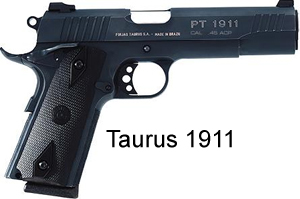
Taurus 1911Then there was the young man who had recently purchased a Taurus 1911 and wanted to learn all he could about it. Great gun. He shot our 22 pistols at the range, then his own .45. Afterwards he came back to the shop where Jerry showed him how to take his gun apart, clean it and put it back together. I was cleaning some of my own guns at the time and he was fascinated by the fact that I took out my .45 caliber Springfield XDm, unloaded it, cleaned it and put it back together while Jerry was struggling with the bushing on the 1911. “How many rounds does that hold?” he asked. “Fourteen,” I replied. “Fourteen rounds of 45 ACP?” “Yep.” The Taurus 1911 is a fine gun, but you can see why some of us elect to carry modern, plastic guns instead.

After the NRA class a customer brought two very interesting guns in to have us teach him how to disassemble for cleaning. This is where the varying talents of the Texas Gun Pros comes into play. Whereas I enjoy the personal side of carrying and using firearms – defensive scenarios, carry options, holsters, ammo, etc., Jerry is really into guns and I’m glad he is. I continue to marvel at his knowledge and mastery of a variety of firearms.

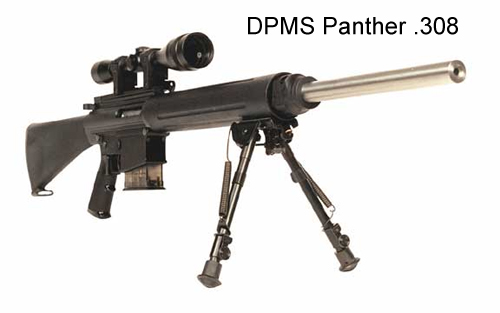
The first of the two guns was an AR rifle, a DPMS Panther in 308 caliber. I learned about M16s in the Army and have owned an AR-15, but I don’t know these guns inside and out like Jerry does. He not only disassembled, cleaned and reassembled this fine firearm, but he taught the customer a lot about his gun in the process.

DPMS Panther 308

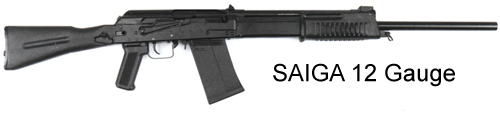
The next gun the customer brought out was a SAIGA 12 gauge shotgun. This is a Russian made gun based on the AK-47 platform. Again, Jerry seemed to know the gun inside and out and pointed out many of its features to the customer while taking it apart, cleaning it and reassembling it. He then had the customer do this as he had with the Panther.

SAIGA 12 gauge shotgun

Desert Eagle 50An added treat of the day was shooting Jerry’s 50 caliber Desert Eagle. You’ve seen the YouTube videos – well, if you hold onto it, the kick isn’t that bad. It sure is loud, though, and you feel the percussion as much as you hear the noise. I did manage to put three holes in the target, each touching the other. Of course they were such big holes, maybe that wasn’t much of an accomplishment after all.

Powerful Little Backup Gun

ITaurus 327 Magnm‘ve been watching the hype about the 327 Federal Magnum cartridge and wondering where it might fit in my personal defense strategy. I like to have backup guns in strategic locations – my truck console, my laptop case, even the pocket of my jeans. Last year I had a Taurus Ultralite revolver in .22 magnum.  It was just the right size and I figured .22 magnum would at least get someone’s attention, especially since it carried 8 rounds, but I didn’t like the heavy double-action trigger pull on that particular gun. A trade opportunity came along and I took advantage of it. That left a small revolver gap in my defense arsenal.

Cheaper Than Dirt in Fort Worth ran a Taurus sale one week and the advertised price for the little 327 Federal Magnum revolver was just too low to pass up. The cartridge is similar in size to the .30 caliber rounds I carried in the M2 Carbine I kept on the back of the seat in my helicopter in Vietnam. I read the specs and found the cartridge is loaded to around 40,000 psi pressure, making it have more impact velocity than even a 357 Magnum.

It’s a pretty gun – mine’s stainless steel – and fairly lightweight. It holds 6 rounds. I took it to the range and not surprisingly, it’s loud and it ‘s got a fair amount of recoil. It is not painful to shoot, but you wouldn’t want to shoot it all day. From approximately 10 feet away I put most of my rounds somewhere near the center of the target.

I find the gun is easy to hide and I expect it to be totally reliable. When you pull the trigger on a revolver you can usually count on it to go “bang.” This one will do that six times. If I place my shots carefully and make them count I have no doubt the 327 magnum bullets will stop somebody in their tracks!

Another Winner from Crossbreed – the SuperTuck IWB Mag Holder

David B. Freeman

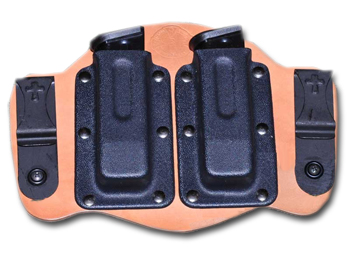
SuperTuck Magazine HolderIn our CHL and defensive handgun classes, we teach our students to carry a backup magazine for their pistols or speedloader for their revolvers. Yet I have personally struggled with an effective way to do this. All the belt-mounted magazine pouches I’ve tried stick out too much to conceal on my frame. I’ve resorted to carrying an extra magazine in a canvas knife holder in my pants pocket on the support side. It’s not comfortable and it certainly wouldn’t be easy to get to in the heat of battle. During my drills, I pull the magazine out of my pocket when drawing my pistol, but it’s still in a velcro-fastened carrier and it’s interfering somewhat with my shooter’s grip.

Thanks to Crossbreed Holsters, makers of my favorite IWB (inside the waistband) holster, I now have the answer that works for me. It’s their IWB mag holder, available in both one and two magazine models, molded to fit the size magazines you carry.

The one I ordered works great with my double-stack magazines in either 9mm or 40 S&W. It doesn’t fit the double-stack 45s for my Springfield XD.

I’m happy, though, because my normal daily carry gun is the 40 Caliber SIG P226. With that gun in a Crossbreed Supertuck holster and two magazines in the Crossbreed Supertuck magazine holder, I’m comfortable all day whether standing or sitting.

The Ideal Life?

By David Freeman 

I grew up living most of my life in the country. My grandfather, uncles and cousins owned most of the land around the small community in Mississippi where we lived (See Oxpatch and the Hill for details). So much of that lifestyle I took for granted, including the ability to walk out back and shoot any time I wanted.

This photo came to me in an email titled “Men who lack female supervision.” Where some of the other photos in the bunch showed an obvious lack of intelligence, I see nothing wrong with this one, except perhaps the beer. As a firearms Instructor, I’m quick to announce that alcohol and firearms don’t mix. Apart from that, I envy this guy.

Hot Tub Shooter