Category Archives: Handguns

Handgun reviews and comparisons.

The Myth of Gun Registration

“My father has this gun he wants to give me, but it’s unregistered.”  or “Is it okay if I bring an unregistered gun to use during my CHL class?” It is amazing how often we hear something like that from one of our students. THERE IS NO GUN REGISTRATION IN TEXAS! That is also true of most of the states except for a few on the East Coast or West Coast.  The ones on a political map we typically call “blue” states.

Since most of our movies and television originate in either New York or Hollywood and those places do have gun registration, the movie makers don’t know any better and apparently neither do movie watchers. As a result, throughout our society ordinary folks believe that if they have a gun that’s unregistered, they’re committing some sort of crime. The anti-gun crowd loves it that people believe this. In fact, the anti-gun crowd wishes it were true. But, it’s not.

Both the Gun Control Act of 1968 and the National Firerams Act imposed a number of restrictions upon the ownership and transfer of firearms. However the Firearm Owners Protection Act of 1986 specifically states:

No such rule or regulation prescribed after the date of the enactment of the Firearms Owners Protection Act may require that records required to be maintained under this chapter or any portion of the contents of such records, be recorded at or transferred to a facility owned, managed, or controlled by the United States or any State or any political subdivision thereof, nor that any system of registration of firearms, firearms owners, or firearms transactions or disposition be established. Nothing in this section expands or restricts the Secretary’s authority to inquire into the disposition of any firearm in the course of a criminal investigation.

In short, they really wish your firearms were registered, but the law prevents it.

One thing that confuses the issue is the transfer form that is completed whenever you buy or otherwise acquire a firearm from a dealer or holder of a Federal Firearms License (FFL). Let me explain what happens here. If you buy a gun from us, or Academy Sports, Cabelas, Bass Pro, Cheaper Than Dirt, etc. you must complete a Form 4473 that attests to the fact that you’re legal to own a firearm. The dealer must add the make, model and serial number of the firearm to the form and, unless you have a Texas Concealed Handgun License, we have to get a clearance from the FBI’s National Instant Criminal Background Check System (NICS) before transferring the firearm into your possession.

That 4473 form goes into our files. The information does not go into a database and is not transmitted to any local, state or federal government. It simply goes in our files. We must keep it for 20 years. What you do with the gun after you buy it, is your business. You can decide you don’t like it and sell it to an individual a day, week or month later and there is no requirement that you do any kind of background check on the purchaser or even record the sale.

If law enforcement recovers a firearm from a crime scene in New York City, they run a records check, find out whose gun it is and show up at the owner’s door within the 50 minutes allowed for the TV detectives to solve the crime.  In the real world, they can run a trace that starts with the manufacturer. If it is a firearm manufacturered since 1968, the manufacturer has a record indicating which wholesale distributor orginally acquired the gun. The distributor will have a record of which dealer the gun was sent to and the dealer will have a record of who they originally sold the gun to. A typical firearm trace can take up to 90 days, because in most cases these records are not automated.

I am a law-abiding citizen and I own a few guns. Some were inherited, some I bought from a dealer, some I acquired from individuals. As an individual, I’ve sold a number of firearms and I have no record of the sale. The Federal government has no record of the firearms I own and no reason to have such a record. Neither does the State of Texas or the City of Keller. It’s none of their business. We need to make sure we elect individuals to office who understand why it’s important to keep it that way.

The Family That Shoots Together . . .

We spent the past week in Charlotte, NC visiting family. The occasion was to celebrate my father-in-law’s 90th birthday. Family came in from all over. An amazing number of them are, or have become in recent years, gun people. Besides my wife and the two of my three sons who were there for the occasion, there were four others who carry. One is a nephew from Florida, who some years back had a pistol stuck in face during a robbery. After my nephew handed over his wallet, the guy pulled the trigger. The gun, which was pressed up against my nephew’s nose, didn’t fire. Whether it was not loaded or it was a case of divine intervention, he never found out. But now he carries a Springfield XD and is very uncomfortable if the gun isn’t with him at all times. He flew to Charlotte and didn’t bring his gun, but we fixed him up with one of ours for the week.

A sister-in-law and a close friend of hers asked me to take them shooting. I located a gun range nearby–Firepower, Inc. in Matthews, NC and we took a couple of 9mm’s and my mother-in-law’s 22 Caliber Colt 1911 and went shooting. The online reviews of Firepower, Inc. were mixed, with some alleging bad attitudes behind the counter, poor customer service, etc. Our experience was fine. We were treated courteously and professionally. The range was a nice one, with equipment very similar to my favorite range in Fort Worth–The Shooting Gallery. Firepower, Inc. is a gun store with a fairly good selection of firearms, all priced at what appeared to be MSRP.

The girls did well with their shooting. I was a little surprised at their lack of experience since one of them was a farmer’s widow and the other has been married to a Vietnam era Army Special Forces guy for years. He has lots of guns, but for some reason she hasn’t done much shooting.

22 Caliber Colt 1911The 22 caliber Colt 1911 is an interesting firearm. My father-in-law described it as a “22 on a 45 frame.” He bought it in 1946 for home protection. I looked it up in the Blue Book of Gun values and if I’m reading everything correctly, its current value is somewhere around $4500. He probably paid less than $100 for it back then.

Like all the Colts I’ve seen, this is a well-made firearm. The magazine is strong and solid, with a spring that made difficult to load. We fired some Winchester White Box through the gun and it handled it superbly.

I asked my mother-in-law to pencil me into her will for that gun when she’s gone. I don’t know any other relatives that would be that interested in it. For me it would be to keep, not to turn into cash.

This trip added some additional confirmation that people all over who didn’t previously think much about guns are thinking about owning some now. We sure do enjoy teaching them to use them safely and proficiently.

Magnum Days

I have a couple of magnums I like – a Rossi .357 revolver for general use, plus a Ruger Blackhawk .357 Maximum, which is somewhat unique. I’ve never owned a .44 magnum, but I’m not in the woods much and unlike Dirty Harry, I’d rather have 14 rounds of .45 in my belt than 5 rounds of .44 magnum.

Taurus 44 Magnum TrackerBut one day this past week a coworker stuck his head in my door and asked if I’d be interested in a .44 Magnum Taurus Tracker for what I thought was more than a reasonable price. I asked about it’s condition and he said “like new.” I said, sure, thinking at that price I could resell it and make a little profit.

He brought it in the next day. It was a little dirty from being fired, but otherwise in excellent condition. I bought it, then went Bass Pro and bought a box of .44 magnums and a box of .44 specials. The next day I was scheduled to conduct a CHL qualification course at the range at 6:00 p.m. I went early with the .44 and my .357 Max along with some reloads I’d done for it.

I shot the .357 first. It’s a handful with the Maximum cartridge. I had loaded these at the bottom end of the powder recommendation for what I thought was a similar bullet, but it exhibited enough power, I don’t think I’d want to go any higher.

Then I shot 5 rounds of magnum through the .44. It’s ported and the amount of fire coming out of those ports was amazing. Would have been blinding at night. The recoil was pretty strong, too. And the boom. It was loud, kind of like when we shoot Jerry’s .50 caliber Desert Eagle.

I next tried some .44 specials. I could shoot those all day long. Although they appear similar to the .44 magnums on the outside, they have a much lighter load on the inside. It’s still plenty of cartridge, but the recoil is very mild, the muzzle flash not even noticable, and the noise somewhat tame.

Ruger Super RedHawk .44 MagnumAfter shooting I went out to the firing range office to wait for my students. A guy came in with a Ruger Super RedHawk .44 magnum with a Charles Daly scope on it. He said he had inherited it from his dad and wanted to sell it for $400. Had I not bought the Tracker the day before, I’d have been tempted. Both of the guys behind the counter contemplated it. One was discouraged by his girl friend, who happened to be there at the time and the other said he didn’t really have the funds, but if he did, he’d buy the gun.

The owner wanted to shoot his gun some before selling it, so rented a lane. After he went to the firing line, I pulled out the Tracker and said, I could sell it for $350. It garnered more attention than the Ruger for some reason. It couldn’t have been just price because mine didn’t have a scope and $50 difference isn’t all that much. The two guys that wanted to buy the Ruger suddenly wanted to buy the Tracker. But again, the same two hindrances were there:  for one a girlfriend helping him watch his money and for the other, no money to spare.

That RedHawk is a beautiful gun and it will sell at that price pretty quickly. As for the Tracker, I don’t care if somebody buys it or not. I might kill a hog with it someday.

A Day in the Life of a Firearms Instructor

We started the day with an NRA Basic Pistol Course, one of my favorite courses to teach. One class member was the wife of a concealed carry guy. She had become interested in firearms from conversations with him and he wisely suggested she take lessons from a pro, rather than trying to learn from him. She was a delightful student, who after learning about firearms safety, the various firearms types and firing her first shots decided to buy both a target pistol and a defensive handgun. She’ll be in in one of our future CHL classes.

Another student, a elementary school teacher, is looking for a new hobby and thought this might be it. I hope so. She did well as a student.

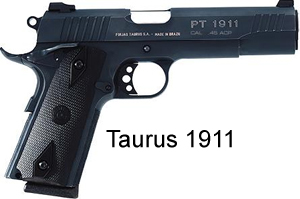
Taurus 1911Then there was the young man who had recently purchased a Taurus 1911 and wanted to learn all he could about it. Great gun. He shot our 22 pistols at the range, then his own .45. Afterwards he came back to the shop where Jerry showed him how to take his gun apart, clean it and put it back together. I was cleaning some of my own guns at the time and he was fascinated by the fact that I took out my .45 caliber Springfield XDm, unloaded it, cleaned it and put it back together while Jerry was struggling with the bushing on the 1911. “How many rounds does that hold?” he asked. “Fourteen,” I replied. “Fourteen rounds of 45 ACP?” “Yep.” The Taurus 1911 is a fine gun, but you can see why some of us elect to carry modern, plastic guns instead.

After the NRA class a customer brought two very interesting guns in to have us teach him how to disassemble for cleaning. This is where the varying talents of the Texas Gun Pros comes into play. Whereas I enjoy the personal side of carrying and using firearms – defensive scenarios, carry options, holsters, ammo, etc., Jerry is really into guns and I’m glad he is. I continue to marvel at his knowledge and mastery of a variety of firearms.

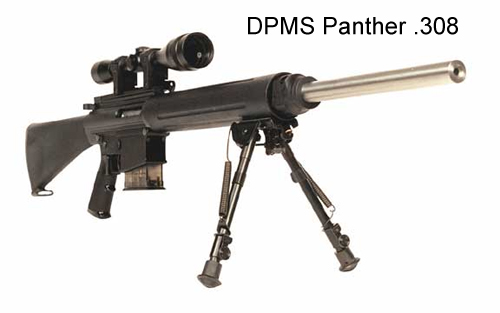
The first of the two guns was an AR rifle, a DPMS Panther in 308 caliber. I learned about M16s in the Army and have owned an AR-15, but I don’t know these guns inside and out like Jerry does. He not only disassembled, cleaned and reassembled this fine firearm, but he taught the customer a lot about his gun in the process.

DPMS Panther 308

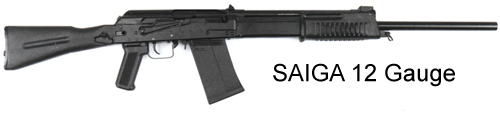
The next gun the customer brought out was a SAIGA 12 gauge shotgun. This is a Russian made gun based on the AK-47 platform. Again, Jerry seemed to know the gun inside and out and pointed out many of its features to the customer while taking it apart, cleaning it and reassembling it. He then had the customer do this as he had with the Panther.

SAIGA 12 gauge shotgun

Desert Eagle 50An added treat of the day was shooting Jerry’s 50 caliber Desert Eagle. You’ve seen the YouTube videos – well, if you hold onto it, the kick isn’t that bad. It sure is loud, though, and you feel the percussion as much as you hear the noise. I did manage to put three holes in the target, each touching the other. Of course they were such big holes, maybe that wasn’t much of an accomplishment after all.

Powerful Little Backup Gun

ITaurus 327 Magnm‘ve been watching the hype about the 327 Federal Magnum cartridge and wondering where it might fit in my personal defense strategy. I like to have backup guns in strategic locations – my truck console, my laptop case, even the pocket of my jeans. Last year I had a Taurus Ultralite revolver in .22 magnum.  It was just the right size and I figured .22 magnum would at least get someone’s attention, especially since it carried 8 rounds, but I didn’t like the heavy double-action trigger pull on that particular gun. A trade opportunity came along and I took advantage of it. That left a small revolver gap in my defense arsenal.

Cheaper Than Dirt in Fort Worth ran a Taurus sale one week and the advertised price for the little 327 Federal Magnum revolver was just too low to pass up. The cartridge is similar in size to the .30 caliber rounds I carried in the M2 Carbine I kept on the back of the seat in my helicopter in Vietnam. I read the specs and found the cartridge is loaded to around 40,000 psi pressure, making it have more impact velocity than even a 357 Magnum.

It’s a pretty gun – mine’s stainless steel – and fairly lightweight. It holds 6 rounds. I took it to the range and not surprisingly, it’s loud and it ‘s got a fair amount of recoil. It is not painful to shoot, but you wouldn’t want to shoot it all day. From approximately 10 feet away I put most of my rounds somewhere near the center of the target.

I find the gun is easy to hide and I expect it to be totally reliable. When you pull the trigger on a revolver you can usually count on it to go “bang.” This one will do that six times. If I place my shots carefully and make them count I have no doubt the 327 magnum bullets will stop somebody in their tracks!

Another Winner from Crossbreed – the SuperTuck IWB Mag Holder

David B. Freeman

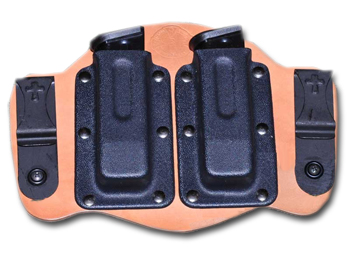
SuperTuck Magazine HolderIn our CHL and defensive handgun classes, we teach our students to carry a backup magazine for their pistols or speedloader for their revolvers. Yet I have personally struggled with an effective way to do this. All the belt-mounted magazine pouches I’ve tried stick out too much to conceal on my frame. I’ve resorted to carrying an extra magazine in a canvas knife holder in my pants pocket on the support side. It’s not comfortable and it certainly wouldn’t be easy to get to in the heat of battle. During my drills, I pull the magazine out of my pocket when drawing my pistol, but it’s still in a velcro-fastened carrier and it’s interfering somewhat with my shooter’s grip.

Thanks to Crossbreed Holsters, makers of my favorite IWB (inside the waistband) holster, I now have the answer that works for me. It’s their IWB mag holder, available in both one and two magazine models, molded to fit the size magazines you carry.

The one I ordered works great with my double-stack magazines in either 9mm or 40 S&W. It doesn’t fit the double-stack 45s for my Springfield XD.

I’m happy, though, because my normal daily carry gun is the 40 Caliber SIG P226. With that gun in a Crossbreed Supertuck holster and two magazines in the Crossbreed Supertuck magazine holder, I’m comfortable all day whether standing or sitting.

The Ideal Life?

By David Freeman 

I grew up living most of my life in the country. My grandfather, uncles and cousins owned most of the land around the small community in Mississippi where we lived (See Oxpatch and the Hill for details). So much of that lifestyle I took for granted, including the ability to walk out back and shoot any time I wanted.

This photo came to me in an email titled “Men who lack female supervision.” Where some of the other photos in the bunch showed an obvious lack of intelligence, I see nothing wrong with this one, except perhaps the beer. As a firearms Instructor, I’m quick to announce that alcohol and firearms don’t mix. Apart from that, I envy this guy.

Hot Tub Shooter

Sometimes Peer Pressure is a Good Thing

By David Freeman

Springfield XDm 45I’m an instructor, right? But the gun I’ve been carrying  everyday isn’t one of the big three:  Glock, SIG, or Springfield. It’s a Taurus! A sweet shooting, accurate, easy to carry Taurus, reliable enough when I feed it the right ammo. I like the Taurus.

Since it was a concealed carry firearm, so there was no real opportunity for eyebrows to raise or for the small nods that seem to say, “Well, if that’s all you can afford, it’s a good gun.” The fact is nobody put any peer pressure on me. I put it on myself. I don’t care for Glocks. I’ve got a SIG, but it’s a 9mm, but I’ve wanted a Springfield XDm they first came out. I didn’t get a 9mm, passed on the 40, but when it came out in .45 I begain drooling over the ads again. All the time, I’ve watched students in our CHL and NRA classes blow the center out of their targets with an XD time and again.

A little insurance money came my way from my Dad’s passing and yes, there were a lot of projects that have been put off for a while, but I took a little of the money and bought a Springfield XDm 45.

First time I took it to the range, I was actually instructing a Basic Pistol student. At the end of the lesson I asked if she minded if I put up a new target and fired a few rounds from my new pistol. “No problem,” she said. I fired 20 rounds of Winchester Silver Tip Hollow Point. The center of the target disappeared and there were no shots outside the center ring. Impressive.

When I tore it down to clean it later, I was impressed with how strongly the XDm is made. The return spring is so strong it’s almost more than I can compress by hand when putting it back together. Teardown was simple, cleaning straight forward.

Subsequent trips to the range have shown that the Springfield will digest whatever I feed it and put the rounds where I point the gun. It’s a little bigger than my Taurus 24/7 and it weights 3 ounces more–not enough to notice. The Taurus has become the upstairs house gun, loaed with the 185 grain Winchester Silver Tip it likes. The XDm is on my hip loaded with whichever personal defense rounds are readily available. If anybody ever asks there instructor what I carry, I can smile and say, “a Springfield.”

Three Things You Must Know if You’re Going to Carry a Concealed Handgun

By David Freeman

Texas law requires a curriculum for potential Concealed Handgun License holders that covers much of what you need to know to carry a firearm safely and legally, and the Texas CHL curriculum goes into more detail than the programs in many other states. Within the limited time we have available, we at Texas Gun Pros try to add more in the area of practical aspects of carrying a concealed handgun than the law requires. In reality, it’s an area that requires an ongoing focus of attention.

I like to break down the things you need to know into three major areas:

  1. You must know the law where you are carrying. This may or may not be your home state. When traveling, you need to familiarize yourself with the laws in the states you’ll be passing through or spending time in. As a minimum you need to know:
    • When and where you can carry
    • The use of force and deadly force
    • What’s expected of a CHL holder during a traffic stop
  2. You must know you can stop an assailant without harming innocent people. This involves being observent and careful, being proficient with your handgun and having the right ammunition as a minimum.
  3. You must know what to do after a shooting incident. This includes calling 911, what to say and what not to say, when to tell your story and to who, and dealing with the emotional aftermath, especially if it’s a fatal shooting.

You learn the basics of these things in an initial CHL class, but walking it out in daily life requires a commitment to read, study, practice and stay mentally alert. That’s one reason we offer additional programs such as the NRA Personal Protection Inside the Home and Personal Protecton Outside the Home classes. If you don’t see these on our current class schedule and are interested, let us know.

Personal Security for Ordinary People

By David Freeman

Guns are great equalizers. You don’t have to be big, physically fit or trained in the Marshall Arts to defend yourself  when you have a gun.

So much of the training I see about personal defense features young, physically fit, police or personal security-type individuals. You know what I mean, the ones with the ripped abs that run 10 miles before breakfast, rappel off the side of mountains and eat rattlesnakes for breakfast.

I’m not like that, but I can defend myself. I legally carry a concealed handgun and I’m relatively proficient with it. So while I’m not looking for a fight, if one comes my way I have a good chance of prevailing.

With a gun, a small woman can defend herself against a man the size of a defensive linebacker. An old guy like me can defend himself against a young, agressive street thug. A person in a wheelchair with a gun is no longer the easy victim an assailant might plan to rob.

While carrying a gun doesn’t require Olympic-like training, there are some things  you should do to insure you’re prepared to use one effectively to defend yourself:

  1. Be mentally prepared. This involves always being aware of your surroundings and recognizing potential threats early enough to do something about it should the potential threat become an actual threat.
  2. Have the right gun. The gun should fit you, it should be reliable and comfortable for you to shoot. It should also be of a large enough caliber to actually stop an attacker.
  3. Have your gun accessible. It must be concealed, but if it’s hidden away where you can’t get to it quickly, it’s of no use.
  4. Be proficient with your gun.
  5. Practice, practice, practice!
  6. Mentally rehearse possible scenarios, including how you would react.
  7. Get involved in the gun community – read the magazines, participate in shooting sports, train when you can.

Bottom line:  guns are great equalizers, but only if you know how to use them