Author Archives: David Freeman

Unknown's avatar

About David Freeman

Professional dedicated to training and equipping people to live safely in a dangerous world.

Being Careful Online – Not About Guns

I write about awareness from time-to-time, usually in reference to self-defense and carrying a firearm. This article is about being careful online. I’ve been developing web applications and databases for more than a quarter of a century, so I take it for granted sometimes that people know this stuff, but others don’t live in the cyber-world as much as I do, so perhaps sharing a few observations might help some of you. Most of this is in reference to emails.

  1. Anything and everything that tells you to view it before it is “Banned” should be considered bogus. Especially if it says before Obama or the government bans it. We have freedom of the press in this country. Nobody can ban anything. Yes, Google or You-Tube can remove stuff they find offensive (translate:  conservative), but they really can’t ban it. It can always resurface on a private server somewhere and probably has. “Banned” is not a part of America, except perhaps in schools.
  2. Emails that say they’re from Fox News, CNN, CBS, ABC or MSNBC are not. They’re from somebody trying to sell you something.
  3. All of those videos you need to watch before they are banned have a sales pitch at the end. ALL of THEM!
  4. Any email that asks you to verify your financial or personal information by entering it is what’s called a phishing email. It’s bogus and it’s trying to get you to reveal your personal or financial information so they can steal it.
  5. Emails don’t necessarily come from who it says they are from in the “From” box. You can put anything in there when you set up an email address.
  6. Links in an email don’t necessarily go where the link says it goes. For example, say you get an email from American Express wanting you to verify your account. There’s probably a link in the email you’re supposed to click on. It may say something like http://www.amex.com/account info.  But if you hover your mouse over the link (don’t click on it, just hover the mouse over it) it you can see where the link really goes. It probably says something like http://iamgonnagetthemgood.bettheyfallforthis@imabadguy.ru. Wow, right while I was posting this I got one of those emails. It said it was from USAA and in order to verify the integrity of my accounts it wanted me to verify my information by logging into:  ussaa.com – that’s what the hyper link said. But guess where it went?  To cinespots.com/www.usaa.com/. The real address there is cinespots.com, not usaa.com. That may look like a real website, but I guarantee you it’s not USAA’s website and I’m not going there!
  7. Spammers have the ability to hijack the email addresses in our email accounts and send out bogus emails to everyone in the list. I don’t know how they do it, but they do. These emails will appear to come from someone you know and they will have a link in them an nothing more, except maybe one sentence that says something like “Check this out:” followed by a link that is almost always dangerous or trying to sell you something. Please don’t click on these links when you get something like that.
  8. While it’s true we have the very real potential for terrorist activity in our county any day, and there is always the possibility of economic collapse, most of the messages of impending doom are really just trying to get you to send them money. No matter how great you think the cause is, find out who the organization is behind it and how much they really spend on what they say they do.

Please, be careful, be suspicious, and as much as you may dislike or like the current Commander-in-Chief, he really doesn’t have the power to create new HARP programs to get you a better mortgage rate, forgive your student loans, and all the other things that he is credited for or blamed for on a daily basis.

You May Want to Re-Think Your Carry Gun

In spite of my consistent recommendations to make sure your carry gun and ammo will do the job, I continue to see people convince themselves that a pocket .380 is the perfect gun for them. Or maybe the perfect compromise. In an effort to understand the pocket gun, small caliber mindset, I spent a few hours researching what both experts and new-to-carry folks had to say on the subject. After reading all of the arguments, I came away thinking, maybe they’re right . . . IF showing the gun is all it takes to stop a fight. Some studies say that’s the case 90 percent of the time. I’m not sure how they can arrive at that number since there is no consistent reporting mechanism on civilian firearm defensive use.

Here’s what I concluded. If you’re only liable to encounter a small-time robber, maybe you’d be okay. If you can get your gun out and if you can get it pointed at them. But you know what I’m thinking? I’m thinking active shooter scenarios. I’m thinking ISIS attacks. I’m thinking crazy, suicidal maniacs. I’m thinking gangs, or drug-crazed felons. Likely? Maybe not, but certainly possible. I want to be ready for the possible.

As I’m thinking through these issues the news comes on today about a mass shooting in San Bernardino, California. It’s early as I write this and very few facts are in. Interestingly, a bunch of left-wing politicians have already waded in for “more gun control” or “stricter gun control.”  What do these people eat for breakfast? Not one mass shooting yet would have been stopped by their proposals.

You and I might be able to stop them. At least, I might. I carry a decent-sized gun with large enough caliber bullets to get some one’s attention, and I can hit what I’m aiming at.

Think about it.

My Second Most Favorite Caliber – And Why

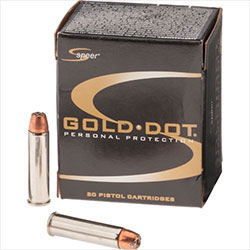
Gold Dot 327I became a .45 believer some years ago. It was a combination of things:  talking with some people who had been shot with various caliber handguns and studying the charts mostly. I figure I need all the help I can get. But my wife isn’t going to shoot a .45 and frankly she’d rather carry a revolver than a semi-automatic. She has a good 9mm semi-automatic and that’s her bedside gun, but when she’s out and about she wants a revolver.
The .38 Special is kind of anemic and the .357 Magnum is way too much for her to handle. So what does the job? When you get a chance, go back and look the comparison charts I did here in this blog in August 2015, you’ll see that an often misunderstood or overlooked revolver caliber ranks right up there with .357 Sig, .40 S&W and .45 ACP in what I look for in stopping power. That caliber is the .327 Federal Magnum. It’s a small cartridge, but because of the velocity with which it is flung from the .327 Magnum case, it packs a wallop! Especially if you choose Speer Gold Dot with 500 ft./lbs. of energy on target.

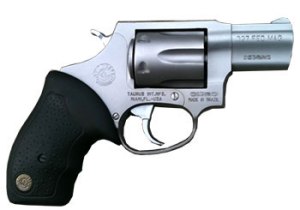
Taurus .327 MagnumOne of the reason’s I turned to the .327 Magnum when looking for a good self-defense revolver is that most of the guns built for that particular round hold six rounds of ammo, where the smaller .357s hold only five. Another cool thing about it is you can shoot .32 S&W Short, .32 S&W Long, .32 H&R Magnum, or .327 Federal Magnum cartridges. Some of these are pretty soft shooting for practice, whereas the H&R Magnum or the Federal Magnum cartridges are pretty serious self-defense rounds.
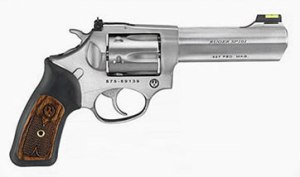
This is a comeback round and I’m really glad to see manufacturer’s taking it seriously. My wife’s gun is a Taurus .327 Magnum. It fits in her purse or in her center console quite handily. Speaking of center consoles, I just happen to have a Ruger SP101 in .327 Magnum in my Jeep console today, and pretty much every daySP101 327 Magnum It’s a great shooting little revolver with sights I can see well and in perfect size for a console gun.
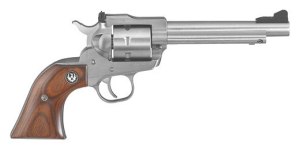
I recently added another .327 to the family collection, a Ruger Single Seven, which compliments the Single Nine .22 Magnum and Single Ten .22 already in the family. So if you’re looking for a self-defense revolver fSingleSevenor either back up or as your primary handgun and don’t want the heavy recoil of a .357 Magnum or .44 Magnum, you might consider the .327 Federal Magnum.

Becoming Aware of Awareness

AwarenessThe discouraging thing about writing an article like this is that those who really need it aren’t aware they need it. If you know someone that does and I’m sure you do, maybe you could pass this along.
In our CHL (soon to be called LTC) classes, we touch on Awareness. We go into it a little more in the Advanced Concealed Carry and Refuse to be a Victim classes. I think it needs to be taught as a way of life beginning in at least Middle School. It’s not a “gun” thing. And it’s about more than personal safety, though that’s a big part of it. Some of it is about a rapidly dwindling character trait in today’s society — common courtesy.

Practically every day of my life I take actions to accommodate people who just aren’t paying attention. I’m sure you do, too. Before getting into the safety aspect of awareness I’m going to list a few of these failure to pay attention actions that are just plain courtesy. If you’re doing this stuff, STOP IT!

  1. In a drive-thru, it can be a bank teller, an ATM or fast food, it doesn’t matter. I’m number two at the window. Number one took a while to place their order, but that’s okay, Everybody wants their food right. It’s just that some people decide what they’re going to order before getting in the drive-thru. But we’re past that point now. Whatever it is, food, money, now it has been delivered, and it’s my turn! Me, back here in the car behind you, waiting patiently. I expect car number one to drive off, or at least to pull up so I can get my business done. But, no. It appears the driver of car number one had unfastened their seat belt and is now searching for it to re-buckle. Now, they are rearranging whatever is on the front seat. It looks like they are putting some stuff away in the glove compartment. Ready to move? Oops, not yet. Are you kidding me?  Did she just pull the visor down and used the mirror to check her lipstick. That done, I’m sure it’s my turn at the drive-thru. But not yet!  Something is wrong with how the wallet went back into the purse. That has to be fixed. Oh, and the mirrors need to be readjusted. Surely when doing that, she noticed that someone is behind her! Finally after what seems like 5 minutes, the car ahead of me drives off. During this whole time he/she never thought about the car behind them and how easy it would be to pull up a little, maybe even into a parking place and take care of all the adjustments so the next car in line can take care of business.
  2. I am on the street at a traffic light with a right turn lane angling off and right turn on red allowed. I want to turn right. But the car in front of me is 10 feet back from the one ahead of it. If the driver would pull up just 2 or 3 of those 10 feet, I can make my turn and be on the way. But, they’re even aware that I’m back here. This is not just a right turn issue. It could involve trying to merge into a lane of traffic from another while at a standstill, or any number of places where if a driver would simply look around them they would see the need to help someone else out a little simply by pulling up a few feet.
  3. Now that we’re on the street, let’s talk about traffic lights. You drive the same route every day. Would it be too hard to learn the sequence of the lights so that when your turn to go is coming up, you can put your phone down (yes, put it down!) and get ready for the change, instead of waiting for the car or cars behind you to honk to let you know that the light has changed. Oh, and because they are nice people, they actually waited a bit to see if you would notice, but since you didn’t, you made it through at the tail end of the yellow light, but they didn’t. Another full cycle they have to wait because you weren’t paying attention.

You get my drift, these are mostly about courtesy, though that thing about the phone and driving is a whole lot more. If you continue to text and drive, I’m going to consider it Assault with a Deadly Weapon when you venture over into my lane and take steps to defend myself!

Situational Awareness

We teach Awareness in our classes for your safety. We start by telling you to be aware of your surroundings and to be aware of the people around you. There’s a lot more to this than I can cover in this one article, but allow me to share some basics that might help keep you alive:

  1. Keep your chin up and head on a swivel no matter where you are. Staring at that little screen in your hand all the time is dangerous. You don’t know who around you may be wanting you or what you have and can get really close without you realizing it. Or when you might be about to walk into the path of an oncoming bus or into a pool of water.
  2. When you enter a room, make note of the exits and places to hide in case that room becomes the type of madhouse that could result from a crazy person or persons on the rampage, whether with a gun or not. If you’re not familiar with the old concept of how a gunfighter never sits with his back to the saloon door, I suggest you adapt something similar. Sit where you have your back close to a wall, if possible, and where you can see the bulk of the room and especially the entrances. That way you can’t be caught totally of guard by a dangerous situation.
  3. Walking or jogging, please always do this on the side of the street facing traffic. Personally, I’d prefer seeing you pick a jogging path or sidewalk or at least some lightly traveled streets. But you know what I see far too often?  A walker or jogger with their back to me when I approach in my car, which means they are moving with traffic rather than against it, with headphones on, listening to music, so they can’t even hear the cars approach from behind them, often wearing dark colored clothing and doing this in the dim light of evening or early morning.  This is STUPID! I don’t know how these people missed the safety classes taught in Boy Scouts, Girl Scouts, schools, or, wait, maybe they don’t teach this stuff anymore. Okay what about some common sense. I got into an argument about this one time with a relative, who was so mixed up. She thought she was supposed to follow the same rules that the cars do. That’s not the case, please, be careful out there.
  4. Here’s something else I see that just amazes me. A driver is sitting number one at a traffic light. The light changes so that they have a green light. Without looking left, without look right, they start right off into the intersection. OMG!  People run red lights! They run red lights! Look in both directions before moving into an intersection, please!
  5. My father taught me a lot of things about driving that aren’t taught anymore. I took driver’s education after I got my license because it resulted in my parents having a lower insurance rate. The Driver’s Education instructor echoed what my dad taught me. One was the thing I mentioned earlier about understanding the traffic light signals so you’re ready to go when they change. Another thing was when you’re turning off a main road into a side road or parking lot, you do not need to, and should not, slow down to a crawl before exiting the main road. That causes people behind you to have to slam on their brakes, which results in a domino effect down the line. Keep your speed up, make your turn and after you’re off the main road, then readjust your hands on the steering wheel or whatever you need to do to proceed on in the new direction. Try it. I promise you can do this.

I think I’ll quit. With these few items I’ve mentioned you can get started onto a life of Awareness and even Situational Awareness. Please do.

Summertime Carry – What?!!

I am honestly bewildered by the plethora of articles about concealed carry in the summertime and how you if you want to carry when the weather is hot you have to get one of those little mouse guns or pocket guns. Yeah, yeah, yeah, the first rule of a gunfight is to have a gun. Right. To me that sounds like the first rule of winning a boxing match is getting in the ring. But a 100 pound woman with no training getting into the ring with a heavyweight champion boxer is not going to win. Likewise, an untrained, civilian with a pocket .380 is not going to win in an altercation with a hardened criminal on drugs armed with a .45 caliber handgun.

Honestly, folks, it’s not hard to carry a decent size and caliber handgun, no matter the season. Wear shorts. Just wear shorts with belt loops. Wear a short-sleeve, lightweight shirt. But get shirts with a pattern to them, preferably in colors other than white. If you’ll do that and follow the suggestions I’ve made in earlier blogs and which I’ll repeat here, you can be well-armed regardless of the season. A gun at your belt does not care how long the pants legs are. A gun covered by a shirt tail does not care how long the sleeves are.

Yesterday I watched a family go into a restaurant. Dad, mom and boy of about 12. Dad was armed. How do I know? Well, I don’t know for sure, but he was wearing cargo shorts with a big bulge in one of his thigh pockets. “He’s got a gun in that pocket,” I thought when I watched them walk. He even looked like a gun guy. My next thought was, “where is he going to find a bad guy who will wait for him to unzip that pocket and pull his little gun out, orient it and get it pointed in the right direction?” My very next thought was that the clothing he was wearing would have been just as conducive to carrying a .45 Springfield Operator 1911 as the clothes I was wearing. His shirt was white, but it was a tactical-type shirt, with a long shirttail worn outside his pants. His shorts were khaki, 5.11-style shorts. Those shorts have belt loops. His combination of clothing would carry and conceal in the same way mine does.

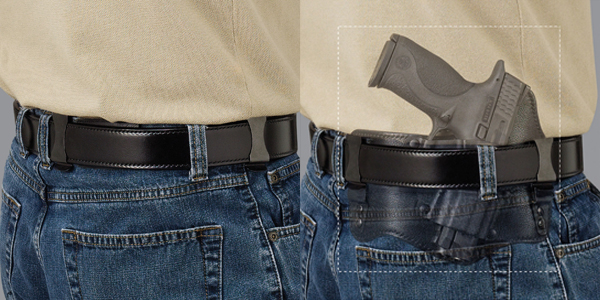
IWB Holster

The image on the right is a cutaway showing where the gun is in the image to the left. Notice this is not a big guy.

THE SEASON DOES NOT MATTER WHEN IT COMES TO DEFENDING YOURSELF AND YOUR LOVED ONES. Once again, here’s how a guy can carry a big gun. A guy that weighs 130 pounds or a guy that weighs 300 pounds. This method works for both.

  1. Buy a good gun belt.  It can be a 1 1/4 to 1 3/4 inch wide, two layers thick, leather gun belt or a 5.11 Tactical Sierra Bravo Duty belt. It just needs to have enough thickness to support the clips from the holster and to support the weight of the firearm.
  2. Get a good IWB holster, custom made for your gun. I’ve used Crossbreed SuperTuck, WhiteHat Holsters, D.M. Bullard Leather, Alien Gear, Galco KingTuk, and MTR Custom Leather holsters. They all work well.
  3. Find the best position on your body for comfort and accessibility. Most of the holster manufacturers recommend the 4:00 position. For me 3:00 works best for semi-automatics and for some reason 11:00 in a cross draw position for revolvers. That’s commonly called appendix carry.
  4. Unload your gun and practice drawing until you can do it smoothly over and over. Don’t worry about speed, worry about smoothness. The speed will come with practice. Break  your practice down into steps:  a) uncover, b) grip, c) draw, d) rotate, e) join hands and extend.  Do this over and over until it becomes muscle memory.

Now, you may actually have a chance should you encounter an unpleasant situation where someone wants what you have and is willing to kill you for it, regardless of the season or length and weight of your cover clothing.

Rock Island Ultra MS 1911 – The Price is So Right and So is the Gun

Rock Island CommanderSome of my buddies have owned Rock Island 1911s and I’ve seen some pretty impressive targets as a result of their shooting range adventures. Recently I saw one of the Rock Ultra series Commanders at an “I don’t see how they can do that!” price. If you’ve read any of my stuff previously, you know Commander-size 1911 pistols are among my favorites. My “I don’t need any more guns” resolve seems to be short-lived, so naturally I gave in. The gun is classified as a Rock Ultra MS and it came with the features I like such as a skeletonized hammer and trigger and ambi-safety. It has what appears to be a very durable Parkerized finish. The sights are not my favorite, I like night sights, but the ones on this gun are visible and snag-free. The factory picture shows it with a fiber optic sight on the front, but mine doesn’t have that. The sights are black all over.

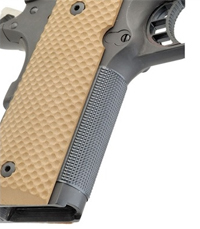
I changed the grips when I got it home. The gun came with a set of very aggressive G-10 grips. I had some not-so aggressive ones on hand, so I did a switcheroo with the grips, wiped off the shipping oil and put the gun and a box of 45 hollow points in the Jeep so I could try it out during the next trip to the range. That trip turned out to be a CHL class and since we had several instructors on hand, I set up on one of the lanes with a B-27 target, the Rock Island Commander and a box of 45s, planning to shoot part, if not all of the Texas CHL Shooting Proficiency test.

RITarget1

Target After the 1st 10 Rounds

After ten rounds I was disappointed. This is not how I shoot. I was confident that every time I squeezed the trigger my front sight was on the X and was properly aligned with the back sight, but my shots were going wide. You’ve seen my 1911 Commander targets. I generally obliterate the center of the target, especially at close range. The distance here was only 9-feet!

I shot another ten rounds and then we moved the targets out to 21 feet. By the time I’d fired 30 rounds total, I figured I was done. I pulled the target back in, and left some ammo so the other two instructors could try their hands at the gun. When the target got close to me I was surprised. The last 15 rounds or so, even at 21 feet were right in the center of the target, where they should be. That was more like it! When the other two instructors shot the gun, their shots were grouping well, but they both said their shots were impacting a little below their point of aim.

As we were discussing our thoughts about the gun later, one of them mentioned he had read that Rock Islands tend to get better after a little break-in. Funny, I read in the manual where they recommended a 500 round break-in period before making any kind of warranty claim. I’ve never been much on these break-in period claims. Most of my guns have cycled and fired right out of the box just like I wanted them to. But in this case, this particular gun’s accuracy did improve after a few rounds had been put through it.

Bull Barrel vs. Barrel BushingThere was another reason besides the price that I wanted to try this gun. It has a bull barrel as opposed to the  barrel bushing arrangement on every other 1911 I’ve owned or shot. I’ve handled other 1911 style guns with bull barrels and noted they’re a little more challenging to take apart for cleaning, but had no information about whether one was better than the other. Comments I’ve read say that it adds a little more weight up front, which might help with recoil and it results in less parts to wear out. Another reason I’ve read is that in some of the early short-barrel 1911s the bushings had to be thinner and tended to break. I think that was a Colt issue with some of the earlier Commander or Officer firearms. Once the accuracy of this particular firearm improved to the point it became a non-issue I can’t tell the difference between shooting it and shooting a standard 1911 with the barrel bushing.

Workmanship on the Rock Island is superb. I find nothing to indicate its lower cost results in lower quality. From what I’ve read about Armscor, the maker of the Rock Island guns, they have state-of-the-art CNC machinery and they make the guns from the same 4140 steel as the best made guns from American manufacturers. I originally thought I might try this gun, write about it, then sell it, but for now I’ve decided to hold onto it. I’ll probably make it my “truck” gun, only now I drive a Jeep, so I guess it will be my “Jeep” gun.

Would I recommend it to others? If price is an issue and that stands between you getting a good 1911 45 versus some other gun, I would certainly suggest it with no reservations. Currently, I believe the Ruger Lightweight Commander 1911 is the best 1911 value on the market, with the Remington R1 Carry close behind. If you’re willing and able to spend more money there are a number of options. But this Rock Island is nothing you would be ashamed to own, carry, even show off!

Update 11/13/2020:

For more on my experience with Rock Island pistols, see my review of the Rock Island MAPP MS in the Mar/Apr 2019 issue of American Handgunner and a review of the Rock Island XTM-22 1911 in 22 Magnum in the December 2019 issue of GUNS Magazine.

Slide Lock or Slide Stop?

Sling Shot Method of Slide Release

Racking the Slide Using the Sling-Shot Method

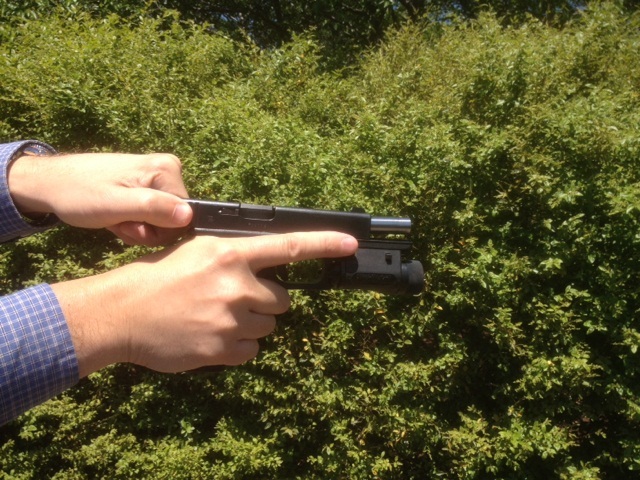
Early in my training to become a handgun instructor, I was taught to place a semi-automatic handgun into battery by pinching the rear end of the slide between the thumb and forefinger of my support hand, pulling back on the slide with the support hand while pushing forward on the grip with my shooting hand, then releasing the slide when I felt it stop, which happens in something like an eighth of an inch on most semi-automatics. For a slide that is difficult to pull back, an alternative to pinching the slide with between the thumb and forefinger is to reach across the rear of the slide with the heal of my hand on the left side of the slide and my fingers on the right side (I’m right-handed), squeeze tight and pull the slide back and release it that way. Either of these methods is commonly called the “sling-shot” method by most instructors. To me the terms “sling-shot” and “rack” the slide are synonymous in this context.

The reason most commonly given for doing it this is that it is easier on the gun and won’t wear the slide-lock notch out like just thumbing the slide lock does over time. Since my initial instruction in this regard, I’ve heard it from instructors and gunsmith’s alike and have adopted it as the method I teach. When I see old-time shooters releasing the slide lock with their thumb, I usually at least make them aware of the alternate method while saying something like “I know the military teaches using your thumb to disengage the slide lock, but they have armorers who can fix their pistols when the slide lock notch wears out.”

In studying the issue more carefully, I’ve discovered some other reasons for using the sling-shot method as opposed to thumbing the slide lock. One of these is that this method provides the gun with a stronger, cleaner push into battery, as long as you don’t ride the slide forward with your hand. That’s the important part. Whether you pinch the slide or reach across it with your hand to grasp it, you must let it go as soon as you feel the slide stop in its rearward move. This will happen with very little rearward movement. When you let it go, let it go like it was hot and burning your hands. If you need to reach across the slide to grasp it, avoid the ejection port as this is a place on the gun that can easily pinch you, perhaps even drawing blood.

Thumbing the Slide Lock

Using the Thumb to Release the Slide Lock

The sling-shot method works on all semi-automatics, pretty much the same. Slide lock levers are all over the place from gun to gun. Some are small, some are large, some are way forward, some are near the rear of the slide, maybe not the notch, but the lever (I’m thinking in particular here of the Sig Sauer SigPro 2022). Maybe you’re left-handed and the slide lock lever is on the side opposite your shooting hand thumb. If you use the sling-shot method, you don’t have to worry about where the slide lock is and if you can get your thumb on it.

Strength is sometimes an issue when racking a slide, especially for women or anybody with hand issues such as arthritis or any of the issues that come with long-term and frequent computer use. Using your thumb to release a slide lock can have the same issues. Regardless, I won’t do it with my guns because I want them to last a long time, plus I find it much quicker to just sling-shot the slide.

When it comes to racking slides and locking them back for the range safety officers or to load the gun, new gun owners are often confused with the internal slide lock associated with an empty magazine. Practically all semi-automatics are designed such that when a magazine is emptied the follower inside the magazine engages a notch inside the gun that locks the slide back. This is how you know the gun is empty and requires reloading before you can continue shooting. This internal slide lock can frustrate your attempts to sling-shot the slide, because with an empty magazine in the gun, you must also be pushing the slide lock down at the same time you’re racking the slide. This should be done with the thumb of your shooting hand if you’re holding the gun correctly.  Just remember, if the gun has no magazine in it or a magazine with ammunition in it, simply pull the slide back slightly and release it to get the slide to go forward with the proper strength and velocity for it to go into battery. But with an empty magazine, you must also push the slide lock down while rack the slide.

It’s Not Bragging if You Have the Pictures!

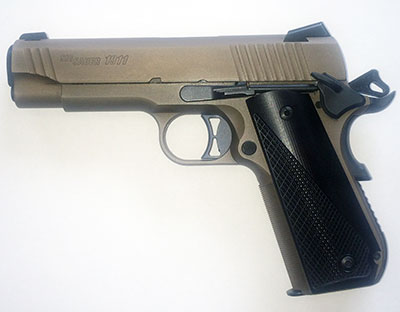
Sig Sauer Emperor Scorpion CommanderWe had finished the range portion of the NRA Basic Pistol class Phil Epps and I had taught Sunday and had the range for a few more minutes. This gave me the opportunity to do a little follow up testing regarding my Sig Sauer 1911 Scorpion Commander. On a recent trip to test various magazine/ammunition combinations I had discovered that Fiocchi jacked hollow point rounds did not feed reliably in that particular gun. Since every other type of ammunition I had tried worked fine, I was puzzled. When I got the gun home and began looking for the source of the problem, I didn’t find one. In fact, when cycling the gun by hand, it fed those rounds with no problem. So, now back at the range, I ran a target out to ten feet or so, loaded eight Fiocchi hollow points in one of my Colt magazines and left whatever was already in the chamber there. Why was one in the chamber? It was my carry gun for the day.

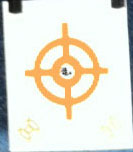
Sig Sauer TargetI started shooting with my typical two-hand grip, unsupported and after 4 shots there had been no issues with feeding the rounds. But there was something else. The target had a single quarter-sized hole in which all four rounds had converged. I called Phil over and got him to take a picture with his IPhone. After getting that benchmark, he snapped a photo after each of the remaining shots in the magazine. After all nine rounds, it was a pretty impressive target.

Sig Target AFter 9 rounds

I went on to shoot some more and a couple of our students who had hung around to watch were given the opportunity to shoot the gun as well. The final target had a big fist-sized hole in the center with a couple of flyers in the inner orange ring.

I could be just bragging on me a little, but what I’m really bragging on is the gun! My 67 year-old arthritic hands aren’t always able to hold a handgun absolutely steady, but I was having a pretty good day that day. The gun was having an amazing day. But, I’ve noticed that about Sig Sauer pistols, at least the ones I own. They always make me look good!

UPDATE 10/3/2015

I had a chance to shoot the Sig again today as we were wrapping up a CHL class. I had approximately 20 rounds of mix and match ammo. It included some Sig Sauer JHP, Speer Gold Dot JHP and Hornady Zombie ammo, which is basically their Critical Defense. I fired 20 rounds during the timed portions of the CHL class, 1 round every 2 seconds and 2 rounds every 3 seconds. The target was at the 9 foot range. The end result looked like 10 rounds had been fired, all well within the 10 ring. The first three shots were in a hole the size of a quarter, then I pulled the 4th one off about 2 inches. The next 10 rounds essentially filled out the first holes. This is one accurate firearm!

Easy DIY Upgrades

Upgrades, enhancements, customization . . . you pick the word. There are some easy things you can do to make a gun truly yours, especially if it’s a 1911. I’m using 1911 examples for this article because the parts necessary for these upgrades are readily available and on a 1911, the upgrades are relatively easy to accomplish. Why would you want to do any of these upgrades? That’s up to you. Maybe this isn’t for you, but I’ve always liked adding my own personal touch to items I own. As a kid I was into Hot Rods and Custom cars and I guess I’m still a kid at heart at 67, so here we go.

First let’s talk about grips. That’s an easy upgrade and sometimes it’s the difference between having a gun you can comfortably shoot and one you can’t. Or maybe you just want to change the look of the gun to make it more appealing. I’ve done several things with grips on my 1911s, but one of the most rewarding has been adding aftermarket logo grips. Here are some photos of grips I’ve added to a Remington R1, and a Ruger LW Commander:

Commander Grip Panels

The Remington Grips are Walnut with the metallic Remington “R” logo added. The Ruger grips feature the Ruger Phoenix logo carved into the beautiful wood grips. I have to admit that as beautiful as the Remington Grips are, I first tried them on my R1 Carry Commander and swapped back out to the full-size Ruger because those particular grips are a little rough on my hands when I shoot. So I’m going for beauty on the one I don’t shoot as much. The Ruger grips are totally satisfying in both look and feel and set the gun apart from a stock SR1911 LW Commander.

ColtGripsAndScrewsI really had fun with the Colt because not only did I find Colt logo grips that look and feel nice, but I even found some logo grip screws to hold them on. What’s really cool about these grips is where I found them–on Amazon.com. There are hundreds of grip choices on Amazon.com. Something to remember about swapping grips out is that if you go for thin grips–and I like thin grips because I have short, stubby fingers–you’ll need screws and bushings designed for thin grips. The bushings are what screws into the frame. The grips fit down over the bushings, then the grip screws screw into the bushings to hold the grips on. If they are not sized right, the grips can be loose or the screws can go too deep through the bushings and contact the magazine making it difficult or impossible to insert or drop. Strike Industries makes grip screws and bushings in both sizes and with in stainless, blued, or nickel and these are all available on the Amazon.com website as well as directly from Strike or through other firearms accessory suppliers.
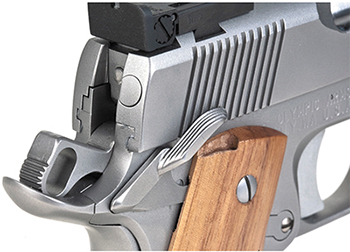
In addition to the logo grips you can find grips of varying styles, colors and textures when shopping at Amazon or any number of other websites–those of the grip makers plus Midway USA or Brownell’s. One of my favorite companies makes VZ-Grips. Google for them and you’ll find quite a variety.

The next two upgrades I’m going to tell you about involve a little more work and gun disassembly than just changing out the grips. The first is installing an ambidextrous safety. I bought my ambi  safeties from Wilson Combat, but they’re not the only makers. It’s just that I’ve learned to appreciate the quality that goes into Wilson products, plus their outstanding customer service. Wilson make two grades of safety, the regular grade and another they call “bullet proof”. I’ve used the regular ones, but I think if I do it again, I’ll order the Bullet Proof design. That’s not because I’m unhappy with the ones I’ve got. I just want to try something different next time.

Ambi SafetyYou may be surprised if you’ve never had reason to try this, but removing the existing safety from a 1911 is very simple. First unload the gun, then cock it. Then move the safety to a position that is halfway between on and off. You may have to get a small screwdriver blade or a the blade of a pocket knife to start it, but in that position, the safety will pop right out of the slide.

Installing the ambi-safety could be a simple as popping it in where the other one came out and pushing the right-hand side of the safety onto the post of the left-hand safety where it goes through the slide, but it’s more likely that you will have to do some filing. There are instructions and videos on Wilson’s website and on a number of 1911 forums. You’ll have to do a little disassembly so you can see how the safety is fitting, but it’s not complicated and the instructions will show you step by step how to do it. File a little, then check the fit. File a little more if necessary, but be careful not to over do it and you’ll find it’s really a fairly simple process. I’ve done it three or four times and the results have been gratifying every time. I don’t need an ambidextrous safety because I’m left-handed, but I like having one because it allows me to easily check the position of the safety in my holster regardless of what I’m wearing or body position.

Wilson Combat TriggerAnother easy upgrade for a 1911 is replacing the trigger. I bought a Sig Sauer 1911 that had a straight aluminum trigger with no holes. For me there were two things wrong with that trigger. The first was that it extended the reach for getting my finger properly placed on the trigger and my short fingers just didn’t like it. The second issue was that the trigger’s appearance just didn’t seem to fit the gun. I found a Sig Sauer 1911 ScorpionWilson Combat trigger that fit the bill perfectly and with it I replaced the original trigger. The Wilson trigger is black, curved and has the three holes. I don’t know if you can really tell from the picture of the gun here, but in my opinion, this is the type of trigger that should have come with the gun.

How much trouble was it to install? Again, it requires some disassembly and it might require a little sizing. In fact this one did. The trigger itself was too tall for the space provided in the gun. It’s made out of plastic and with a few touches with a file, checking the fit as I want along, I was able to make the trigger fit perfectly. Installing this trigger as a drop-in like I did had no affect on the weight of the trigger pull. But it did make for a slightly smoother trigger pull because the part of the trigger that slides in the frame was narrower than the stock trigger and produced less friction. Not a lot, but enough that trigger operation felt smoother to me after I did the upgrade.

Colt MagazinesI’ll cover one more upgrade and this is an easy one. Ever since I started shooting 1911s I have bought Wilson Combat magazines to replace the ones that came with the gun. This may have been superstition or it may have been because I’ve seen Wilson magazines solve other people’s ammo feeding problems on the range during our classes on numerous occasions. But after buying a Colt with 8-round flush-mount magazines, I have switched to using the Colt magazines in all of my 1911s and with great success. This gives me 9 rounds available before reloading and nothing extending from the frame grip. That’s more aesthetically pleasing to me and it helps with concealing the handgun.

Another thing I like about the Colt Magazines is the follower inside the magazine is metal, rather than plastic as in so many other brands. It’s angled just perfectly for feeding the rounds and I’ve never experienced any of the next-to-last-round failure to feeds that is common with other magazine brands. As I’ve written previously, I’ve vetted these magazines in all my guns and have absolute confidence in them.

So there you have it, some ideas about how you can easily tweak your gun to fit your own personality or needs. Parts are readily available, as is “how to” information on YouTube.com and other websites. Have fun and if you think about it, let me know how some of your projects have gone.


Weighing In on the Lightweights

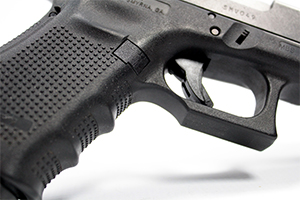
If all gun salesmen were required to spend some time on the range as instructors, I think what they offer to customers and tell them about guns would be different. For the past several years, because of the increased interest in concealed carry, everyone from the manufacturers on down have been pushing small, lightweight guns to first time gun owners. SHAME ON US!

I know the arguments:   “Any gun is better than no gun”, “It doesn’t do any good to have a gun you can’t shoot”, “What about concealing in the summertime when you wear lightweight clothes?”, etc., etc. The problem with those arguments is they work only when you’re talking about carrying a gun. But they fall apart quickly if you ever have to actually use your gun.

Common lightweight .380 handguns

Some Common Lightweight .380 Handguns

We see all of the guns shown above, as well as others that are similar, in our CHL classes. We sell some of them in our store. But we are careful to provide other options to our customers and to let them know of the disadvantages as well as the advantages.  These are all good guns, but they’re not necessarily good guns for primary concealed carry for relative inexperienced shooters.

The problems we see in the classes is only a small part of what we would expect to see on the street should, God forbid, one of our clients actually have to defend themselves. Here is what they’re not told at the Gun Shows or the Big Box gun stores:

  1. That small gun kicks like an SOB.
  2. It’s really hard to hold onto when you’re shooting it.
  3. If you’re not holding on tight and have kept your gun really clean and are shooting good factory ammunition, you may be shooting a jam-a-matic.
  4. That short barrel means a short sight radius (less accuracy), less stability for your bullets (less accuracy), less muzzle velocity (less power).
  5. Speaking of power, the .380 ACP cartridge is way down the scale in stopping power against a determined aggressor.
  6. Oh, and how many of those small, underpowered bullets does it hold?  Not many, usually 5 or 6.

If you’re a strong shooter, a very good shot, very cool under pressure, by all means carry one of these small .380s–as a backup gun.

Let me get to the bottom line here. I’m an experienced shooter and it is rare that I don’t hit what I’m aiming at. I’m a war veteran who has been shot at a number of times and I have learned to be calm and collected under pressure. I practice with my firearm regularly. You could say I’m somewhere near the top of the professional heap when it comes to concealed carry. And I wouldn’t dream on carrying a small .380 handgun for my personal protection or the personal protection of my loved ones.

But what about someone who just can’t handle a bigger caliber?  Get a PMR-30 with 30 rounds of .22 Magnum. Okay, I know they’re hard to get and hard to conceal, so let’s back off that a bit. One option might be a small, steel-frame (not lightweight) revolver in .327 Magnum. That’s a kick-ass round, with pretty much the same ballistics as a .357 Magnum, but the .327 revolvers carry 6 rounds and sometimes more and they’ve got enough weight to absorb some of the recoil.

Most small, lightweight .380 Semi-Automatics or even lightweight .38 Special revolvers have more felt recoil than most 9mms with a little size to them. Seriously. Go shoot some guns. You may find that a 9mm S&W M&P is a whole lot easier to handle than one of those small .380s.  There are some nice 9mms that hold 9, 10 or 12 rounds and are very concealable. The slim ones that are pretty popular are Ruger LC9, M&P Shield, Springfield XDs, and Berretta Nano. Bersa’s BP9CC and the Taurus PT-111 are a couple more favorites.

If you’re really serious about carrying a gun that might save your life, you may have to make some wardrobe changes. Our instructors, who come in all sizes, all carry big guns, usually in IWB (inside the waistband) holsters, but sometimes OWB (outside the waistband). We also carry spare magazines. In the unlikely event that we ever have to use our gun, we want to be the one standing, not the one who couldn’t hit the target, or whose gun jammed, or who shot until they ran out of ammo, but didn’t stop their aggressor.

The hunting regulations in every state I know of specifies a minimum caliber that can be used to hunt deer. They do this because they don’t want a lot of wounded deer running around. The deer should be harvested with a minimum amount of suffering. But, if you wound a deer, the worst case is you may lose the deer or you may have to track it to the location it finally stopped running. If you wound a bear, however, that bear is coming after you. In society, when preparing to defend yourself against one of the predators in society, you don’t know if that predator is going to be like a deer or like a bear. It’s best to be prepared to stop a threat that is big, hopped up on drugs or adrenalin, and mean as a snake.