Typical Gun Store Visit

A young lady comes into the gun store alone and timidly approaches the counter. “I want to buy a gun,” she says to the salesman who approaches her.

“What kind of gun, ma’am? Shotgun, rifle, handgun”

“A pistol,” she replies. “A Glock, the little one, I think it’s a 42 or something . . .”

The fact that her voice trails off signals the salesman he needs to ask some questions. “A Glock, that’s what you want? Do you know why that’s what you want?”

“Well, my brother-in-law is a policeman and that’s what he carries.”

“Oh,” our helpful salesman replies. “What does he drive?”

Lady Buying a Gun“You mean his police car?”

“That’s probably a Dodge Charger, would be my guess. No, what’s his personal car?

“I think it’s a Toyota . . . maybe a Camry?” She’s not sure, but the salesman has the information he needs to help her with her gun purchase.

“Is that what you drive?” he asks her.

“No, I drive a Lexus coupe. You know the IS 250?”

“Nice car,” our salesman replies, then challenges our new gun buyer. Now remember, he could have turned around, picked up a Glock 43 and he would have had a sale. I’d would have been proud of him for making a sale, because we sure need to make sales, but I’m more proud of him for what he did next.

“If you don’t drive the same kind, or even brand of car, your brother-in-law drives, could it be possible you may prefer a different kind of gun than the kind he uses?”

“Well, I’ve always heard that Glocks are good guns,” she says, just a little defensively.

“They are,” our salesman replies as he puts a Glock 19 in her hands. “But so are Smith & Wesson, Sig Sauer, CZ, Beretta, Bersa, Springfield and lots of other brands.” As he says this, he gestures to the counter where various 9mm handguns are on display. “Why don’t you pick up some of these, see how they fit your hand. See how they feel when you cycle the slide. Try the trigger. You may find the Glock is the one you like best, but you may find others you like better.

Taurus 738“Oh, I like this,” she says, heading away from the 9’s and over to a pink Taurus 738. “And it fits in my hands so well and I could hide it easily . . . ” and on and on with the arguments that sound so right for picking a self-defense handgun, especially for a small-framed woman, but which in reality aren’t really right.

“It’s a pretty gun,” our salesman agrees, then asks her, “What is your primary purpose for buying a gun today?”

“Self defense,” she replies. “I want some protection the way society is going today.”

We had a sure sale with the Glock 43. The Taurus cost less than the Glock and it’s pink so it could easily be a sale right now.

BUT . . . is this the right gun for the lady. Probably not. Our professionals will hopefully coach her a little by explaining in terms that you don’t have to be a gun guru to understand about how bigger is better when it comes to protection . . . bigger bullets . . . a bigger gun to hold onto . . . more weight to absorb recoil . . . and perhaps encourage her to get a little training and some range experience before plunking down her dollars. Is this a lost sale for our gun store? I hope not. I hope it’s just a delayed sale. Or if she really wants to get a gun today, I’ll bet my guys can steer her into something that feels good in her hands, she can manipulate all the features on and would provide some decent firepower for her protection.

What someone’s brother-in-law, brother, boyfriend, father, husband . . . whatever . . . would choose for a gun is not necessarily the right gun for you to choose, whether you’re a man or a woman. A handgun is a personal thing and there are lots of very fine handguns from which to choose. A little research, a little time at the gun store or at the firing range and some bonding should go into picking your perfect packing gun. And if you don’t get it right the first time, you’ll have gained some experience to help you make a better choice the second time.

Ruger’s 9mm 1911 and Colt’s Magazines

Some of you long-time readers may remember my 1911 love affair began with a Ruger. It was the original .45 ACP all steel commander-sized Ruger that caused me to totally re-evaluate my understanding of the 1911 platform. Prior to having that particular pistol in my hands, I just didn’t understand why the 1911 continued to be so popular when there are so many excellent newer designs available.

Even though I’m a firm believer in the .45 ACP cartridge for personal defense, arthritis is taking it’s toll on my hands and shoulders to the point I carry a 9mm about a third of the time. Continuing developments in 9mm ammo make me more comfortable with the 9mm’s ability to get the job done.

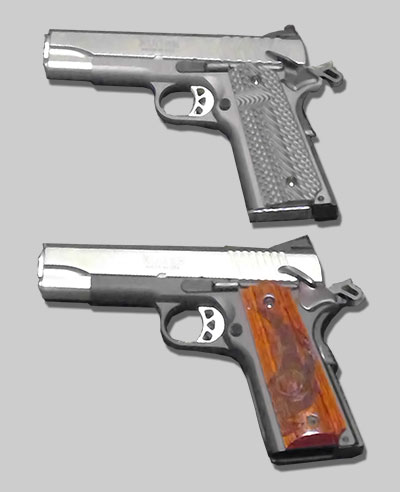
Ruger 9mm and 45ACP 1911sThe Ruger 1911 LW CMD has been one of my favorites. When Ruger announced they were coming out with a 9mm version of that handgun, I put my name on the waiting list because I knew it would be popular and that I should evaluate one for the benefit of my students.

I bought the first one that came into our shop and the other two sold almost immediately. We ordered more as soon as we could.

It came with black rubber grips. Those didn’t appeal to me, but I’ve got a drawer full of 1911 grips (try Amazon.com) so I swapped out the grips. That’s the 9mm at the top in the picture. The one on the bottom is my .45 ACP LW model. As you can see, they changed the color scheme slightly, but everything else looks pretty much the same. The trigger is the same, the sights are the same. The cocking serrations are slightly different, but other than that, it’s really hard to tell the difference.

Some things I noticed when holding the gun and checking it out:  1) it is easier to rack the slide on this gun compared to my other 1911s and most of the double-stack 9mms I have. 2) it has some side-to-side motion in the slide that I thought might affect accuracy. It doesn’t. 3) it was very difficult for me to load rounds into the magazine. So difficult, I couldn’t do it with out resorting to my UpLULA.

Today, after our License to Carry class had finished shooting and we were packing up to go back to the shop I told my instructors I had 4 magazines loaded. Some were loaded with ARX and some were loaded with 124 Grain Gold Dot JHP. That’s the heavy end of the spectrum and the light end of the spectrum as far as 9mm rounds go. We hung a target and pushed it downrange approximately ten feet.

I shot the first magazine, resulting in 10 shots (I had one in the chamber) in pretty much the same hole. The target was approximately 10 feet away. Each of the instructors at the range with me picked a different aiming spot and emptied a magazine with the same results, one ragged hole. The gun did not care if it was 80 grain ARX rounds or 124 Grain Gold Dot HP rounds. It handled them all the same.

The three guys who didn’t own the gun, each placed an order.

Here’s what I know about the magazines. I don’t think Ruger has made the wisest choice in selecting who makes their magazines. They work, but they don’t load well and in my .45 Ruger 1911, I can’t make the slide go forward with an empty Ruger magazine in it. I told their product manager about it and he didn’t seem to think it was an issue to be concerned about (meaning, probably they have a contract and are committed). I solved that problem by buying some Colt magazines to use with the Ruger. In the .45 platform they hold an extra round even with the flush base-plate, so they have become my go-to source for .45 ACP 1911 magazines. The Colts work in everything.

When I discovered the loading issue with the 9mm magazines, I ordered to 9mm Colt magazines. They’re easy to load. When we shot today, we shot with two of the Ruger magazines and two Colt magazines. As far as shooting goes, the gun didn’t care. They all worked the same. It’s just that the Colt magazines are much easier to load.

The shooting experience was pleasant. One of my instructors who previously didn’t like the Ruger 1911s (he’s a Springfield guy) said this one shoots much better in his opinion.

I believe this is going to be a mainstay. I know mine will be on my belt often.

Real Life Examples of Why Carrying “Enough” Gun Matters

I have long been an advocate of carrying a gun that holds more than five or six rounds and in a caliber that everyone agrees would do some damage. When I speak on this subject it’s from more than just a personal preference but from the point of view of an instructor who has some personal experience, but who has also thrown his life into studying everything he could get his hands on. Often, I’m simply ignored. “The guy at the gun store told me this would be enough gun,” seems to be the common response. I sure hope the guys at MY gun store didn’t tell you that!

I decided to aggregate in one place some of the incidents that have shaped my thinking so that my readers can understand it’s not just me that’s saying it. Let’s look at some real-life incidents and see what conclusions can be drawn from them

Incident 1:

Glock21

August 25, 2008, Officer Tim Grammis of the Skokie, IL Police Department found himself engaged in a firefight with a fleeing bank robber, who did not want to go back to prison. In the ensuing gun battle, Officer Grammis emptied two magazines of .45 ACP from his Glock 21 at the robber and was on his third when the robber, Raymond Maddox, stopped shooting. Reconstruction of the episode revealed that 54 rounds had been fired during the incident, 33 from Officer Grammis. Autopsy results revealed that 17 of Grammis’ 230 Grain Speer Gold Dot Jacketed Hollow Points had struck Maddox. Some had struck extremities but Maddox had also been hit in one kidney, both lungs and his heart. The last three rounds that Grammis fired had hit Maddox in the head, but two were in the face. Only the last had pierced his brain and ended the fight. Arguments that he was on drugs and that’s why he didn’t succumb easily when shot were nullified when autopsy results revealed he was totally drug-free at the time of the incident. You may deduce from this incident that if even the big gun wouldn’t stop this guy, why carry one? I would argue differently. My thoughts on it are if it’s this hard to stop somebody, I need to start with something that might have chance instead of something that would just irritate him.

Incident 2:

Taurus738

Tammy Sexton, age 47, was shot in the head with a .380 by her estranged husband. The bullet struck her square in the forehead and exited the back of her head.  Sheriff Mike Byrd of Jackson County, MS said, “When a sheriff’s deputy responding to a disturbance call arrived, she met him at the door holding a rag on her head and talking. She was conscious, but she was confused about what had happened,” he said. “She had made herself some tea and offered the officer something to drink.” Byrd said the bullet passed through the lobes of the woman’s brain without causing major damage.

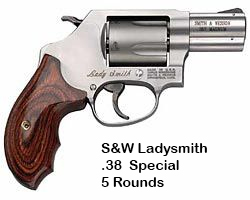
Ladysmith

Incident 3:

January 8, 2013 – Melinda Herman was working at home when a man began to ring the doorbell. She called her husband at work, who told her to gather their 9-year-old twins, a boy and a girl, and go hide. All three of them went to an upstairs crawl space, and Melinda brought along a .38 caliber handgun to the hiding place.

The man broke into the house and rummaged around before making his way to the crawl space, where he found the mother and children hiding. Melinda shot the intruder five times, hitting him in the face and neck. She told the man if he moved she would shoot him again, although she had run out of bullets.  The intruder, who police identified as 32-year-old Paul Slater, managed to get to his car and as he tried to flee, crashed into a tree.  That’s five times in the face, folks, and now the gun is empty, but the guy is still on his feet!

Incident 4:

October of 1997 – Jacksonville, Florida officer Pete Soulis made contact with a suspicious driver, Joseph McGrotha, at a gas station.  McGrotha produced a 9mm handgun, firing one round into Soulis’ chest (it was stopped by his armor).   Before it was over Soulis was shot three more times while shooting McGrotha 22 times, 17 of which were described as “center mass.”   It would take McGrotha as long as 4 minutes to die after the last shot was fired. Officer Soulis service weapon was chambered in .40 S&W, Winchester Ranger SXT rounds.

I’ve been aware of various studies about what happens in real-life scenarios, including the one by Tom Givens of Rangemaster Training in Memphis, who has been able to track graduates who have been involved in shootings over a twenty-five year period and whose findings I’ve quoted in some of my training. The results of Tom’s research indicate that encounters involving firearms are usually 3 shots within 3 seconds from 3 yards or less, with the success rate from pocket guns being something like 50%, meaning the good guy lost about 50% of the time. Not very good odds in my book.

I recently came across another study conducted in central Texas by Karl Rein of KR Training in which he put students to the test with pocket guns and with medium to full-size guns. It’s an interesting study that you can read about here at usconcealedcarry.com/is-a-pocket-gun-enough. If you don’t have the time or inclination to read it, here is his conclusions:

Data analysis indicates that a five-shot .38 probably holds enough ammunition to handle 70 percent of all likely situations. In the hands of a “low skill” shooter (anyone lacking training beyond the CHL level), the odds of getting acceptable hits are poor; that group averaged 57 percent on the test. When those two probabilities are multiplied to calculate total probability, the result is 40 percent, which isn’t great, but is better than 0 percent (no gun).

What’s interesting to me is that the majority of the comments following Karl’s article are justifying anything from .32 to .380 to .38 caliber guns and basically telling him his research is full of it.

TaurusPT111

I want my loved ones, my students and myself to have a much better success ration than 40% if we’re ever involved in an armed encounter where we are fighting for our life. For this reason, I do my best to teach people to shoot and carry handguns that are at least 9mm with 10-12 rounds of ammo or more. Keep that pocket gun around as a backup for when you’ve run your fighting gun dry.

The Taurus PT111 is just one of many choices for a decent-sized, affordable carry gun in a caliber (9mm) and with a capacity (13 rounds) that should provide adequate protection in almost any civilian armed encounter imaginable. If you’d put this gun up side-by-side with most of the popular pocket guns you’d have a hard time making the argument that you could carry one, but not the other.

Subjective Comparisons – They Matter, Too!

Some things you can measure:  height, width, weight, trigger pull, magazine capacity, barrel length, etc. Some things are totally subjective. You may like or not like something and not be sure why, or at least not be able to explain it to someone else. That doesn’t mean your subjective comparisons aren’t important. I think you should like the car or truck you drive, even if no one else does. I think you should be happy with how you dress, even if other folks think it’s funky. Objective is facts; Subjective is feelings.

Why am I on this rant? Because I’m on my fourth day of feeling really good about carrying a gun I’d never really thought about until a few  days ago. For the best part of this year my carry gun has been a Sig, either a 1911 Commander or a P229. Occasionally, I carry a S&W M&P. If it were just me, I’d have no real reason to change this trend. But, I’m not just me, I’m the head of an organization that’s goal is to train and equip others to defend themselves with a handgun. I take this responsibility seriously, so I make it a point to familiarize myself with a variety of options, because one person doesn’t necessarily like, feel comfortable with, or can afford, what’s right for someone else.

I practice drawinPractice Drawingg and aiming my pistol multiple times a day, no matter what I’m carrying. While doing these drills with the CZ-P07, I found it darn near as comfortable as my 1911. Knowing this was probably just a subjective observation, I decided to do a little testing.

I unloaded and placed 4 handguns on a table. The P07, a Glock 23, the Sig Legion P229 and an M&P .40. I closed my eyes and had my wife mix them up. Then I picked them up one at a time, still with my eyes closed, feeling and pointing and trying to decide just from feel which one I liked best. Of course I could tell them apart since I’m very familiar with all four.

For Comparison

I had my wife do the feel test, then I had two of my grandsons try it. Funny, both the boys picked the P229 as their favorite, while the wife and I both preferred the P07. I thought for a minute she was going to go for the Glock and had it been a Gen 3, I believe she would have. But the texture on the Gen 4 grip wasn’t comfortable for her.

The boys liked the tactical feel and the heft of the P229, but they didn’t know what it was when doing the test.  When you consider you can buy two P07s for the price of the Sig Legion P229, it seems to me a pretty good endorsement that at least 50% of the testers (admittedly a very small group to start with) like it best.

I’m going to keep on carrying it for a few days and I’m going to shoot it some more. It remains to be seen whether or not I’ll go back to one of the Sigs for daily carry.

UPDATE July 5:

I keep putting his gun on every morning. It is still very comfortable to wear and my daily drawing drills are right on the money. This is definitely a great handgun for Every Day Carry.

CZ-P07 – This Could Easily Become a Personal Favorite

In Europe they love CZ pistols like we love 1911s. I guess when I say “we” in Europe I’m mostly talking about police and military since very few countries outside of Switzerland allow their citizens the freedom to own and shoot firearms like we have here in America. Česká zbrojovka Uherský Brod is a firearms manufacturer in the Czech Republic responsible for some of the finest-made firearms in the world. They make pistols, rifles and shotguns that are held in high esteem in the military, hunting, sporting and personal protection arenas. In the US these are imported by CZ-USA.

The most popular of their handguns since before WWII has been the CZ-75 of which there are many models. There are also many clones. I first came to know this style of pistol through the EAA Witness and the SAR B6 and K2 models imported by European American Armory. These are all clones of the C-75 and my experience with all three of these models has led me to like them, trust them and recommend them for several years now. Throughout those years, I’ve owned several EAAs and SARs but I’ve never actually owned a CZ manufactured version. Until now, that is.

CZ P07The original CZ-75s are all steel. They have several models such as the 75, 85, Compact, and others with differing features such as size, finish, capacity, caliber, etc. The one that I felt I just had to own is the CZ-P07. As you might surmise, the “P” stands for Polymer and I’m guessing the ’07’ means it’s a James Bond gun. Oh, wait, not enough zeroes. Okay I think the 07 has something to do with size, since I know the P09 is bigger and maybe the P05 and P06 are smaller. We gun guys can’t know everything.

What I do know is I really like this gun. I know what you’re thinking . . . “but, David, you like ALL guns!” Well, that’s simply not true. I’ve handled guns I don’t like and I’ve handled guns that I’m just indifferent about. For me to like them they have to 1) feel good in my hands, 2) fit my hands well, 3) have good sights that I can easily pick up and align, 4) have a decent trigger, one that is easily operated without pulling the sights off target, 5) be absolutely flawless in operation under normal and sometimes a bit stressful conditions, 6) be of a caliber that makes sense for it’s purpose, 7) be affordable and 8) be comfortable to shoot. The CZ-P07 passes all of these tests.

But if you’ve already got your gun needs and a lot of your wants covered, there has to be something else, doesn’t there? Otherwise, it’s a “ho, hum, just another gun.” This gun looks like a real gun to me. It’s a bit futuristic, but frankly it looks all business. It’s got the different-sized backstraps that are commonly offered with modern firearms, so it was no trouble to make sure it fits my hands. When I pick it up or pull it out of my holster it’s in the right place in my hand, ready to go with no shifting around. The sights line up and I can easily put my finger on the trigger with the proper positioning.

The slide-lock lever, which doubles as a takedown lever, is big and it’s flat with a surface that’s easy to work. There’s a decocker. The grip surface has just the right amount of aggressiveness to make the gun easy to hold onto without hurting my hands.

I tested it with my common defensive rounds:  Ruger ARX, Speer Gold Dot and Fiocchi JHP. It did what I expect a carry gun to do, which is shoot one ragged hole at 10-12 feet and keep everything in a fist-sized grouping at 20-21 feet. If it can do that it will keep the shot placement relatively tight at 15 yards.  I don’t have a bench rest and my personal arc of movement is enough not to blame the gun for what happens at 15 yards.

So, I’m carrying it for a while. It’s comfortable, fits in my P226 D. M. Bullard leather holster, and draws easily. If I have to use it, I’m confident the results will depend a whole lot more on me than the gun. It will do its job.

Ruger Single Six and Single Seven — A Pair of 32s

I would have love to have written “A Brace of 32s” in the title, but I can’t because they’re not exactly alike. They’re close, however. I’m referring to a couple of Ruger Single Action Revolvers that have made their way into my collection. One is a Ruger Single Six .32 H&R Magnum and the other is a Ruger Single Seven .327 Federal Magnum.

Ruger Single Six and Single SevenKind of look alike, don’t they? It really is hard to tell them apart, but one does hold six rounds and the other seven. Up to a point, they both shoot the same types of ammunition. They both shoot .32 S&W Short, .32 S&W Long, .32 H&R Magnum, but only one of them, the Single Seven, also shoots .327 Federal Magnum.

I took them to Mississippi recently and thought they would be part of my family shooting adventure back on my grandparent’s farm. But rain shortened our outing and these never got fired. I really wanted to compare them, so I took them to the range last Sunday afternoon and put them through their paces, which for me simply means running a target out to 10 or 12 feet and punching holes in paper.

I didn’t have any .32 Short ammo on hand so I started with the .32 S&W Long. With that ammo you couldn’t tell a bit of difference in the two guns except for the fact that one shoots seven rounds before reloading while the other only shoots six. As far as shot placement, recoil (or lack thereof), sights, grip, etc. I could tell no difference.

Then I loaded them with .32 H&R Magnum cartridges. Still, there was no discernible difference. You can’t shoot .327 Federal Magnum in the Single Six, so I set it down and loaded the Single Seven with some Gold Dot .327 Federal Magnum. Loud – it’s loud! And the paper goes flying back when it is struck by one of the bullets propelled by that cartridge. That’s always fun to see, because even my .357 Magnum doesn’t send the paper swinging like the .327 does.

Okay, I know what you’re thinking. Just what are these guns good for? I could probably crank up a Earth, Wind & Fire record for you and let them declare “Nothing! Absolutely Nothing!” and you might agree. But – they really might have some use. For me, it’s just fun, or perhaps the fun of letting someone else have some fun while I watch. But  there was a day when I’d have used either one for rabbit or squirrel hunting. Or to keep the critters out of the hen-house. These days I don’t have a hen house, but I do have snakes and the .32s make a pretty good snake gun.

Way back before we knew better, cops in Europe considered the .32 enough gun. Even Teddy Roosevelt had some on the force when he was Chief of Police in New York City. But these days, we all pretty much understand it’s not such a good self defense caliber.

That’s not true of the .327 Magnum, however.  Here’s a little ballistic chart for you:

Cartridge Bullet Wt. Muzzle Vel. Ft./lbs Energy
.32 S&W Short 85 680 87
.32 S&W Long 98 778 132
.32 H&R Magnum 80 1150 235
.327 Fed. Magnum 100 1500 500

How about that .327 Federal Magnum? Not, too shabby, huh? It’s actually a favorite caliber of mine for personal defense, but of course these guns are little larger for daily defensive carry. But for a packing gun, on the trail or camping out, either would be ideal. And for just plain plinking fun, the .32 ammo isn’t very expensive and is still readily available. So, two Rugers for fun, that will belong to some of my grandkids someday.

How Important is Comfort Level?

In 1969 my employer had a Chevy pickup that I drove for work. Something about it didn’t feel right to me. I’d owned and driven an older Ford truck for years and the seating was just different. In the Chevy I always felt like I was sitting too far forward and leaning over the wheel and I never could find a seat adjustment that felt right to me. Chevy owners in that time frame probably would have had the same discomfort level driving a Ford.

What’s that got to do with guns, you ask? Hold on, I’ll get there, but I want to fast-forward this auto analogy a bit. I drive a Jeep Wrangler Unlimited. I love it! My wife drives a Denali SUV. She Comfort Zoneloves it. I don’t like getting in her vehicle and she doesn’t like getting in mine. We don’t particularly enjoy driving each others’ vehicles, either. Why? The seating and mirror adjustments are off, the controls are different, the accelerators require a different touch – they’re just different. But they’re both excellent vehicles and they are up to the tasks we expect them to perform.

Now to the guns. A few weeks ago I wrote about comfort while carrying a gun. Today I’m writing about comfort while shooting a gun.

In the past several weeks I’ve shot four different handguns to test their functionality with several types of ammunition, with the added goal of just staying in practice. The guns were a S&W M&P .40 ACP, a Sig Sauer P229 Legion 9mm, a .45 ACP Sig Sauer Commander-sized 1911 and a Glock 23 Gen 4. I was satisfied with how each of them handled the ammunition I fed it, which was a mix and match combination of Ruger ARX, Speer Gold Dot JHP and Fiocchi JHP. These are the rounds I primarily depend on for personal protection.

Results on the target were not much different from one gun to the next, with the exception of the Sig 1911. That particular SIG allows me to consistently put all the rounds I shoot into a small ragged hole, usually the size of a 50-cent piece from a distance of 10-12 feet. With each of the the other three I was successful in creating a tennis ball size ragged hole with some scattered rounds an inch or two outside that hole.  Any one of those handguns would be “comforting” to have in a defensive situation.

But this article is about being comfortable, not just having something that is comforting. I’m always comfortable shooting that Sig 1911. The aiming is natural and consistent. I never even think about trigger pull, it just happens as I’m squeezing the trigger and I get the results I want almost every time. The sights line up naturally without me even thinking about it.

The M&P is the same way. I’ve always felt the S&W M&P was one of the most comfortable guns to hold and shoot. I keep one by the bedside and my wife has one on her side of the bed. I like it as a carry gun, especially now that I’ve learned I can shoot .40 caliber ARX ammo comfortably. If I wasn’t such a 1911 fan, the M&P would probably be my every day carry gun.

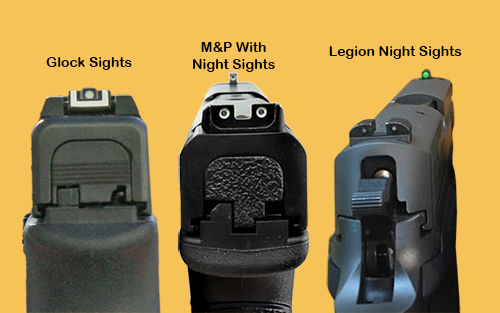
The other two guns give me pause when I’m shooting them, especially the Glock. There’s something about the Glock sights that just doesn’t work for me, especially on follow up shots, like when you’re doing a double-tap or a timed drill. It takes me a couple of seconds, to get those sights lined up and I’m always squinting or moving my head around to get the proper sight picture.

The sights on my Sig P229 Legion are very close to the Trijicon night sights I prefer on my carry guns  but with an improvement that sets them apart. The dot on the front sight is a different color and is slightly larger than the rear sights, making it easier to pick up.

Here’s picture of the different types of sights I encountered during these shooting trips. Yes, I know the sights are not aligned for hitting the target, but this will work for illustration purposes.:

Handgun Sight Differences

The SIG 1911 has sights almost exactly like the M&P in the center. Maybe, that’s a big part of the reason I feel like I shoot these guns better, the fact that the sights are familiar to me and I like them. But I don’t think that’s the biggest reason. I do struggle with the Glock sights, and I don’t struggle with any of the others, but I think the biggest reason might be grip. The M&P line has always enjoyed a following because it fits the hand so well and something about the angle of the grip and the alignment of the bore axis makes for less “felt” recoil than many other handguns of similar size, weight and caliber. I put “felt” in quotes because recoil is somewhat subjective. There are ways you can measure the foot-pounds of pressure being exerted on the hands, I guess, but what we shooters deal with is what we feel, not necessarily what’s actually there.

Between the Glock, the Sig and the M&P, the M&P just feels better in my hand, I line the sights up quicker and when I shoot it, I feel less recoil, all of which make for a better shooting experience as long as my rounds hit the target where I expect them to.

Between the Glock and the Sig, I like the Sig better. It’s got a better feeling trigger and the sights work well for me.

Among them all, however, I still pick the 1911 as the one I am the most comfortable shooting. Do you know what that translates into? I’ll choose to shoot it more often, which means I’ll practice with it more often and I’ll get better and better with it.

That’s why comfort is important.

The Reason We Sell

(Note: 8/6/2021 — I wrote this article when I owned a gun store. I no longer do so I was thinking about removing the article from my blog site. But I read it and I still believe everything that’s written here. So I’m leaving it because it might help somebody someday.)

I read most of every gun magazine that hits the stands. I’m a gun guy and a firearms instructor and much of the information that’s in those magazines helps me be better at what I do. That said, I can’t help but notice most of the wording on the front of the magazines, in the advertisements and in the article titles is designed to sell guns. “Rimfire fun! .22 Long Rifle Conversions”, “.45 ACP PERFECTION!”, “Sexiest XDm Ever!”, “9mm CC Shoot Out!” Makes you want one, right! Or two, or all of them!

Hi Cap .45I’m all for selling guns. I’m in the business. And like any business owner, I’ve got rent to pay, suppliers to keep happy and employees I want to take care of. I can’t do all of that without selling guns, along with the ammunition, accessories and training to go along with them. But to me, it’s not about selling merchandise as much as it is about helping people. You see, deep down in my heart of hearts I believe people should be able to defend themselves. I believe they should be able to stand up against a tyrannical government, if it becomes necessary. And I believe people in a free country should be able to responsibly own guns because they’re cool, they’re fun to shoot and frankly, just because they want them.

So I’m not down on the fancy, eye-grabbing magazine covers or article titles designed to create the desire or need for this firearm or that firearm. But I am down on some of the marketing techniques that suggest to people that are brand new to firearms that this is the gun they need to own, when in fact it probably isn’t.

Let me give you some examples. A recent article in a popular gun magazine  was titled “Today’s Top 12 Concealed Carry Pocket Pistols”. The intro went like this:

Want something that is powerful and portable? Compact yet capable? Omnipresent but not overwhelming? Well, there are many choices out there, with a broad selection of compact autopistols and revolvers (as well as interesting derringers and the like) in powerful and capable chamberings available.

The listing started off with the S&W Bodyguard .380 auto pistol. Okay, I will sell you one of these if you give me every indication that you know what it is and why you want it. But if you’re a first time pistol buyer, especially if you’re  woman, I am not going to sell you that gun without insisting first that you go rent one and shoot it. Even then, I’ll want you to look over some of the ballistics charts and hopefully, understand just why a .380 is such a minimal caliber for personal defense.

The other day one of our students showed up at a Handgun 101 class with a Ruger LCP.  Not a Ruger LC380, but an LCP. She wanted to learn everything about her gun because the next day she was coming to a License to Carry Class. I must confess, without singling her out, I kind of dissed her gun. Not hers specifically, but I did talk about little guns, little calibers and the shortcomings of them, pointing out that it’s not just about the effectiveness or non-effectiveness of the .380 round. I discussed recoil and how difficult it is for a small lightweight gun to absorb recoil, leaving your hands to do it. I discussed additional facts that in my humble, but somewhat educated and informed opinion, are important to know. Facts like:  the little guns like the bodyguard don’t hold much ammo, they don’t offer much to hold on to, they have a short barrel and short sight radius and in general are just not very easy to shoot accurately and effectively. And most importantly, the ammunition they shoot is not very powerful compared to just moving up one notch in caliber.

The student in my class smiled throughout my little discussion and seemed to not have her feelings hurt. The next day she passed the License to Carry Shooting qualification with her bodyguard. She passed, but not with flying colors. She asked the instructors if she could shoot again with another group, this time using one of our 9mm handguns. They pulled a SAR B6 9mm out of our loaner bag and she shot the qualification test again, this time with a much higher score.

In my mind the bottom line of this story should be that she came back to our shop and bought a SAR B6. But that’s not what happened. She’d spent hard-earned money on that Bodyguard and at least for now, that’s the one that will have to do.
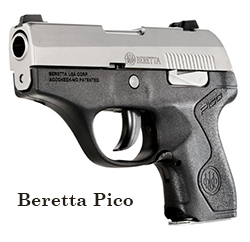
Beretta Pico

Okay, here’s another article, this one from Personal Defense World. The article’s title was:  380 Pocket Pistols Under $700 That Deliver Instant Self-Defense.  The first gun on their list was a Beretta Pico. Now I love Berettas.  The M9, the PX-4 Storm — these are great pistols. The Nano, not bad, but the Pico is just too darned little.

Here is how they tout it:  “At only 11.5 ounces, the ultra-compact Beretta Pico pistol is easy to carry all day long. Chambered in .380 ACP, the Pico was designed by Beretta to be flat and snag free, so that it slips into a pocket or holster without any obvious bulges.”

No doubt it’s easy to carry, but as I’ve said to my students many times. Carrying isn’t the objective. Defending yourself is. If the only objective is to carry, we’d all carry lightweight, snag-free tiny little pocket guns. But the objective is really to have a gun that will defend you.

I’ve yet to see any of the Picos shot in my classes fire more than two or three rounds without some type of stoppage. It’s probably not the gun, but the shooter, trying to hold the gun in way that lets it function.

My purpose in this article is not to be critical of a bunch of different guns, but to make you think twice about whether or not the gun you want to carry for personal defense will actually do the job of defending you.

I bought a little .380 myself. It’s a Taurus 738 that fits in a little pouch that you can put on your belt and most people would think it’s cell phone or PDA. I shoot it occasionally, just for fun. But do I carry I carry it for self-defense? Only if I want an additional backup gun.

Shoot Like a GirlI want you to think about something. What kind and size of guns do the police carry?  What kind and size of guns to the LTC instructors you may know carry? You don’t find them carrying little guns. You don’t find them carrying small calibers. Or, if you do, I can almost guarantee you they are new to the business. Those of us who have really studied what goes on in the real world, those of us who have shot a lot of different guns, those of us who have studied real-world ballistics, rather than the fancy headlines in magazines and advertisements, are pretty careful about what guns we carry. Those of us who are instructors and who sell guns, have totally different perspective on what we recommend than does a typical gun salesman in a retail establishment.

Let me suggest to you that before you buy your next gun you seek out a veteran instructor. Let that instructor talk to you about your shooting experience, about your need for the gun, how you intend to use it. Then try to shoot one if you can. I’ve told the guys at my shop that if it’s not the right gun for you, they can only sell it to you if you have been advised of how it may or may not work for you and you are twisting their arm and throwing money at them.

We need your money, believe me, we do. But we want you to have a gun, or guns, that you like to shoot and can shoot well, and which will stop bad guys if that’s what you need. If you just need the gun to punch holes in paper or put game on the table, maybe it’s not as critical. But if there’s a chance you would have to use the gun to defend your life, we want it to be capable of doing that. Let me say that another way. If you’re a lady, I wouldn’t sell you a gun for personal defense that I wouldn’t provide for my wife for that same purpose. If you’re a girl, I’ll have to take that analogy to my daughters-in-law and my granddaughters because I don’t have a daughter, but you get my drift.
Comfortable or Comforting – Why Not Both?

Clint Smith, well-known firearms and self-defense trainer has a saying:  “Carrying a concealed handgun is not supposed to be comfortable, but comforting.” Okay, if you can’t comfortably carry, I guess I can go with that. But, I carry comfortably every day, and I know others who do as well and most of us carry BIG guns.

Here’s another saying that has merit:  “Same gun, same place, every day.”  I don’t remember where I heard that one, but I’m pretty sure it was another well-respected firearms trainer. If I were just an armed citizen, I’d probably go with that and if I did, it would probably be my Sig Sauer 1911 Emperor Scorpion Commander. When I do carry that gun, using my D.M. Bullard belt, IWB holster and dual magazine carrier for my two spare magazines, I rarely give it a second thought except to touch it from time-to-time to remind myself it’s there or to practice my draw, which I still do several times a day. When I shoot that gun, it goes “bang” every time I pull the trigger and the bullet holes go right where I expect them to go. I have confidence in that rig and I find it both comfortable and comforting.

I’m not just an armed citizen, however. I’m an instructor, certified by the Texas Department of Public Safety, the National Rifle Association and Texas Law Shield, entrusted with the responsibility to help other armed citizens prepare to defend themselves and their families, should the need arise. And I’m a firearms dealer. So with those added responsibilities, comes the need to broaden my experience so that it encompasses a variety of firearms and carry rigs. In order to honor that responsibility, I make it a practice to carry different guns from time to time.

You might be surprised by the size of them. My first daily carry gun was a Taurus 24/7 Pro. After that a Smith & Wesson M&P. Both guns are available in 9mm, .40 S&W and .45 ACP, all with the same external dimensions, so carrying a .45 takes no more space than carrying a 9mm.  For a while I carried a Springfield XDm 45 with 4.4 inch barrel. Each of these guns I’ve carried in an inside-the-waistband (IWB) holster worn at approximately 3 o’clock with one or more spare magazine pouches carried IWB at 9 o’clock.

When I joined the 1911 bandwagon, it was with a Commander-sized handgun. In 1911 parlance, Commander means 4.25 inch barrel, full-length grip. Sometimes you’ll see the barrels as 4 inch or 4.2 inch, but generally 4.25. I find I can carry a Commander-sized 1911 with 9 rounds of .45 ACP, using a Colt flush-bottom magazine and I’m both comforted and comfortable.

What about other guns, those bigger ones I mentioned? All this week I’ve been carrying a Sig Sauer P229. I had ordered a D.M. Bullard holster for a P226, knowing it would also fit a P229 and just to make sure I wouldn’t be misleading anyone if I recommended it, I put on that holster, along with a dual mag carrier that holds two double stack 9-mm magazines, and here it is Thursday and I can’t say I’ve had an uncomfortable moment. That’s a nice gun, sixteen rounds of 9mm in it and 30 more rounds in case the terrorists show up when I’m eating lunch somewhere or maybe even at my office.IWB Carry

These pictures are not me. This is just a new shooter, trying stuff out, but look, he’s already figured out he can wear his shirt tail out or tuck it in, and he can keep his gun hidden from prying eyes, even when it’s not a tiny pocket pistol.

This is repetitive from some of my earlier articles, but here it is one more time:

  1. Get a GUN belt – not just a regular belt. A GUN belt – thick leather, two layers, made specifically for guns. I have belts made by Crossbreed and by D.M. Bullard that fit the bill.
  2. Buy your pants a little larger than normal, maybe even two inches larger, you’ll have to experiment. Most of my pants have some elastic in the waist, so that helps, but for you skinny guys and gals, just buckle down and buy you some bigger pants.
  3. Get a good IWB holster from somebody like D.M. Bullard and White Hat (we sell both of those at Texas Gun Pros), Alien Gear, or Crossbreed. I’ve heard others rave about Milt Sparks and Galco, but I tried both of those and went back to my Crossbreed or D.M. Bullard holsters. Probably just a matter of preference.
  4. Get a spare magazine carrier to go with your holster. You can’t carry too much ammo. All of that “if I can’t get them in 6 shots . . .” is head-in-the-sand baloney. You do not KNOW what you might encounter from which you would need to defend yourself or your family.
  5. Wear your gun and your spare magazines every day, all day. If it’s not comfortable at first, make small adjustments here and there until you are comfortable. You can comfortably carry.
  6. Summertime, wintertime, it makes no difference. A gun on your hip doesn’t care how long your pants are, so all of this “I need a smaller gun in the summertime” just doesn’t make sense if you REALLY DO WANT TO DEFEND YOURSELF or your family.


Personal Preferences – As Varied as the People Who Have Them

I’m very careful about recommending a gun to someone else. I can tell you if a choice is a bad one for you, based on my experience training a lot of shooters, but among the many good choices, I can’t pick a gun for you. It’s just too personal. I spend a lot of time reading. I read every issue of the fifteen or more gun magazines that are available here in the U.S. I read the letters to the editor first, then the gun reviews, followed by the training articles. I often find the gun reviews amusing as well as informative. That’s because every gun writer has his or her prejudices and these color how they review a gun. Some love 3-dot sights, others hate them. Some like big thumb safeties on 1911s, others like little bitty ones. What’s funny about it is they often write as if their particular preferences are the ones everyone should have. But in all fairness, many mention them as just that — personal preferences.

Just for grins I thought I would tell you what I like in a handgun and why. There is one given I can get out of the way quickly. I want a gun that is very tolerant of a variety of ammunition and that if kept relatively clean works 100 percent of the time.  But what else?

Trijicon Night SightsI like night sights. All of my defensive guns don’t have them, but most do. It’s not just for shooting if the light is low. I like them because if I need to locate the gun quickly when startled awake at night, or if the lights go out, the sights beckon me.

I like grips that aren’t too rough. Some of those tactical grips people put on handguns are very uncomfortable to me. A textured or checkered pattern is welcome, but don’t make it too rough because I rarely wear gloves. Tactical operators that wear shooting gloves when heading for a fight — those are the ones that like tactical grips.

Checkered Front StrapFor a 1911 type gun I like a checkered front strap and back strap. I’m not sure why, but they just feel better in my hand. One of my favorite guns, a Colt Commander, doesn’t have a checkered front strap, though the back strap is. I love the gun, but I find myself wishing the front strap was checkered. There is an aftermarket solution I tried for a while, but it didn’t stay in place well. I may try again with some type of adhesive.

Except for single-action handguns that are carried (at least by me) cocked and locked (hammer back, safety on) I don’t like external safeties on handguns a couple of my guns that have them, if I’m carrying the gun I leave the safety off so there won’t be an added complication should I need to draw and shoot.

Ambidextrous SafetyOn my 1911s I like a an ambidextrous safety and I like the over-sized ones. Why? For a reason that may not be applicable to many people, but I carry my defensive pistol in an inside the waistband (IWB) holster worn at the three o’clock position. With the gun in that position, the safety is against my body so it’s not really  easy for me to check, as I periodically do, to make sure the safety is still on. With a safety on the right side of the gun also, it’s very easy to check the safety to make sure the motion of my body hasn’t pushed it off.

When it comes to 1911s, I could care less about whether it has a Series 70 or Series 80 firing pin system. I cannot tell the difference when shooting the gun and both offer the safety I desire. But when it comes to guide rods, I prefer not having a full-length guide rod. Some 1911s have that, others don’t. For me the difference is simple. It’s easier to disassemble the gun for cleaning with a short guide rod than with a full-length guide rod. Does it change how the gun shoots? Nope. Does it change its reliability? Nope. A full-length guide rod, as far as I’m concerned isn’t a red flag that would keep me from buying an otherwise desirable gun, but my preference is to not have one.

Caliber – I like a .45. But sometimes I carry a 9mm. I used to carry .40 S&W from time to time, but the arthritis in my hands and shoulders makes shooting a .40 uncomfortable. Even with the .45 I’m tending towards rounds with less recoil (think ARX). I’ve covered this in so many articles before, I won’t take up any more space here.

Handgun With RailRails – should your gun have a rail or not?  I think that one depends on where you’re going to use the gun. I have an M&P in the bedroom with a Streamlight flashlight/laser combination, so the fact that gun has a rail makes it work. Some of my carry guns have rails and all they are good for as far as I’m concerned is making me choose a different holster. I personally will not have a light on a carry gun because I don’t intend to open carry and having a concealed carry rig big enough for a light or laser on the rail just isn’t feasible. Besides, I don’t anticipate the need in a defensive gun that I carry.

Striker-fired versus hammer-fired. For me this makes no difference, but I read a lot of handgun guys that say they don’t like the idea of a double-action first shot followed by single-action for the follow up shots. Many seem to imply this is a training problem. I guess if you just don’t shoot much it could be, but I don’t seem to have a problem adjusting quickly to whatever gun I happen to be shooting. So I have guns with hammers and I have striker-fired guns and I just shoot them without worrying about it. If a semi-automatic has a hammer, it usually has a de-cocker, and I like the fact that I can de-cock the gun and put it back in my holster. The striker-fired guns don’t have that.

How about the finish? On some guns you have the option of stainless steel versus a blued finish.  I like stainless steel. Wait, I like blued. I like polymer finishes. I like bi-tone guns. Okay, too many choices. Let me back up and pick just one. Hmmmm. I have this desert tan, Marine Colt that looks pretty nice. But I keep eyeballing the Metro Arms Chrome Commander. Then  there’s the deep blued finish on the Remington R1. See, it’s hard to choose. Mix them up and get some of each, that’s what I say!

Triggers. If there’s anything gun guys love to hate it’s a certain trigger or trigger pull. But what some folks hate, others love. Really heavy double-action trigger pulls, I don’t like, but beyond that, I just don’t seem to be as “trigger sensitive” as a lot of guys. I find the trigger on most guns pretty easy to get used to if I just shoot it a few times. When you’re picking a gun, you do need to make sure the trigger pull isn’t too hard. Anything over 12 pounds for me is just not something I want to deal with. I will say that 1911 triggers, which move straight back as you pull them and which usually have somewhere between 4 and 5.5 lbs. of “pull”, are a pleasant surprise to people who have previously only shot handguns with hinged triggers, which is what basically every other type of pistol has.

Undercut Trigger GuardI could cover many more details that people either like or don’t like about guns, but I’ll stop with just one more. It’s something the writers usually call “undercut” and it applies to the trigger guard. The purpose is to allow you to get a higher grip on the frame which mitigates some of the recoil. I was reading about some of the new Sig Sauers the other day and the writer was talking about how they had an undercut trigger guard which was an improvement over earlier models. I started looking at my Sigs – an SP2022, a P226 and an M-11, which is really a P228 in military dress, and a couple of 1911s. All of them except the 1911s have an undercut to some degree or the other. The picture I’ve used as an undercut example here is actually on a Glock, but it’s not stock. It’s a gunsmith enhancement and you may notice, it was done by cutting a way a significant portion of the stock trigger guard. I’m for anything that mitigates recoil, so I’ll say that’s a good thing, but I’ll also tell you have guns I love to shoot that don’t have that undercut.

You will develop your own preferences over time. Maybe you have already. It’s kind of what makes selecting a firearm so personal.