Major manufacturers such as Glock, Kimber, Ruger, Sig Sauer, Smith & Wesson, Springfield Armory and Taurus introduce new handguns practically every year. These guns get written up in all the major gun publications and are featured in numerous reviews on YouTube, such that they are hard to miss. If you are a gun guy or girl, you know about these guns or find out about them if you’re looking for a new gun for yourself or researching to make recommendations to a friend or family member.
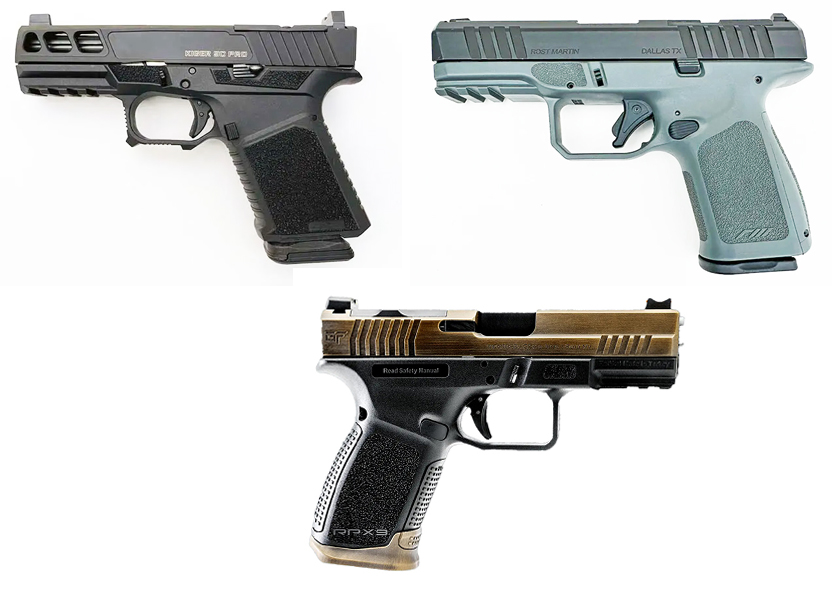
The other day when I was working in my gun safe to put together some guns for a range trip, I pulled out three pistols I’ve acquired within the past couple of years that none of my shooting buddies had heard of. I know about them because I was sent each one from the factory to review, and after the review I decided to keep them. All three are 9mm mid-size, semi-automatic pistols that warrant consideration for anyone looking to buy a gun for personal protection or sport shooting purposes.
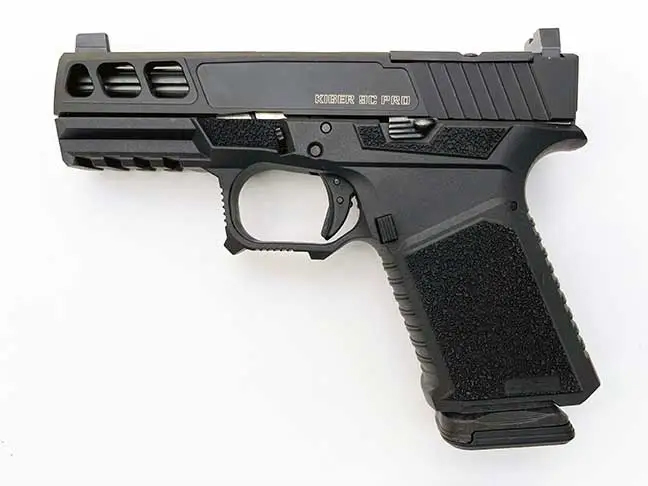
I would like to revisit these guns in no particular order just to let our readers know about them, or perhaps to just be reminded. The first is the Kiger 9C by Anderson Manufacturing. The Kiger 9C is a compact, striker-fired, semi-automatic pistol chambered in 9mm. It comes with a 15-round magazine. If you want more, Glock 19 magazines fit. The slide and barrel are made from 416R stainless steel with a DLC coating. DLC stands for “Diamond Like Coating,” and it’s a finish competitive with DuraCoat but with a hard shiny surface designed to last through years of heavy usage.
#1 Anderson Mfg. Kiger
Note: After writing this article I learned that Anderson Manufacturing has been purchased by Ruger and the Ruger has no plans to manufacture the Anderson product line, including the Kiger. Their goal in making the purchase was to acquire the manufacturing facility and skilled workers to increase their manufacturing capability. It’s possible Ruger will at some time add it to their product line, or another company will adapt it. Meanwhile there are some of these pistols currently in the pipeline at various auction sites such as Gunbroker.com and GunsAmerica.com.
The Kiger frame is constructed from high-strength lightweight polymer. The Kiger actually comes in four different models. The one I have is the Pro. The Pro model adds a few features the standard doesn’t have. The 9C Pro has aggressive slide serrations, detailed frame stippling, and a trigger guard undercut that serves to make an attractive and useful pistol. The beavertail is extended as are the slide release and magazine release.
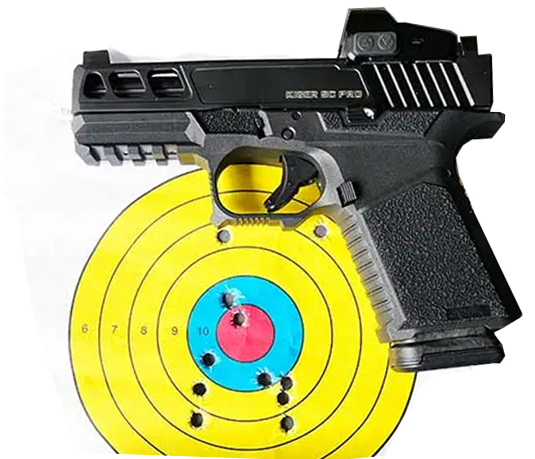
The slide includes three ports on either side and a window cut on top. The barrel is not ported but is fluted for weight reduction. It has a 1:10 twist rate, recessed crown and measures 3.91 inches long. The slide includes an RMR pattern optics cut and a set of blacked out suppressor height sights. I installed a Swamp Fox Kingslayer on my pistol. There is also a chamber-loaded indicator on the right side of the slide that is a pop-out extension of the extractor.
There is a suppressor-ready version of this pistol called Kiger 9C Pro SR that comes with a non-fluted, 1/2×28 threaded barrel and tuned recoil spring.
Shooting the Kiger held no surprises. There were no malfunctions and I found it quite easy to keep my freehand shot groups within a 5-inch circle from 10 to 14 yards.
#2 Rost-Martin RM1C
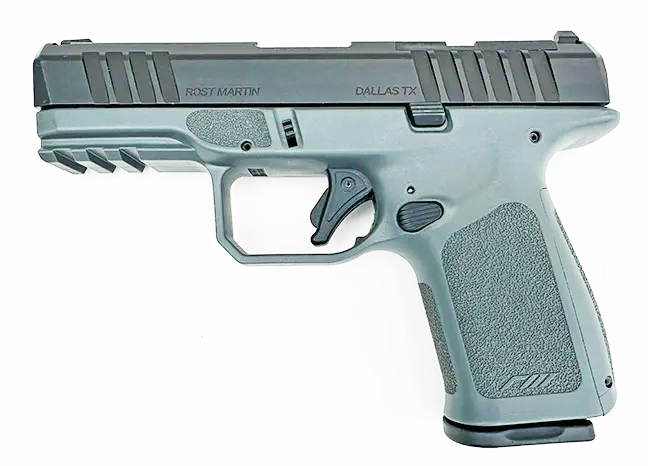
The husband-and-wife owners of Rost-Martin, Chris and Stefany Toomer, have a background with Springfield Armory—Stefany as a family member and Chris as an employee. They opened a new company in Dallas in 2020 and offered their first product, the RM1, in early 2024. The RM1 I have is the original model in two-tone black and gray. The Company has since issued a California model, a compensated model and a subcompact model.
The RM1C weighs 21.1 ounces, is 7.1 inches long and 5 inches high. The width is 1.22 inches. It ships with one 15-round and one 17-round magazine with an extended baseplate. Three interchangeable backstraps are included along with an RMR compatible plate for optic mounting. The RM1C is well-balanced, and the texture provides a secure grip which is not overly aggressive. The rear sight is a black U-shape, and the white dot of the front sight fills that notch when the sights are aligned.
The top of the slide has anti-glare serrations. A small window at the rear of the ejection port allows you to see whether the chamber is loaded. The back of the slide has another small opening which is filled with a red indicator when the gun is cocked.
The flat-faced trigger has the Glock-type safety lever. It was designed to break at under five pounds with a short take-up and reset. Mine breaks at just under four pounds according to my Lyman trigger pull gauge.
The RM1C is completely ambidextrous with slide lock and magazine release controls on both sides of the frame. The slide lock lever on each side is small but has serrations. It extends out (far enough) from the frame to provide easy access.
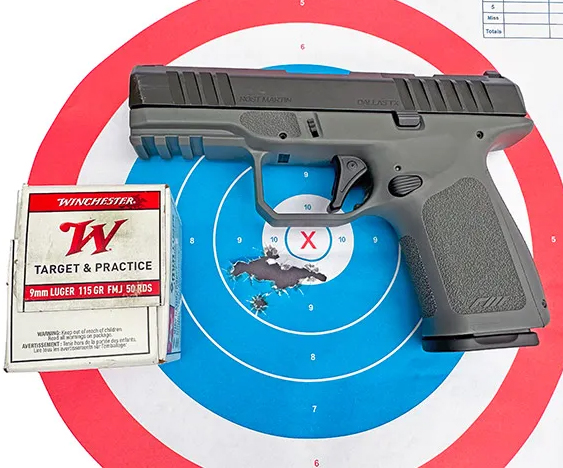
I’ve made several range trips with the RMC1 and used at least ten different ammo types. There have been no malfunctions. I’m impressed by the results I get when shooting freehand at ten yards. It’s a fun and easy gun to shoot and one that will make its mark in the gun world.
#3 GForce RPX9 Exodus
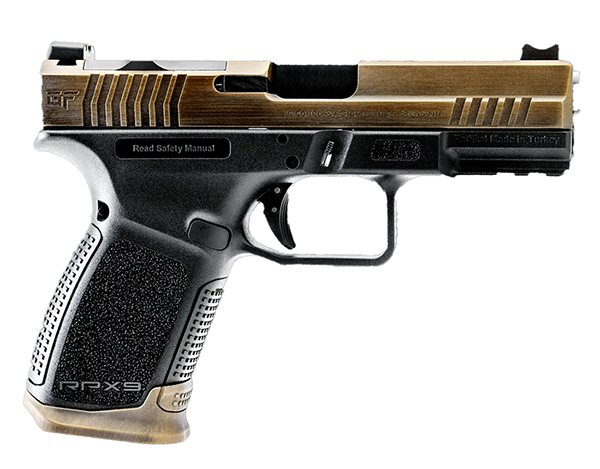
Although it is functionally the same as the Glock and is compatible with any add-ons or accessories for the Glock 19, the Exodus has some design features that set it apart. Yet it sells for $300. The RPX9 is chambered for 9mm. It comes with two 15-round (or 10-round) magazines. BTW, all three of these guns use Glock-compatible magazines. Empty weight is 1.33 lbs. Length of the RPX9 is 7.3 inches, height is 5.25 inches and the width is 1.5 inches—Glock 19 size almost exactly.
The RPX9 consists of an ergonomic polymer frame utilizing one of six color schemes topped with a 4140-steel slide. The slide on this one is finished in Bronze Tactical. Other colors are USA Flag, Tactical Gray, FDE, Bronze and Blue. The Exodus has both front and rear cocking serrations. The top of the slide is open. The slide is cut for a SHIELD RMSC. The slide lock is similar in size to the one on the Glock but with a bump that makes it easy to access.
Equipped with Glock Fiber Optic sights, the RPX9 facilitates rapid target acquisition and enhanced accuracy in various lighting conditions. Its compatibility with both GEN 3 & 4 Glock 19 parts and magazines offers versatility and convenience allowing users to personalize their firearm to suit their preferences. For safety, the RPX9 incorporates multiple layers of protection including a loaded chamber indicator, trigger safety and firing pin safety. I personalized mine with the same enhancements I did for my Glock 19. I replaced the stock trigger with a flat-faced, forward-set trigger from Apex. Then I replaced the trigger spring with a lighter pull spring kit from M-Carbo. When deciding if I’m going to wear my Glock 19 or this Exodus, I’ve been choosing the Exodus. The bronze slide and the enhanced look and feel make it an attractive gun that’s fun to shoot.
Any one of these pistols will make you a good defensive firearm, and they each cost around $400 or less where you can find them in stock.
GForce Arms located in Reno, Nevada, imports twenty-seven (27) models of shotguns, six (6) handguns and three (3) rifles, all made in Turkey. A couple of the handguns are of particular interest here. After being introduced to the product line, I selected these two pistols for review. Both are 9mm. One is a mid-size handgun, the other a 1911. In this article I’ll review the Exodus RPX9, which is a Glock clone.
The GForce Arms Exodus RPX9 pistol is essentially a Glock 19 clone
Although it is functionally the same as the Glock and is compatible with any add-ons or accessories for the Glock 19, the Exodus has some design features that set it apart. Yet is sells for $300. The RPX9 is chambered for 9mm. It comes with two 15-round (or 10-round) magazines. Empty weight is 1.33 lbs. Length of the RPX9 is 7.3 inches, height is 5.25 inches and the width is 1.5 inches—Glock 19 size almost exactly.
GForce Exodus RPX9 Bronze
The RPX9 consists of an ergonomic polymer frame utilizing one of six color schemes topped with a 4140 steel slide. The slide on this one is finished in Bronze Tactical. Other colors are USA Flag, Tactical Gray, FDE, Bronze and Blue. The Exodus has both front and rear cocking serrations. The top of the slide is open. The slide is cut for a SHIELD RMSC. The slide lock is similar in size to the one on the Glock but with a bump that makes it easy to access.
Equipped with Glock Fiber Optic sights, the RPX9 facilitates rapid target acquisition and enhanced accuracy in various lighting conditions. Its compatibility with both GEN 3 & 4 Glock 19 parts and magazines offers versatility and convenience, allowing users to personalize their firearm to suit their preferences. For safety, the RPX9 incorporates multiple layers of protection including a loaded chamber indicator, trigger safety and firing pin safety.
The Exodus is compatible with the G3 or G4 Glock.
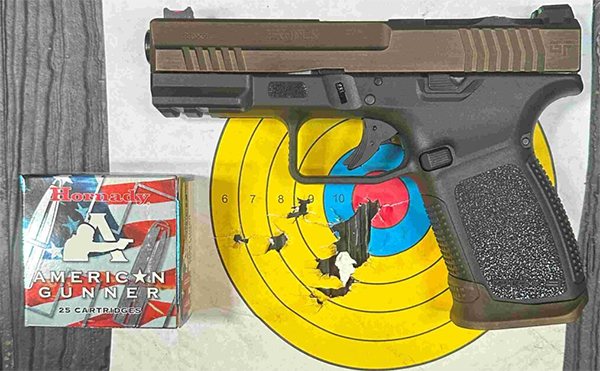
The trigger on my example was a little rough and initially measured a bit over 8 lbs. I subjected the gun to 115 grain, 124 grain and 147 grain practice ammo plus three or four different types of defensive ammo and experienced no ammo failures of any kind. The sights are larger than the sights on my Glock, and they made it easy to put solid groups on target. All in all I figured this for a good carry gun if it just had a decent trigger. Fortunately, I knew of a solution made of aftermarket parts for a Glock 19. If it works on the Glock, it’s supposed to work here. The parts are inexpensive and drop-in so I decided to try them.
Apex Action Enhancement Trigger
First, I added an Apex Action Enhancement Trigger, cost about $90. That resulted in a smooth trigger, but with a pull of over six pounds. I knew of another product that could reduce that. A company called M*CARBO makes reduced power spring kits for all kinds of firearms including the Glock 19.
M*CARBO Spring Kit for Glocks
The spring kit had the choice of 4, 5 or 6 lb. springs. I went with the 4 lb. spring and couldn’t be more pleased. I’m not sure how the spring tension works out because putting the 4 lb. spring in the gun resulted in a pistol with just under 3 lb. trigger pull. Because there were extra springs in the kit, I put the 5 lb. spring in my Glock 19 and it now has an under 4 lb. trigger pull.
I’m very pleased with the Exodus and currently have it as my daily carry gun. I may put a Riton or SwampFox red dot sight on it but the fiber optic sights on the gun are pretty nice as they are.
Most, if not all, gunwriters are also collectors. We almost have to be in order to be knowledgeable enough to write intelligently for our target audience. We have the luxury of being able to buy guns at reduced prices, which makes it tempting to acquire and keep guns we really like. For the past few months, along with a friend, I have been shooting the guns in my collection just to keep them exercised and to remind myself what’s in the safes. We went through the collection more or less alphabetically. Now we’re going back through by what I’m calling category. These are the categories I’ve defined so far: Pistol, Revolver, Rimfire Rifle, Centerfire rifle, Shotgun and Combination. The subcategories in pistols for example are: Full-size, Micro, 1911, etc. Today’s topic as you can tell by the title of the article is 1911s. Having recently shot them all I thought it might be a good time to review why they are in my collection. Here they are in the order of acquisition. There’s a point in here where you learn I haven’t always been a 1911 fan.
Colt/Umarex Government Model With Rail
This rimfire is the oldest one in my collection. It’s not the first 1911 I owned, however. I had three or four before this one I let them get away for some reason or the other. And yes, I regret that I didn’t value them enough to keep them around. I’m glad I decided to keep this one. It has been in my collection since December 2011 when I got it to use in the NRA Basic Pistol classes I was teaching at time. It’s a good teaching tool for any beginner, plus it’s a lot of fun to shoot. It is very similar to the standard Colt Government Model 1911 except it has a Picatinny rail on the frame, double slide serrations, skeleton trigger, low mount 3-dot combat style sights and a commander style hammer. It was manufactured by Umarex in Germany and imported and distributed by Walther. It was licensed by Colt with the Colt Logo. I purchased this 1911 through the gun store I owned at the time, Texas Gun Pros.
Colt Ace Service Model .22
This is one of two collector’s guns I have in my 1911 inventory. It has a very interesting history, some of which I unfortunately don’t have any record of. According to the Colt letter I received from the factory my gun was originally sold to the US Army and delivered to the Commanding General at Springfield Armory on December 16, 1941. Here’s where the history is unknown to me. It was obviously used in training somewhere during WWII, but I don’t know where. My Father-in-Law Joe Ireland bought it at a gun store in Atlanta for his wife Reecy when they were in the Navy and on their way to a duty station at Norfolk. How did it get from Government ownership to being in a civilian gun store? I have no idea. Joe was gone from home a lot and wanted Reecy to have something for personal protection. Reecy carried it in a military holster in her purse whenever she was out and about in the Tidewater Virginia area.
This gun has some unique features that make it valuable. The Colt Ace was derived from the powerful .45 ACP chambered Colt 1911 to allow military, police, or civilian shooters to train with the Ace without the recoil and expense of the 1911, but with similar ergonomics and sighting. Chambered for the far less powerful .22 LR cartridge, its barrel was constructed with a hinged floating rear chamber that amplifies the recoil when cycling the heavy slide, giving it more of the feel of the larger, heavier gun. These were used primarily by the Navy. Since my father and my wife’s father were Navy officers during WWII there is a good chance they both trained with these firearms. There were only 3,800 of these made and I have serial number 2565. Some of these guns have sold at auction for as much as $8,500.
Remington 1911 R1 Carry Commander
Remington jumped into the 1911 game with both Government and Commander models. I bought one of each back on 2/23/2014 but somewhere along the way I sold the Government model and kept the Commander. I have used this gun as a learning platform for gun finishes. Itt was blued when it came from the factory but the bluing was weak. I tried two or three different methods to get a deep color blue on it, then I managed to scratch it up a bit with my Dremel tool. My fix for that was to polish the slide and I really like the results. This is a .45 ACP with a de-horned forged carbon steel frame and slide with a 4.25 match grade stainless steel barrel with a target crown, lowered and flared ejection port, enhanced hammer, skeletonized aluminum match trigger, Novak sights with Tritium front night sight, checkered front strap and mainspring housing, beavertail grip safety with checkered memory bump and ambidextrous safety.
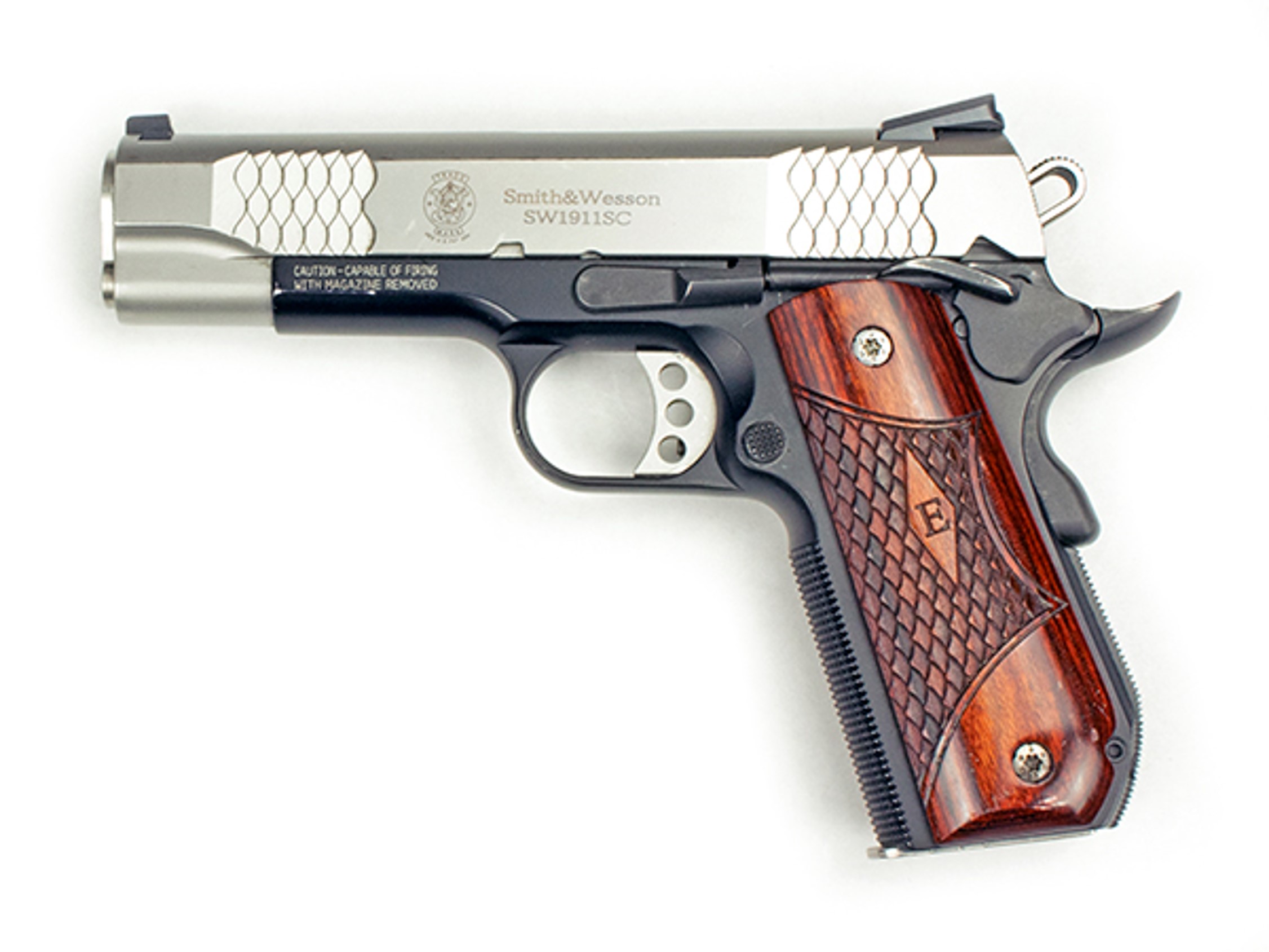
Smith and Wesson SW1911 SCE
This is the closest thing I have to a BBQ gun, or the gun I’d wear to show off if I actually showed off my guns, which he don’t. I bought this gun on March 21, 2014, and have carried it from time to time. When I was working at an office, I carried it often in an IWB holster. It is light, easy to carry and easy to shoot. There is some scandium in its frame which helps make it light, but there’s not really a lot. I still where it every now and then when it’s a dress up occasion or when I want to enjoy some good shooting. It never disappoints me in the accuracy department.
Ruger SR1911 LW
I had a Ruger 1911 Commander before this one, but it was all steel. That was actually the gun which won me over to the 1911 platform. It found a home with a good customer of ours and I replaced it with this one which is an aluminum frame model in 45 ACP with a gray anodized finish on the frame, 4.25 inch stainless steel barrel, stainless steel slide with low-glare finish, oversized ejection port and extended mag. release, skeletonized hammer, aluminum skeletonized trigger, drift adjustable Novak 3-dot sights, hardwood grip panels, checkered backstrap, oversized beavertail grip safety, extended thumb safety, standard recoil guide system, slide serrations and it came with a soft case. This one came aboard on January 23, 1915.
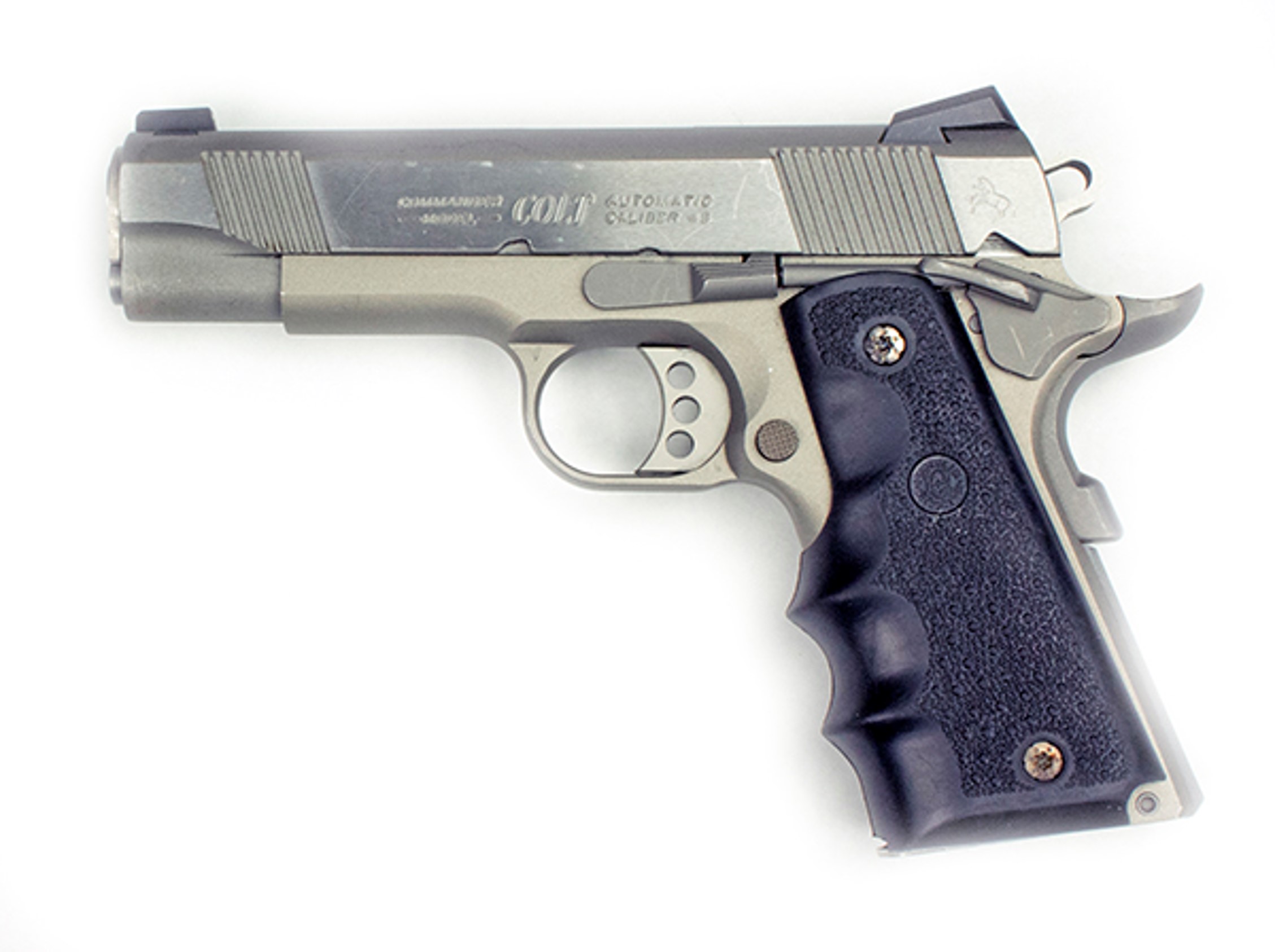
Colt XSE Commander
Gotta have a Colt, right? I have two or three but this is the one that gets the most use. It joined my collection in March 1915 through a Colt Stocking Dealer arrangement with the gun store owned at the time. I picked it out of the lineup because it has an aluminum alloy frame that makes for a nice carry gun. It also has a 4 1/4 in. barrel, brushed stainless steel slide and an 8 shot magazine. Being a Colt puts added pressure on it to be a great gun and so far, it has kept up that responsibility. It is accurate and reliable. You may notice the Hogue rubber grips with the finger grooves, which are an add-on my son talked me into trying and although I don’t necessarily like the look, they do feel good and help with recoil.
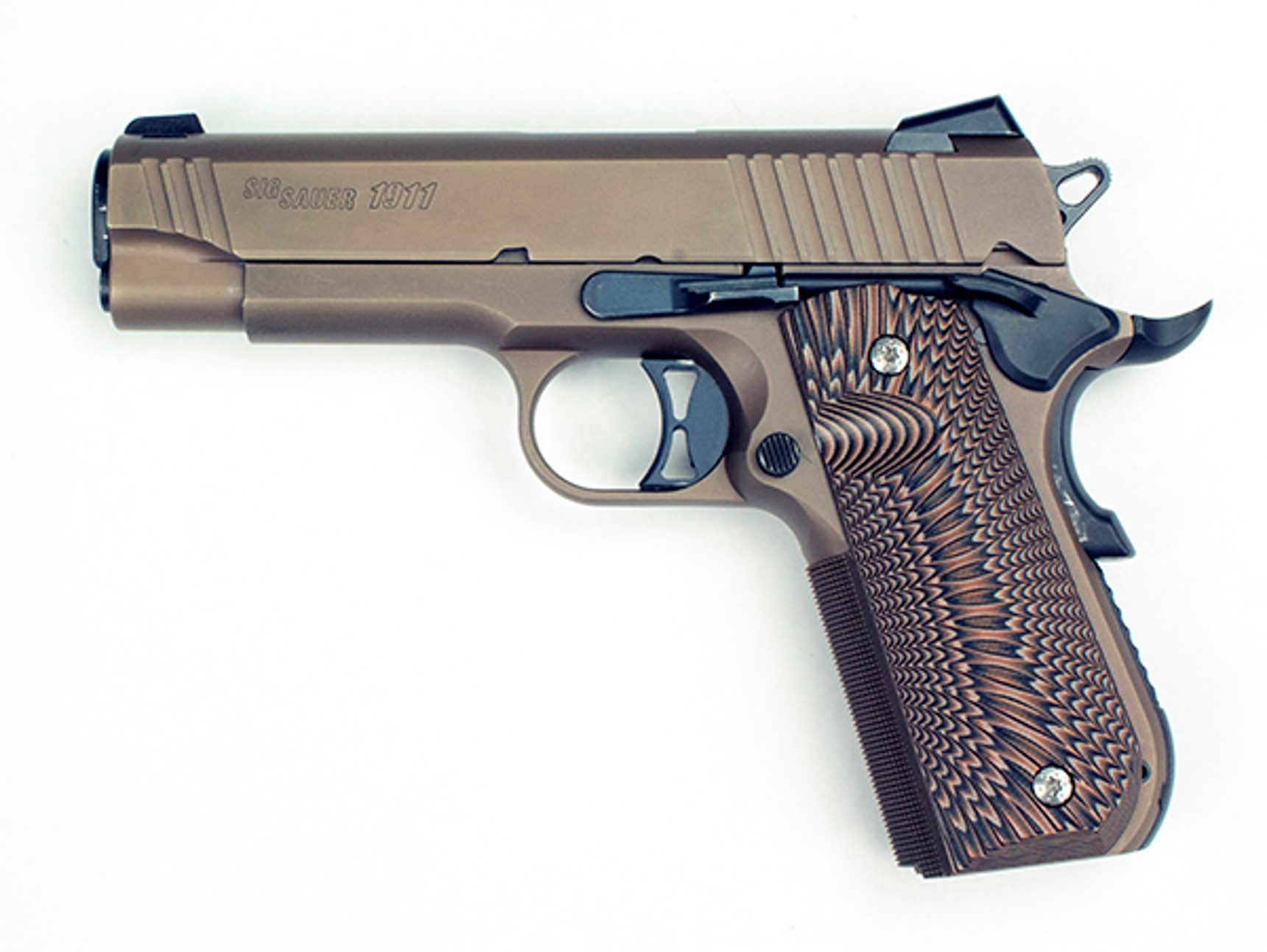
Sig Sauer 1911 Emporer Scorpion Commander
This is the most accurate handgun I’ve ever shot. I discovered that the first day I took it to the range, right after acquiring it on March 31, 2015. It was an indoor range and I had the target set at 10 yards. Because I like to use Colt 8-round, flush fit magazines in all my 1911s I had it loaded with nine rounds when I started shooting. It put round after round in the same hole. When the magazine was empty you could have covered that 9-round hole with a quarter. I gave my IPhone camera to one of my fellow instructors and asked him to take photos of the target as I continued to shoot. By the end of the second magazine load, it would have taken a half dollar to cover the hole. It doesn’t always do that well, rarely does it disappoint and when it does, it’s more my fault than that of the gun.
This was my main carry gun as long as I was comfortable shooting .45 ACP. It got replaced by a Mossberg MC2C when recoil became a factor, but I have never stopped bragging on and enjoying this gun. It’s a .45 ACP Commander with a carry-size fastback frame, 4.2 in. barrel, two 8 shot mags., stainless steel frame and slide (with traditional contour), Siglite night sights, ambi safety, Flat Dark Earth PVD coated finish, 35 oz. I replaced the stock black grips with a pair of Cool Hand Coyote Tan grips.
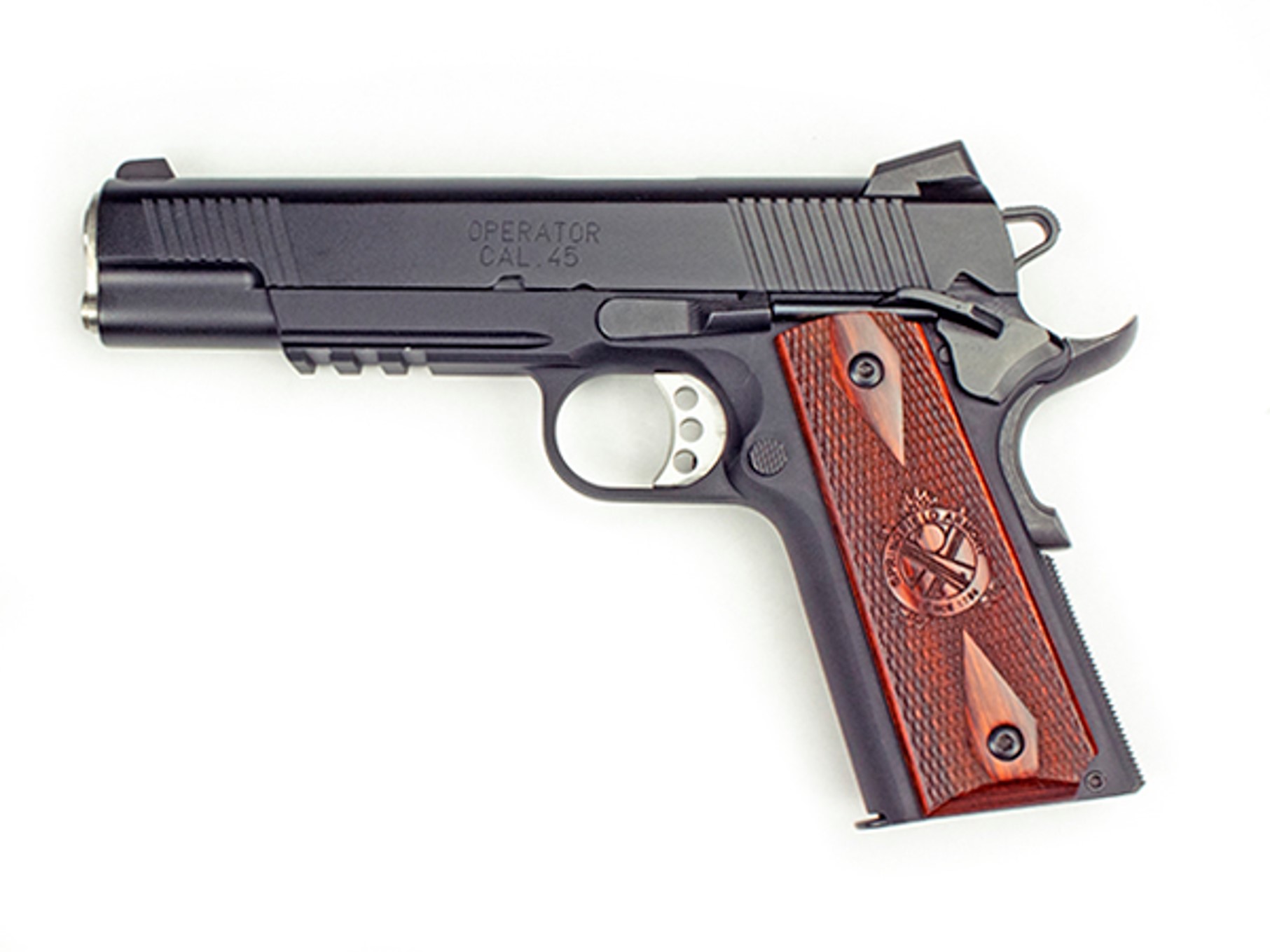
Springfield 1911-A1 Loaded Lightweight Operator
If you’re going to be a 1911 collector, you’ve got to have a Springfield, and this is the one that fills that role from me. I’m just noticing as I type these guns how many of them were acquired in 2015. This is another one I picked up on August 1, 2015. Springfield Armory offers a lot of different 1911 models. This one is made from an alloy material so it’s lighter than an all-steel gun and it has an accessory rail for mounting a light or laser. Those two features are why it is called the Lightweight Operator. It’s also called Loaded because it has all the features offered by Springfield on its 1911s. That would refer to sights, trigger, grip and so on. It is a .45 ACP caliber with a 5 in. stainless steel barrel, blue finish, fixed low profile combat rear sight, dovetail front sight, Cocobolo grips and it weighs 34 ounces. Attractive, don’t you think?
Colt M45A1 Marine Corps
The M45A1 Colts were originally issued to U.S. Marine Corps Forces Special Operations Command (MARSOC) Marine Raiders and the Corp’s Force Reconnaissance Marines. They were marked “USMC” on left side of slide. When released to the civilian market the USMC had a laser etched “X” over it. Approximately 1,000 guns like this were made and they were decommissioned late 2018. Both early and later models were released into the civilian market. The first ones still had the word Marines on the slide but with an X etched over it. Some M45A1s were released through the Colt custom shop and another round released through normal distribution, but when they hit around 2,600 they were no longer offered.
I purchased this one from Texas Gun Pros and it came at a time when I had no full-size Colt 1911s in my collection. It was unique enough I thought it would hold its value well. I didn’t know it would become one of a limited run and its value would escalate to about five times what I paid for it due to collector demand for such a limited availability. Remember, it was designed for use by the Marine Corps Special Operations Command and though this is a Commercial version it has the same features as the Marine pistol and is labeled the same as the Marine pistol. Colt only made about2,600 of these.
Ruger SR1911 LW Commander
This Ruger came on board in August 2016 as the first 9mm 1911 in my collection. I got it for two reasons. Number one was because I was a 9mm. Arthritis does affect your ability to manage recoil, like it or not, and my arthritis had significantly worsened. Number two was because of the positive experiences I had with my other Ruger 1911s. During the first few months of this gun being a part of my collection, all of the instructors who worked with me enjoyed shooting it. That’s when we discovered Colt had some 10-round magazines, which is what I use now.
Rock Island XT 22 Magnum
I got this 1911 on September 6, 2019 from Rock Island for an article. This was a writer’s T&E (test and evaluation) sample purchased directly from Rock Island Armory, also known as Armscor. I was interested in the engineering Armscor did to get it to cycle properly. The cartridges it shoots are .22 WMR, also known as .22 Magnum, are very loud cartridges and they spit fire. While they’re not ballistically a great stopping cartridge, nobody wants to get shot with one. This is an all-steel construction pistol with a modular barrel, 15 shot magazine, delayed blowback action with integral rail mount, low profile snag free sights, checkered synthetic grips and parkerized finish that weighs 2.22 pounds. I did a feature article this pistol for GUNS Magazine’s December 2019 issue.
American Tactical FNX Moxie
The Moxie is a hybrid 1911 built with a polymer frame with two metal inserts for added stability and durability. The slide is 4140 steel with a parkerized finish. The frame was built to have an ergonomic feel with built in finger grooves. Even though it’s a hybrid, most 1911 parts and grips will fit it. American Tactical was originally an importer who now makes many of its products in house. This is one of them.
Tisas U.S. Army 1911A1
I was writing an article about using military guns as mentoring tools and I didn’t have a good example of a true military 1911 except for the Colt M45. Several companies make WWII replicas of the 1911 but I felt this was the best value around. It was $400 where other companies were charging something like $700. This gun has not been a disappoinment at all. It looks and shoots just like an original US Army 1911A1.
Taurus 1911 Commander
When I purchased this Commander in October 2022, I had owned a Taurus 1911 before. It was during a time when the Taurus reputation was not so good, and my Taurus 1911 had the Taurus name in big bold letters along the slide. That and that alone was why I sold the gun. That’s too bad, too, because I had a story to tell about the day I bought that other Taurus 1911. I paid something like $750 and when I got it back to the Texas Gun Pros training facility there was a guy there who had a Springfield 1911 he had paid $2,500 for. After looking the Taurus over for features the Springfield owner said, “Dang, I paid about $1,700 too much for my gun,” meaning feature for feature the Taurus had it beat. I bought this one because it was a very reasonably price 9mm and I only had one 9mm 1911 Commander. Though it hasn’t gotten much use I have some upcoming training events that should remedy that.
CSG 1911 22 LR
German Sports Guns subcontracts to Sig Sauer to make the rimfire guns Sig sells. American Tactical cut a deal to import GSG guns to the US and that’s how come I wound up with this gun. It’s no secret I like .22s and this is an especially attractive .22 1911. It’s also relatively inexpensive, so when I saw several examples of these in Cheaper Than Dirt’s inventory, I bought this one to have another .22 1911 for shooting with the grandkids and friends who were new shooters. This one joined my collection on 11/9/2022.
Kimber LW Shadow Ghost
I was not a fan of Kimbers for a long time because of the number of FTF and FTEs I observed when teaching live gun classes. A couple of things opened my mind toward them. One was shooters who came to the Texas License to Carry course who had been on a military shooting team and who owned Kimbers. Most of them blamed Kimber’s ills on the magazines and reported that Wilson or Chip McCormick magazines solved the feeding issues. The other thing that caused me to be more open was when the Hurst, Texas, police department adopted Kimber 1911s as their official sidearm. The training officer there told me they had done significant testing and it appeared Kimber had solved their feeding issues. When a local gun store ran a Christmas special on the LW Shadow Ghost, I decided to give it a try. Much to my surprise, it has been totally reliable since day one. In fact,it has been a delight to shoot.
Kimber Custom Raptor F22 Fighting Eagles
What do you know? I’m the second Kimber in the collection of this former Kimber dissenter. Maybe this doesn’t count however, because this Kimber lives in a display case with the idea being it will increase in value over the years and someday be sold or traded at a profit. Although there is another collector’s item 1911 in the collection, I’m not sure this one would be here if wasn’t for it belonging to a friend who was moving overseas and needed to find a home for it. This particular gun was part of a limited-edition special order for the original pilots and ground crew of the F22 Raptor when it began its mission as a US Air Force fighter aircraft. The original owner died and his family sold it at auction. I’ve tried to learn something more about but no one at Kimber now seems to have any recollecion of this particular issue.
Tisas B9BA Carry Commander
I got this Tisas in October 23 because I wanted to do an article about it, but I also wanted a good 9mm 1911 for a carry gun. It’s well-built and has all the features I like in a carry pistol. It has an aluminum frame which makes me it lighter than its all-steel counterparts. Also, I’ve has the Ed Brown curved grip that reduces the tendency to print through outer garments. The G10 grips fill the hand and provide a slip-resistant texture. It is equipped with Novak style sight for a precise sight picture. I has an ambidextrous safety and a Cerakote finish.
Tisas 1911 Raider
You may notice this one looks very much like a pistol you see a little earlier in this article, the Colt Marine M45 Close Quarters Combat Pistol. That’s because it is a clone of that pistol. They are both .45 ACP pistols with Series 70 internals, a full-size frame, a 5-inch hammer forged barrel, a skeletonized hammer and trigger, flared and lowered ejection port, 3-dot low-profile sights, Novak style cut, with a Picatinny rail. Want to hear something kind of funny? Everybody who shoots this gun and the Colt M45 likes this one a little bit better. Imagine that, the copy being better than the original.
We are not all-knowing, super marksmen swimming in free guns and best buddies with the presidents of all the major gun companies. We are, however, some of the luckiest people on the planet. You may be wondering how we came to be gunwriters. For me, it happened like this. I wrote a letter to the editor of American Handgunner and he published my letter in the next issue of the magazine. I wrote another letter and he published that one, too. Then I saw that one of the regular columnists for American Handgunner was moving on and I wrote the editor, Roy Huntington, and asked if I could take that guy’s place. Roy wrote back and said something to the effect that you can’t just become a columnist for a magazine, you have to know a lot, have industry contacts, etc. , etc. At the time I owned a gun store and I was teaching the Texas Concealed Handgun License course and the Texas Hunter’s Education course and I thought I did know lot.
So, I started a blog and put up a few articles and I sent a link to the blog to Roy. Roy wrote back and said if I could provide good pictures with the text I had on affordable carry methods, he might could use that. So I took pictures and put them and the article text on a thumb drive and mailed it to Roy. Roy said the pictures sucked, but he is a gifted mentor. He very patiently coached me through setting up a photo lab with the right camera and lighting to take magazine quality photos over the course of my first year as a writer, which was 2017. The answer to how you get started for me it was pretty much a God thing that I found favor with Roy such that Roy saw enough potential in me that he tutored me into being a decent magazine writer. Seeing my words and pictures in print to me was sort of like Dr. Hook and the Medicine Show seeing their picture on the cover of the Rolling Stone. I was just turning 70 years old when I started getting articles published and I told people, “I am 70 years old and I finally know what I want to do with my life.” I loved it and still do. It’s hard work, but it’s fun work and the reward is recognition of your hard work by having an editor use it in a publication that goes out to thousands, if not millions of gun loving people.
There are hiccups along the way. Roy retired after turning over the reins of GUNS and American Handgunner to capable editors. As it turned out, those capable editors didn’t want my stuff. I was discouraged until I met Dave Dolbee, the editor of Cheaper Than Dirt’s blog, The Shooter’s Log. I had history with Cheaper Than Dirt, having headed up the web team that built their first website back in 1999. That’s my current gig, writing for The Shooter’s Log and one thing I love about that is I get an article published every week instead of one a month for GUNS magazine and one every two months for American Handgunner.
The aptitude test I took in high school to help me decide what to major in when I went to college said I should be a journalist. So, I majored in journalism when I started college and immediately learned that writing was all about answering the who, what, when, where and how questions. My high school English teacher had taught me that. My assignment during the first semester journalism class was to write a story each week about the Library. Boring. I quit journalism and went to business school with the journalism professor yelling at me that I was a coward.
I churned through some interesting times in the military and in my civilian jobs which all started out with me being a company pilot but ended up with me being something else that involved computers. In every position I had, I somehow became a writer or a video producer. All of those experiences prepared me for the role of being able to write for fun and money on topics for which I have a passion. That passion is to see ordinary Americans so knowledgeable and comfortable with their firearms that they can defend themselves against anything or anybody determined to do them harm. That commitment requires me being knowledgeable about guns so I can help my clients or customers find the right gun for them and the right gun for the purpose for which it is intended. So here I am writing about guns and about using guns.
Time to talk about free guns. What free guns? Oh, I have a few. There are some companies that are very generous in distributing new models to guys like me who they know are going to promote the products in a publication that gets wide distribution. Most of the time the guns we write about come to us as loaners. After 90 days we’re expected to return them or to buy them. I’ll admit the price we are quoted is attractive enough that most of the time I buy the gun. Let’s see, the $600 gun is sold to me for $400 and the article I wrote about it pays $300, so I got a nice gun for $100. But how do I make a living with that kind of math? The answer is I don’t. I know there are some gunwriters who are making a living at it. Those writers are very prolific and very good and probably don’t buy many of the loaner guns that come their way. So, I guess you could say I write to support my gun habit. Thankfully, I have income as a firearms instructor that helps in the pay department. And there are times as a gunwriter I do pretty well. For instance when I write about guns I already own. Or write articles that are instructional in nature and which don’t require a new gun to demonstrate.
When I read some writers I see a formula, a template if you will, and they just fill in the blanks. Informative, but boring. I don’t like to write like that. I try to make my articles more like a story in which the gun plays a major role. Sometimes it works well, other times it doesn’t. There are writers who just have a gift of descriptive and entertaining words flowing out of them seemingly effortless. I’m not one of those and when I try it, I flop. My MO is to hold the gun, shoot the gun, share the gun and write about what happens. Actually, I talk about what happens and take down my own dictation. My wife worries sometimes that my talking to myself is just a sign of old age, but the fact is I talk to myself so I’ll listen and maybe do the right thing.
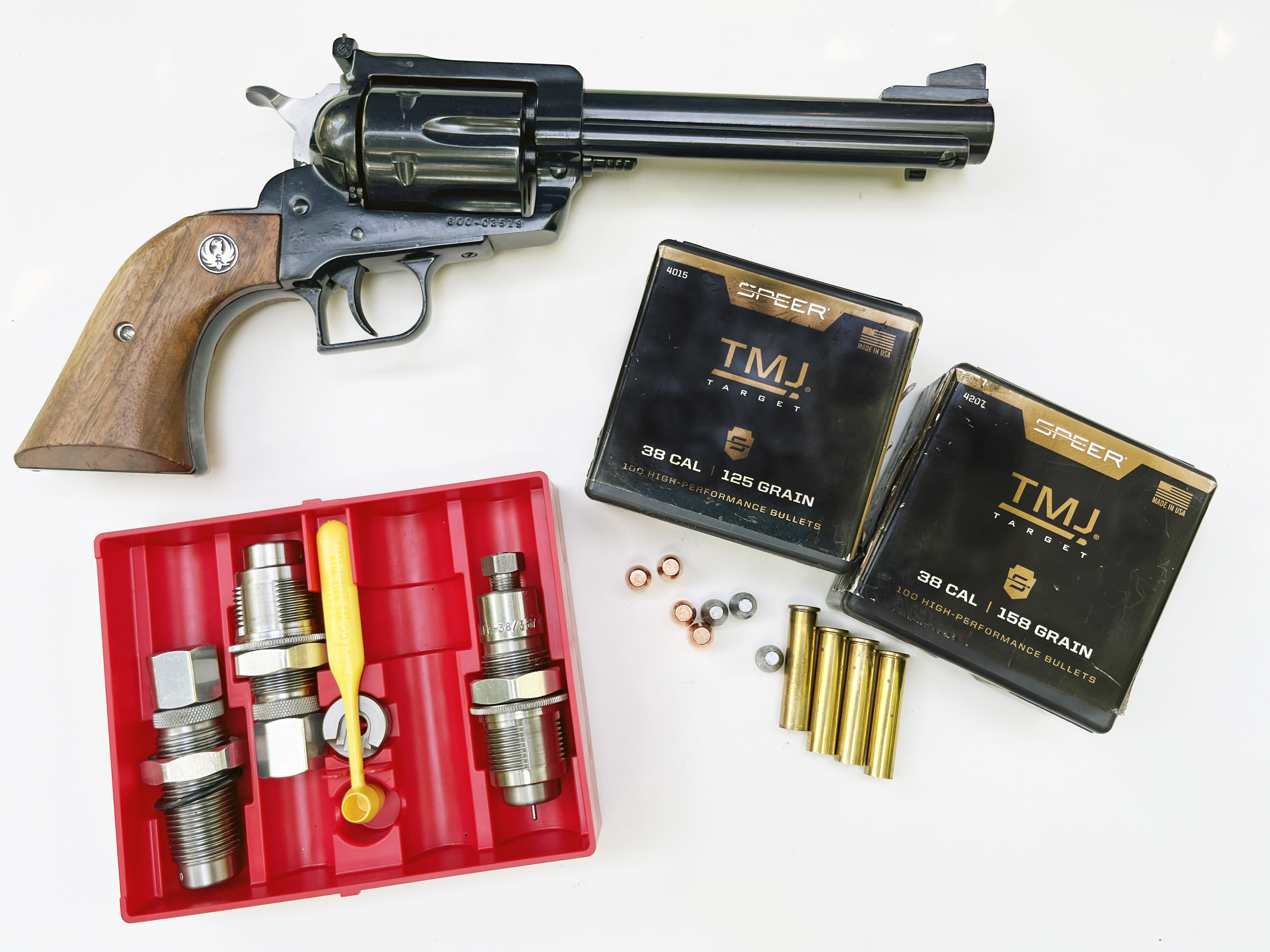
Let me give you an example of how I would write about a gun that hardly anybody else has written about. The gun is a Ruger New Model Blackhawk in a caliber that’s not common. I was working in the Internet department for a company that had a storefront gun store as well as an online presence. I had occasion to go the store to ask a merchandise question and as I walked by one of the counters, I saw a beautiful black revolver with a long barrel and wooden grips. It reminded me of Wyatt Earp’s Buntline Special on the TV program about Wyatt. The price tag on the gun was $300. I could do $300 and I had not bought a gun since I was 14 years old. “You do realize this is a .357 Maximum?” the salesman asked me. “Oh, yeah,” I replied as if I bought guns everyday and knew all there was to know about them. What I didn’t know was what a .357 Maximum was and so I thought he said, or meant, Mangum.
The Ruger .357 Maximum that got me started on gun collecting, along with some reloading supplies.
That gun, which I still have today, has taken me on a most amazing adventure of learning. The first thing I learned was the .357 Maximum round was developed by Remington and Ruger developed the New Model Blackhawk to shoot that round primarily for long range steel plate shooting. Reloaders were powering cartridges up for more performance and those heavy loads were burning a groove into the top strap on the Blackhawks. Ruger stopped making them after around 11,500 and initiated a voluntary recall on the guns that were out there. My .357 Maximum exhibits no evidence of any burning so I’m very pleased with it. That gun has served me well as a fun gun and a learning platform. I’ve used it instructionally to demonstrate the difference in recoil between a .38 Special, .357 Magnum and .357 Maximum. I’ve used it as a project gun for various refinishing projects. First, with the aid of a friend who had the tools and know-how to do it, I cut the barrel down from 10.5 inches to 6 inches. I installed a new front sight that involved soldering the sight to the barrel. I re-blued the gun, then later did a full Duracoat job on it. I learned to reload .357 Maximum loads by modifying a .357 Magnum die set into a .357 Maximum die set. I learned to scrounge for remanufactured .357 Maximum rounds and to locate .357 Maximum brass for reloading.
This experience with the Ruger .357 Maximum began a quarter of a century ago and in the years since then I’ve been so immersed in the gun culture I’ve built up a very interesting gun collection, I’ve owned and operated a gun store, I’ve become an instructor in several disciplines and have put over 22,000 students through the Texas License to Carry course. We all have to start somewhere.
I can’t and don’t even try to review every new gun that comes out. Although I do some rifles and shotguns, I primarily concentrate on handguns. The reason for that is physical. Handling long guns while in my wheelchair is challenging but I can handle handguns just fine. When I review a gun, I try to describe it to the reader in words and pictures. I give all the dimension measurements, the weight and the capacity. I describe how it handles. Then I shoot it for accuracy and reliability. Then I clean it and describe how to take it apart for cleaning.
One of my earliest guns up top, a Hi Standard .22, and on the bottom a gun I got to write about 60 years later, a Diamondback Sidekick.
The photos associated with my articles are another subject entirely. When Roy Huntington first started accepting my articles, he informed me that in the gunwriting business writers were expected to provide their own photographs. Many years earlier, my dad had been a speaker in the conservation world and he had accumulated a lot of expensive photography equipment to take the slides he used along with his talks. I wasn’t interested enough then to pick his brain and when I did get interested he was no longer around. Roy coached me through the camera to buy, how to buy and set up lighting and how I could tell what made a good picture. I knew a little about composition from a video course I had taken in relation to a job I had which involved making training films. I was and still am a work in progress along those lines, but these days the IPhone and PhotoShop can do wonders with my efforts.
I now have the privilege of writing for the blog published by the company I was working for when I bought the Blackhawk with the 10-inch barrel. One of the things I enjoy the most about this gig, in addition to the great people I have the privilege of working with, is the comments section that goes with each article. I get to interact with my readers and that is so cool—even the criticisms, which I use to help improve my writing and the research behind it. This article is getting to be pretty long, so I’m going to post it and write another article about the guns I’ve carried along the way.
When I became disabled such that I could not walk the VA issued me a four wheel cart to get around. Included in the deal was a Hamer lift that went into a standard trailer hitch receptacle. At the time I received this setup I drove a Jeep Wrangler.
The four wheeler didn’t work for me so I went on my own to get a wheelchair. At that time I weighed something like 347 lbs. so I needed a heavy-duty wheelchair. The one I settled on was a Jazzy 614 HD, with the HD standing for Heavy Duty. I did some modifications to the Hamer lift to fit with the wheelchair. Soon thereafter I traded the Jeep for a GMC pickup.
Although this isn’t my rig, it is similar to what I had hanging off the back of my pickup truck when I visited Roy Huntington.
With a rig similar to that shown above, I visited Roy Huntington at his shop with my heavy-duty chair bouncing around on the Hamer lift behind my GMC pickup. Roy took a look at the rig and offered to do some improvements. While he was welding up some stress points we were talking and Roy asked about transporting the wheelchair in the truck bed. I told him I had checked into options to do that and the medical equipment providers offered lifts in the $2,500 range which was a little steep for me.
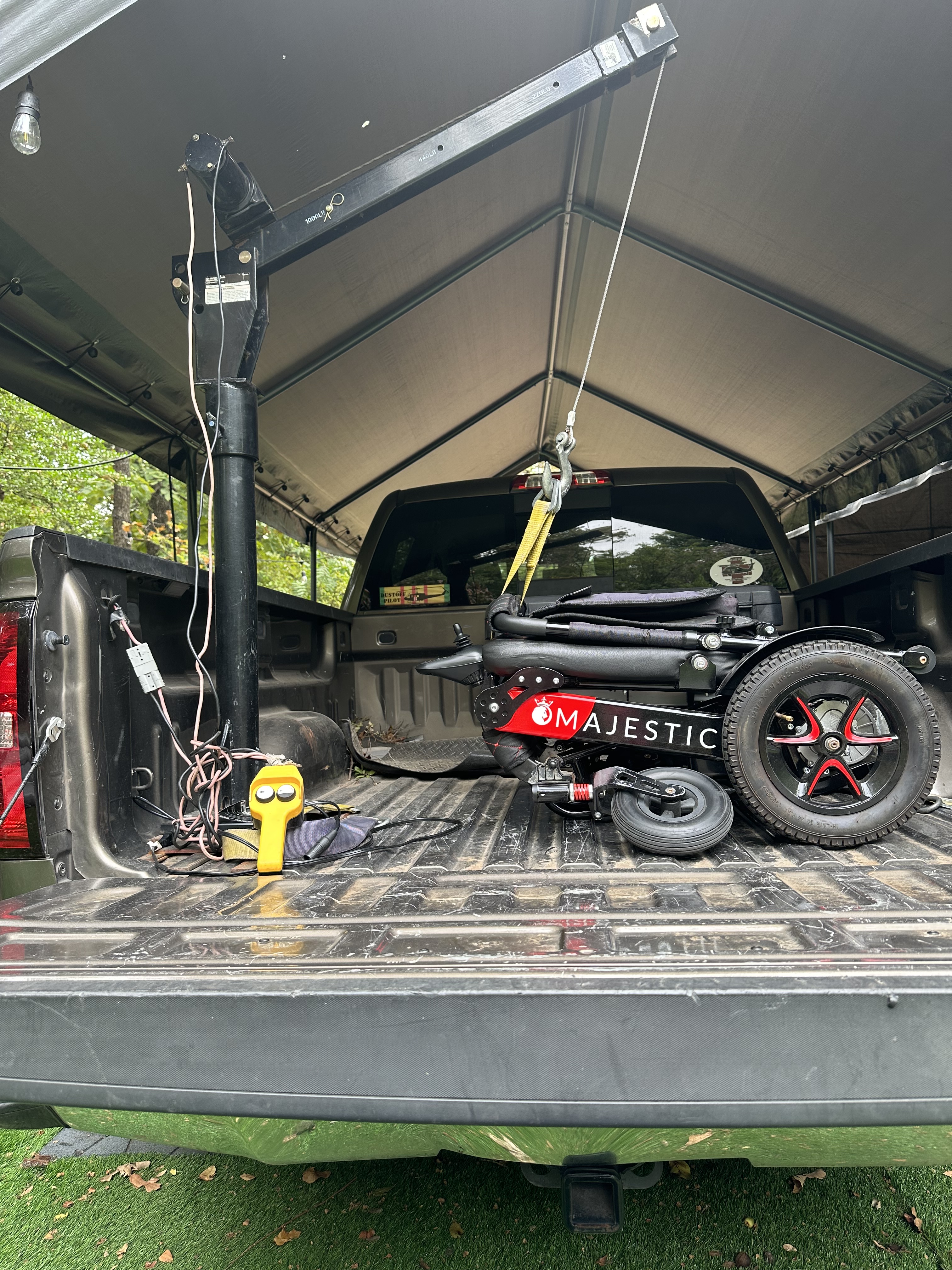
Roy suggested I could buy a hoist from Harbor Freight or Northern Tool Supply for around $500 that would accomplish the same purpose. I took that suggestion to heart and here’s the result:
Here’s an overview picture of my wheelchair hoist unit, but it doesn’t tell the whole story.
I bought the hoist unit from Northern Tool Supply for around $500. I don’t remember now if the motor and controller were included or if I had to buy them separate, but either way I have the hoist unit in the back of my pickup and it works well for the two electric wheelchairs I now own.
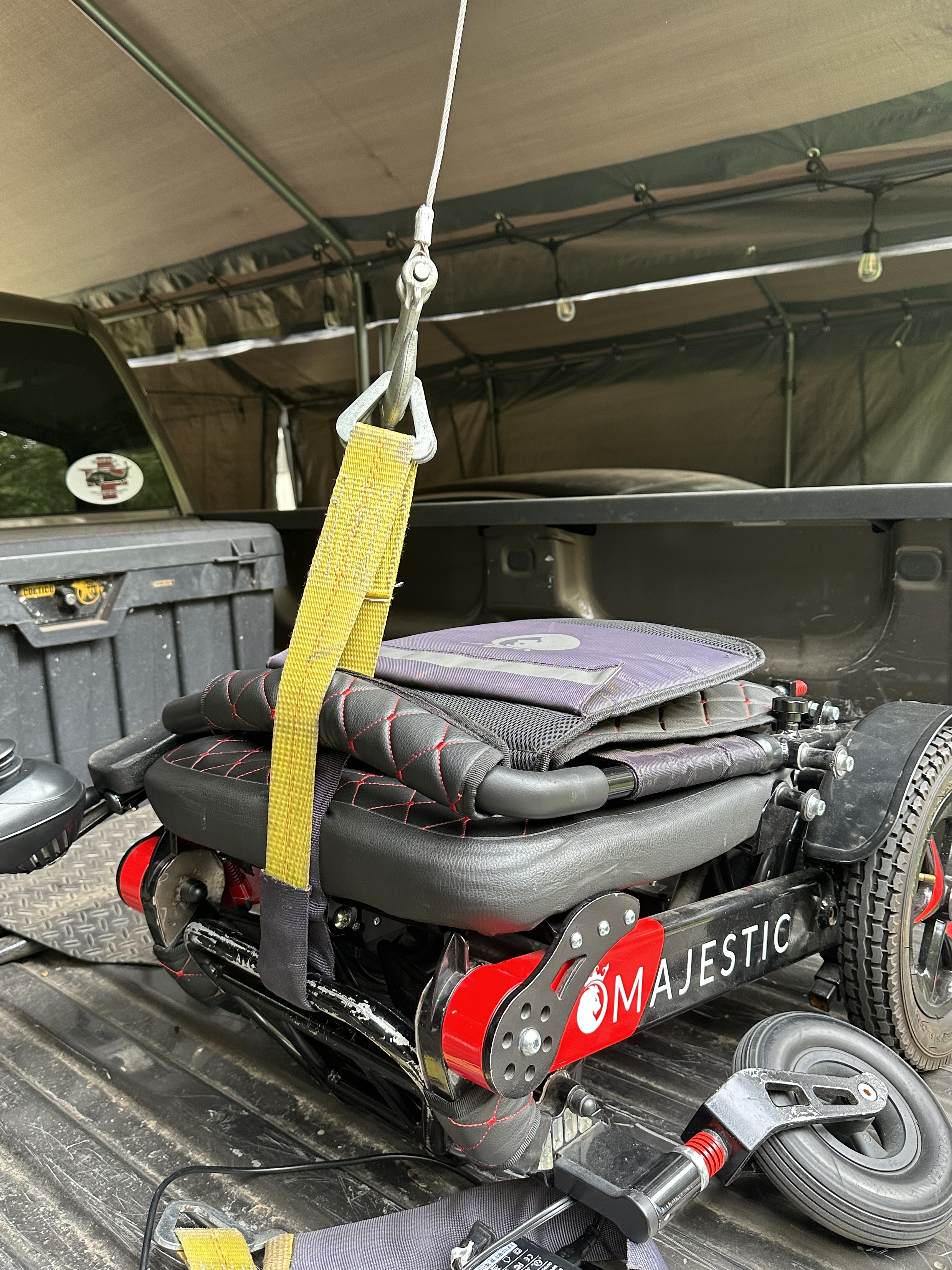
Here is a closer look at the rig with my lightweight, folding wheelchair all hooked up.
The floor of the pickup bed needed some reinforcing so I bought a steel plate from Lowes, along with some strips of steel and my son Phillip and I jury rigged the installation so that it is secure and won’t rip the floor out of the pickup..
Steel reinforcement of the hoist mount in the pickup truck
I mentioned that I have two chairs, a heavy chair and a lightweight one. The lightweight chair can be lifted by one strap wound through the footrest and the back of the seat.
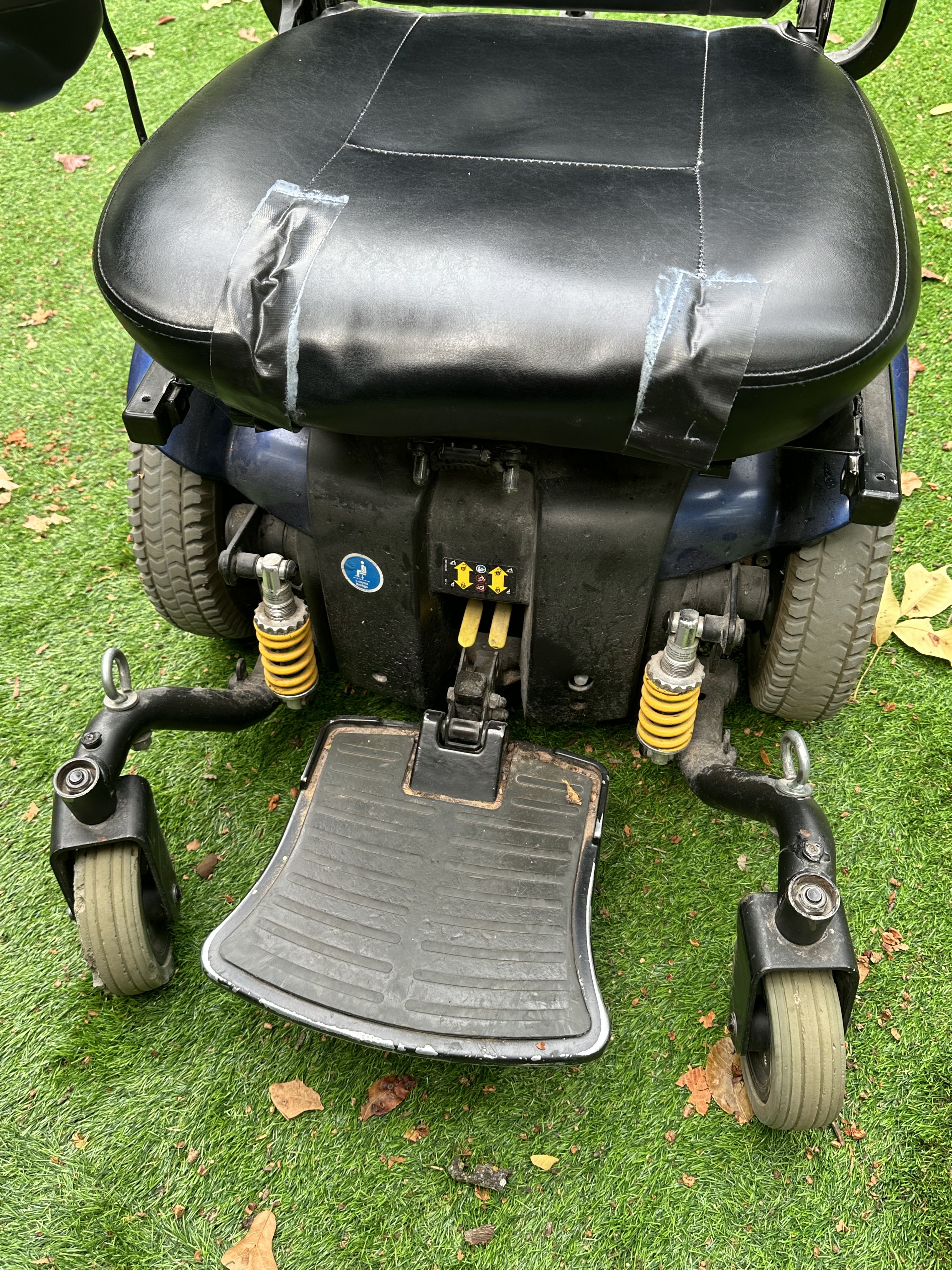
To lift the heavy chair I added eye-ring bolts to each of the outrigger wheel units.
Jazzy 614HD with eye bolts at four corners for lifting.
I drilled a hole in the lift post so I could insert a peg through it to keep it from swinging back and forth while I drive.
http://A pin inserted through holes in the lift pole keep the arm from swinging.
I’ll wrap up with just a couple of comments. The Jazzy chair weighs something like 225 lbs. which is well within the hoists’ limits. I can hook that chair up and lift it in and out by myself using the hoist. The Majestic chair weighs just 60 lbs. and my sons, grandsons and several friends, lift it in and out of the truck for me. When I’m by myself I use the hoist. It has push buttons on the controller that fold it up for transport and unfold it for use. All in all it’s a handy rig and I thank Roy Huntington for suggesting it to me.
I’m a collector of guns. I didn’t set out to become a collector, but by virtue of my life’s circumstances I’ve compiled a collection of guns that mostly just sit in the safe. I’ve sold some of my guns before, but almost always regretted it later, so now when I acquire a gun for writing a review I generally don’t send it back. Also, during the decade I owned a gun store, I also had a job. So instead of paying myself in cash for the services I provided to the gun store, I paid myself in guns. I’ve worded my will such that upon my departure from this earth one of two things will happen to my gun collection. If my wife needs money, the collection will be sold to provide her with the proceeds. But if she’s well situated, my sons and grandchildren will have the opportunity to each choose a share of the collection. And if they don’t want it, my youngest son who has been with me in the gun business and has a modest collection of his own will get the collection to do with as he pleases.
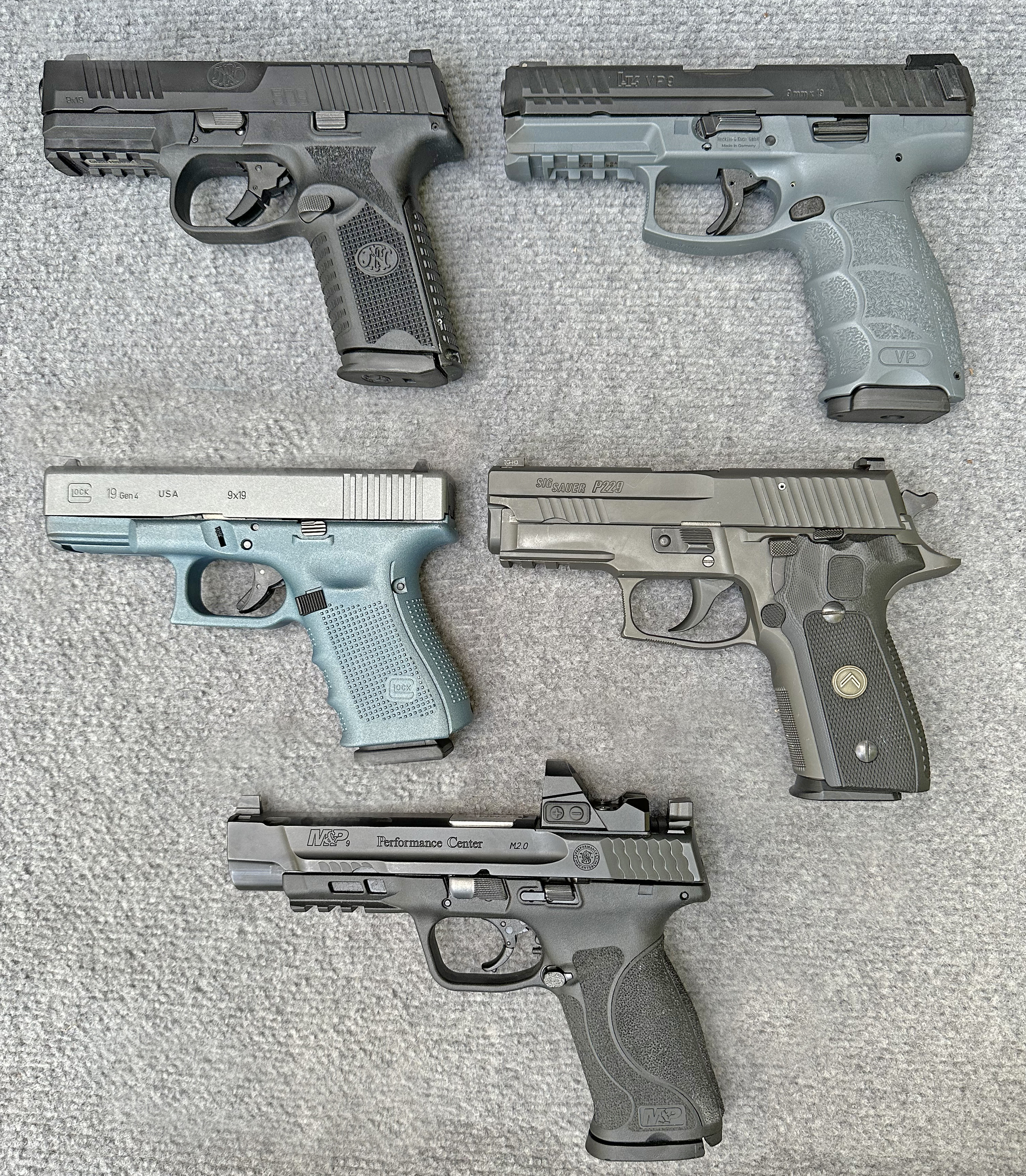
This week’s mission was to shoot the following: FN 509, H&K VP9, Glock 19 Gen4, Sig Sauer P229 and Smith & Wesson Performance Center M&P
Meanwhile, it seems almost a dereliction of duty for me to not shoot the guns that are under my care. Recently, I decided upon a plan in which I will make my way through the collection by shooting some of the guns each week. Last week I shot the ones whose manufacturer name begins with the letter A. This week I was all set to take out the Berettas and Brownings when an interruptive thought hit me. Why not this week shoot some of my favorite duty-size carry guns. I have a few that you might say are favorites of people who are not only “into guns” but actually carry one everywhere they go. I picked five: the FN509, the Glock 19 Gen 4, the H&K VP9, the Sig P229 and the S&W Performance Center Ported M&P. These are all best of class handguns in my book and none of them are in my collection by accident. Next week I may go back to alphabetical, but I can also see myself opting for a selection of compact handguns. We’ll see.
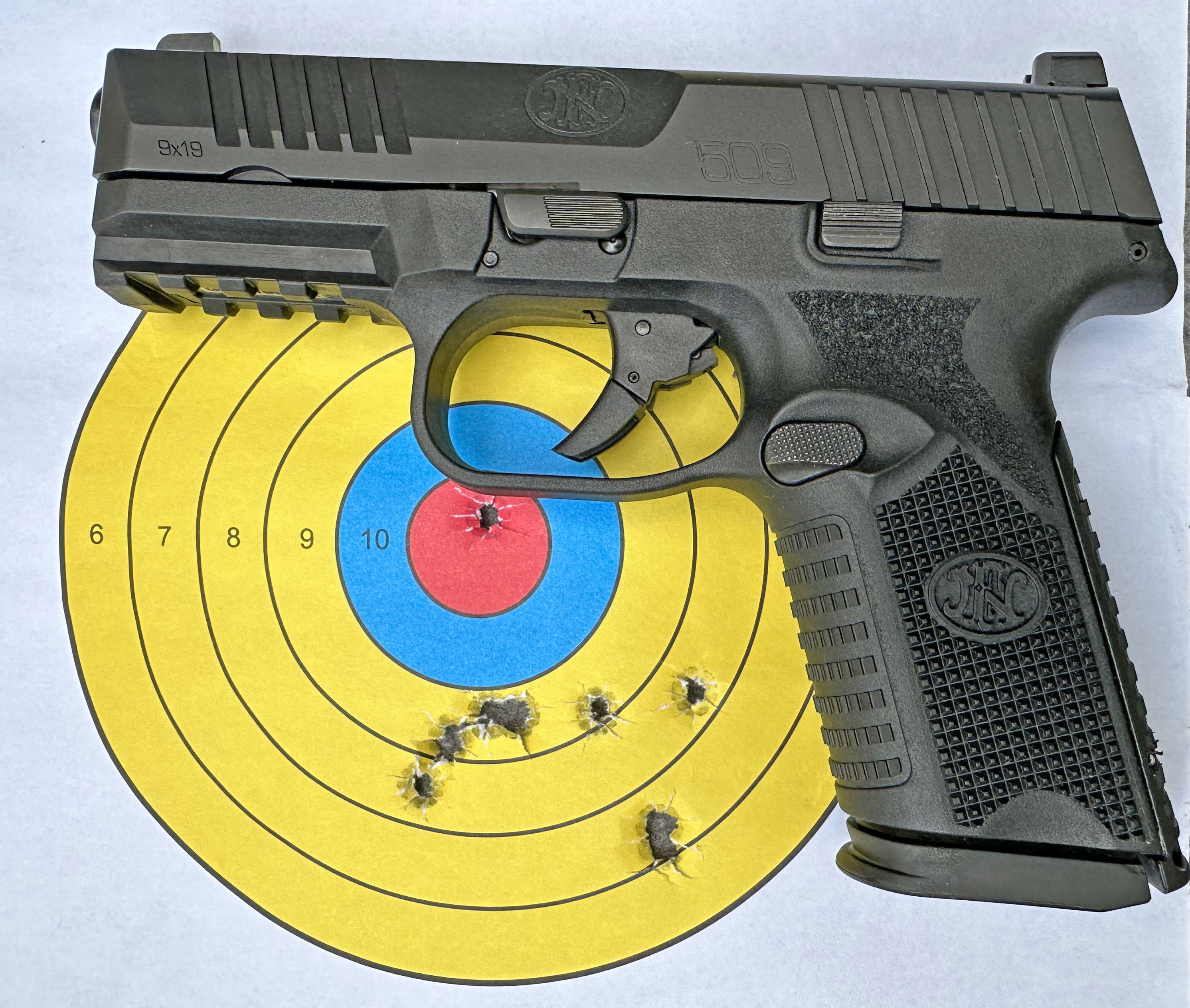
My range session consisted of shooting 20 rounds through each gun. The target distance was five yards just because I wanted to see tight groups. I shot the guns in alphabetical order which means I started with the FN 509. There is an online article by me on each of these guns done within the last couple of years. If you’re interested in reading about a particular gun, I’m sure you can find an article by me or someone else so I’m going to skip that part and just hit on the highlights of shooting each gun. I do want to highlight the sights and triggers. The sights on all of these guns were easy for me to see. The S&W has a Riton Red Dot sight mounted and it was spot on target. I’ve been writing about and testing Red Dot sights for a while now and I’m getting used to them. My only frustration is when they’re not sighted in properly and that’s always on me as I have the responsibility to adjust them. Every now and then I shoot a gun with a Red Dot and it’s shooting off a bit. I bring it home and check it with my laser boresighter and it shows to be right on. Next range trip with the gun it’s shooting right on, so I don’t know what’s up with the consistency.
After shooting the FN 509 and the H&K VP9 I found the Glock trigger to be hard. The last two guns, the Sig and S&W had fine triggers. Wondering what was up with the Glock I got out my trigger pull gauge and measured all five guns. Here’s what I got: FN 509 – 7 lbs., HK VP-9 – 6 lbs., Glock 19 – 8 lbs., Sig P229 – 7 lbs. and S&W M&P – 6 lbs. They’re all pretty similar and the Glock was the highest at 8 lbs. but that shouldn’t have been that much difference. Oh, well. Pictures of the targets follow.
FN 509H&K VP9Glock G19 Gen 4Sig Sauer P229S&W PC M&P 2.0
My first gun cleaning kit was an Outers. It was a small red tin box with a cleaning rod, a couple of bronze brushes, some patches and some oil. While cleaning guns hasn’t changed much in the past 60 years that I’ve been cleaning guns, the products available to help with the task have.
Outers Shotgun Cleaning Kit Circa 1955.
I recently became the proud owner of a GuardTech Plus Universal Cleaning Kit that is destined to make my gun cleaning tasks easier. You see I have tons of gun cleaning chemicals and hardware accumulated over the years and especially as carryover from when I taught gun cleaning classes as part of my Texas Gun Pros gun store and training academy. People come up with new stuff for gun cleaning all the time. And although much of it impresses me the way I clean guns hasn’t changed in 60 years. Will the GuardTech kit change that? Not the chemicals, not the methods or techniques, no, but it will make things easier because of how organized it is.
GuardTech Plus Universal Gun Cleaning Kit
This kit has all the hardware I need to clean guns and it has it so organized that I can keep up with the right brush for the caliber, the correct rods, everything. Here’s what’s in the box:
3 solid brass rods for calibers .30 and larger
3 solid brass rods for calibers .17 -.270
3 utility brushes — stainless steel, brass and nylon
13 brass jags
4 brass slotted tips
14 bronze brushes
3 brass adapters
9 cotton mops
1 bore cleaner
cleaning patches
cotton cleaning swabs
3 muzzle guards
The kit holds everything in it’s place, which will eliminate the digging around in a box or pile to find the size brush or jag needed. I’m all for organization and this kit makes it easy.
Thank you Jim Toshack and his crew for making this kit available. You can find it on Amazon here: https://amzn.to/3rANpcV
I have become a fan of the 5.7x28mm cartridge as the result of reviewing pistols in that caliber by FN Herstal, Ruger and Smith & Wesson. Palmetto State Armory released a 5.7x28mm pistol a couple of years ago. That one, called the “Rock,” is the subject of this review.
The Palmetto State Armory Rock 5.7×28 Caliber Pistol
The 5.7x28mm came about as a result of NATO seeking a 9mm replacement with greater range and accuracy and the ability to penetrate body armor. FN Herstal designed a cartridge to meet the NATO requirements and built a gun that would shoot it. The new FN 5.7x28mm cartridge featured a 1.138-inch-long case with a rebated rim and a 35-degree shoulder designed for a .22-caliber bullet weighing anywhere from 23 to 31 grains. Obviously it’s a much smaller projectile than the 9mm, but what it lacks in size it makes up for in velocity. Shot through a long barrel, the cartridge drives a 26-grain slug at a velocity of nearly 2,400 feet per second, about 2.5 times faster than typical 9mm loads. The size of the projectile has evolved so we’re now shooting 40 grain most often and there are even 5.7x28mm rounds with 62 grain projectiles. These larger bullets are slower, traveling in the 1650 to 1799 fps range.
FN’s first two guns to shoot the cartridge were the FN P90 PDW (Personal Defense Weapon), along with the FN Five-seveN pistol. The Five-seveN became an immediate hit with some militaries, law enforcement agencies and sport shooters, but its price kept many potential firearm buyers away. All of this happened in the latter part of the 1980’s. In recent years, several firearms companies have designed new guns around the 5.7 cartridge causing somewhat of a rebirth in interest among shooters which led to more companies giving the cartridge a try.
Ruger somewhat surprised the market with its 2019 introduction of the Ruger 5.7. Featuring a 4.9-inch, alloy steel barrel with a nitride coating for wear resistance, the full-size pistol has a lot going for it. Impressive ergonomics include an easy trigger reach, robust slide release and reversible magazine release latch. The hardened, billet steel slide with lightening cuts is drilled and tapped for easy mounting of optics with separately available optic adapter plates. The Ruger 5.7 ships with two 20-round steel magazines and is priced several hundred dollars below the FN pistol.
At this year’s SHOT Show, Smith & Wesson announced it was jumping into the 5.7 game. The M&P line now includes the M&P 5.7. The M&P 5.7 uses a newly designed internal hammer-fired, gas-operated, locked-breech barrel system in which the barrel doesn’t cam open until the bullet passes the gas port for what the company calls “worry-free consistency.” The polymer-framed, full-size pistol features a 5-inch barrel to utilize as much of the cartridge’s potency as possible. It comes optics-ready and with a threaded barrel for use with a suppressor if desired. Capacity is 22+1 giving it a bigger ammo payload than similar-size 9mm pistols. I’ve previously covered the Ruger 57 and the S&W 5.7 here on the Shooter’s Log.
Palmetto State Armory’s 5.7 offering is similar in size and capacity to the Ruger and the Smith & Wesson. As best I can tell from studying PSA’s website, the Rock is available in 52 different configurations. The one I have is the 5.7 Rock Black Standard. It has a black frame, non-treaded barrel and 3-dot day sights.
This is the PSA Rock Standard Model
The PSA 5.7 Rock is a striker-fired, polymer-frame handgun designed to maximize capacity with the small FN cartridge. It can be had in an optics-ready configuration with a milled slide cut for the Shield footprint, and open-sighted models with night sights are available that accept Glock-pattern sights.
Externally, the PSA 5.7 Rock is highly similar to the Ruger-5.7 and the S&W M&P 5.7. All three guns have a Picatinny accessory rail on the frame, front and rear slide serrations, extensive texturing throughout the grip frame, blade trigger and a magazine capacity of 20 or more rounds.
They are very similar in size:
Length
Height
Width
Weight
Barrel Length
Capacity
PSA
8″
5.2″
1.2″
25 oz.
4.7″
23+1
Ruger
8.65″
5.6″
1.2″
24.5 oz.
4.94″
20+1
S&W
8.5″
5.25″
1.1″
26.7 oz.
5″
22+1
Here are specs for the Rock as listed on the Palmetto State Armory website:
Model: PSA Full Size 5.7 Rock
Caliber: 5.7x28mm
Capacity: 23+1
Weight with Empty Mag: 25 oz.
Barrel Material: Carbon Steel with QPQ Finish; Fluted
Barrel Length: 4.7″
Twist Rate: 1/9″
Slide Material: 416 Stainless Steel with QPQ Finish
Action: Delayed Blowback Striker-fired
Mag Catch: Reversible
Safety: Trigger & Striker
Accessory Rail: Picatinny
Magazine: 23 round Steel 5.7x28mm Magazine (Ships with 2)
Designed to work with Glock™ compatible sights
Ships in Palmetto State Armory Soft Pistol Case
Right about now you may be asking, “What’s QPQ?” QPQ stands for “Quench Polish Quench.” It refers to a process used to increase corrosion resistance. Other properties can also be improved by performing the QPQ treatment including: wear resistance; capacity to reduce friction, known as “lubricity,” and fatigue resistance.
I’ve received several guns lately that were shipped in canvas cases. The one from Palmetto State Armory has a pouch for the barrel and Velcro strap for the grip to secure the gun plus pockets for the two magazines and the lock. On the outside front it has a very nice, embroidered PSA Logo with a clear plastic pocket beneath it for displaying ID information such as a business card. Unzipping the case and pulling out the gun for the first time felt a little bit like Christmas morning.
PSA Rock in it’s Carrying Case With Two Magazines
Although some say the Rock designers stole its look from the Ruger 57, I don’t think so. I find it very attractive in its own right. My first impression when holding the gun in my hand was, “If this gun shoots like it should, this is a gun I will be proud to own.” Naturally I racked the slide to clear the gun, found a good dry fire target on the wall and pulled the trigger. Very nice! I struggle with the slide on some of my 9mm handguns, but the 5.7x28mm doesn’t require a strong spring to cycle the gun; therefore, I can easily rack the slide on any of the 5.7 handguns, this one included.
The size of the 5.7x28mm round is such that the pistol grip is long and narrow to accommodate. There is a high undercut on the trigger guard allowing a high grip on the frame. The trigger reach is such that even my short, stubby fingers have plenty of extra length there. Sights on my gun are the standard three white dot arrangement. The slide has the standard Glock cut for sights making any of a number of aftermarket sights an easy upgrade. Front and rear serrations on the slide are there to assist with any hand position the shooter likes to use for racking slides. The Picatinny rail has three slots, and behind it the trigger guard is squared off in front for those of us who like to put the index finger of the support hand on the front of the trigger guard for stability.
The slide lock lever is small but easy to manipulate and it has a protective ridge around the bottom and front to prevent inadvertent operation during shooting. Unfortunately for South Paws, it exists only on one side. The magazine release button is rectangular in shape and reversible. Its operation is positive, resulting in a nice magazine ejection. The magazine baseplate is slightly larger than the bottom of the grip allowing for an easy grasp to pull out a magazine that may be stuck. Also there is an indention on both sides at the bottom of the grip to facilitate grasping and pulling the magazine out. The texture on the grip and on both sides of the frame where the index finger rests is very comfortable, yet aggressive enough to provide a non-slip grip. There’s a single bump on the front strap positioned to go between your index and middle finger. It makes a secure grasp easy.
Takedown for cleaning is non-standard by very easy. Follow instructions in the manual for the first time.
Takedown for the Rock is a bit non-standard. After ensuring the gun is unloaded, the trigger pulled and the magazine out of the gun, wrap your firing hand over the top of the slide and pull the slide back until approximately ¼ of it extends toward the back. Don’t go too far or the trigger will reset, and you’ll have to start over. With your support hand, pull the takedown levers that are located above the center part of the trigger guard down on both sides. Release pressure on the slide with your firing hand, allowing it to move forward until the rear of the slide is approximately 3/8 inch forward of the end of the grip. You can then lift the slide off the frame. Remove the recoil spring, then lift the barrel out and that’s it. Reassembly is a simple matter of replacing the barrel and recoil spring, then setting the slide down on the frame, the notches on the slide aligned with the front and rear tabs on the frame, then sliding it rearward until you hear and feel a click. Then rack the slide and you’re done.
One nice thing about loading 5.7 magazines is you simply push the rounds down from the top like you do an AR magazine. I didn’t take the time to load a full 23 rounds but once, but when you’ve got that many rounds in the gun on your hip, you’ve got a pretty good defensive load in my opinion. Speaking of carrying the gun on your hip, the Rock fits easily into any of the holsters I have that were made for the S&W M&P.
First rattle out of the box shooting from ten yards away, I was very disappointed. The Rock was putting all my rounds off to the left of my aiming point and with an unacceptable spread of 5 inches or more. I handed the gun to one of my shooting buddies, and he had the same experience except instead of shooting off to the left, his rounds were going low. I tried loading some rounds from a different box of ammo, and darned if the gun didn’t shape right up and start looking pretty good. Those first rounds were from a box of FN 27 grain ammo. The second load was American Eagle 40 grain ammo. Amazing difference. After shooting that for a while,20 I tried some FN 40 grain ammo, and it also shot well.
Typical target for the Rock, fired offhand at ten yards.
The Rock is a very comfortable gun to shoot—nice trigger, low recoil, acceptable accuracy, right on par with the Ruger and S&W examples I have of 5.7x28mm handguns and at a price below the others. If you’ve not tried a 5.7x28mm pistol yet and want to jump in the game, the Palmetto State Armory Rock is a great place to start. And if one 5.7x28mm is all you’ll be buying, you won’t be disappointed with this one.














 David Freeman