Some of you long-time readers may remember my 1911 love affair began with a Ruger. It was the original .45 ACP all steel commander-sized Ruger that caused me to totally re-evaluate my understanding of the 1911 platform. Prior to having that particular pistol in my hands, I just didn’t understand why the 1911 continued to be so popular when there are so many excellent newer designs available.
Even though I’m a firm believer in the .45 ACP cartridge for personal defense, arthritis is taking it’s toll on my hands and shoulders to the point I carry a 9mm about a third of the time. Continuing developments in 9mm ammo make me more comfortable with the 9mm’s ability to get the job done.
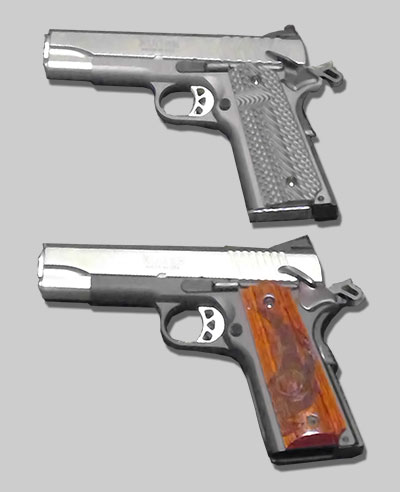 The Ruger 1911 LW CMD has been one of my favorites. When Ruger announced they were coming out with a 9mm version of that handgun, I put my name on the waiting list because I knew it would be popular and that I should evaluate one for the benefit of my students.
I bought the first one that came into our shop and the other two sold almost immediately. We ordered more as soon as we could.
It came with black rubber grips. Those didn’t appeal to me, but I’ve got a drawer full of 1911 grips (try Amazon.com) so I swapped out the grips. That’s the 9mm at the top in the picture. The one on the bottom is my .45 ACP LW model. As you can see, they changed the color scheme slightly, but everything else looks pretty much the same. The trigger is the same, the sights are the same. The cocking serrations are slightly different, but other than that, it’s really hard to tell the difference.
Some things I noticed when holding the gun and checking it out: 1) it is easier to rack the slide on this gun compared to my other 1911s and most of the double-stack 9mms I have. 2) it has some side-to-side motion in the slide that I thought might affect accuracy. It doesn’t. 3) it was very difficult for me to load rounds into the magazine. So difficult, I couldn’t do it with out resorting to my UpLULA.
Today, after our License to Carry class had finished shooting and we were packing up to go back to the shop I told my instructors I had 4 magazines loaded. Some were loaded with ARX and some were loaded with 124 Grain Gold Dot JHP. That’s the heavy end of the spectrum and the light end of the spectrum as far as 9mm rounds go. We hung a target and pushed it downrange approximately ten feet.
I shot the first magazine, resulting in 10 shots (I had one in the chamber) in pretty much the same hole. The target was approximately 10 feet away. Each of the instructors at the range with me picked a different aiming spot and emptied a magazine with the same results, one ragged hole. The gun did not care if it was 80 grain ARX rounds or 124 Grain Gold Dot HP rounds. It handled them all the same.
The three guys who didn’t own the gun, each placed an order.
Here’s what I know about the magazines. I don’t think Ruger has made the wisest choice in selecting who makes their magazines. They work, but they don’t load well and in my .45 Ruger 1911, I can’t make the slide go forward with an empty Ruger magazine in it. I told their product manager about it and he didn’t seem to think it was an issue to be concerned about (meaning, probably they have a contract and are committed). I solved that problem by buying some Colt magazines to use with the Ruger. In the .45 platform they hold an extra round even with the flush base-plate, so they have become my go-to source for .45 ACP 1911 magazines. The Colts work in everything.
When I discovered the loading issue with the 9mm magazines, I ordered to 9mm Colt magazines. They’re easy to load. When we shot today, we shot with two of the Ruger magazines and two Colt magazines. As far as shooting goes, the gun didn’t care. They all worked the same. It’s just that the Colt magazines are much easier to load.
The shooting experience was pleasant. One of my instructors who previously didn’t like the Ruger 1911s (he’s a Springfield guy) said this one shoots much better in his opinion.
I believe this is going to be a mainstay. I know mine will be on my belt often.



 g and aiming my pistol multiple times a day, no matter what I’m carrying. While doing these drills with the CZ-P07, I found it darn near as comfortable as my 1911. Knowing this was probably just a subjective observation, I decided to do a little testing.
 The original CZ-75s are all steel. They have several models such as the 75, 85, Compact, and others with differing features such as size, finish, capacity, caliber, etc. The one that I felt I just had to own is the CZ-P07. As you might surmise, the “P” stands for Polymer and I’m guessing the ’07’ means it’s a James Bond gun. Oh, wait, not enough zeroes. Okay I think the 07 has something to do with size, since I know the P09 is bigger and maybe the P05 and P06 are smaller. We gun guys can’t know everything.
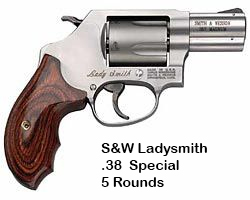
 Kind of look alike, don’t they? It really is hard to tell them apart, but one does hold six rounds and the other seven. Up to a point, they both shoot the same types of ammunition. They both shoot .32 S&W Short, .32 S&W Long, .32 H&R Magnum, but only one of them, the Single Seven, also shoots .327 Federal Magnum.
 loves it. I don’t like getting in her vehicle and she doesn’t like getting in mine. We don’t particularly enjoy driving each others’ vehicles, either. Why? The seating and mirror adjustments are off, the controls are different, the accelerators require a different touch – they’re just different. But they’re both excellent vehicles and they are up to the tasks we expect them to perform.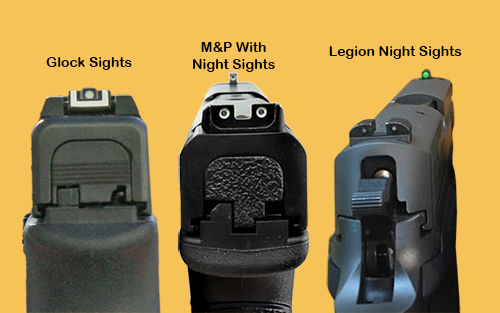
 I’m all for selling guns. I’m in the business. And like any business owner, I’ve got rent to pay, suppliers to keep happy and employees I want to take care of. I can’t do all of that without selling guns, along with the ammunition, accessories and training to go along with them. But to me, it’s not about selling merchandise as much as it is about helping people. You see, deep down in my heart of hearts I believe people should be able to defend themselves. I believe they should be able to stand up against a tyrannical government, if it becomes necessary. And I believe people in a free country should be able to responsibly own guns because they’re cool, they’re fun to shoot and frankly, just because they want them.
 I want you to think about something. What kind and size of guns do the police carry? What kind and size of guns to the LTC instructors you may know carry? You don’t find them carrying little guns. You don’t find them carrying small calibers. Or, if you do, I can almost guarantee you they are new to the business. Those of us who have really studied what goes on in the real world, those of us who have shot a lot of different guns, those of us who have studied real-world ballistics, rather than the fancy headlines in magazines and advertisements, are pretty careful about what guns we carry. Those of us who are instructors and who sell guns, have totally different perspective on what we recommend than does a typical gun salesman in a retail establishment.
 I like night sights. All of my defensive guns don’t have them, but most do. It’s not just for shooting if the light is low. I like them because if I need to locate the gun quickly when startled awake at night, or if the lights go out, the sights beckon me.
 For a 1911 type gun I like a checkered front strap and back strap. I’m not sure why, but they just feel better in my hand. One of my favorite guns, a Colt Commander, doesn’t have a checkered front strap, though the back strap is. I love the gun, but I find myself wishing the front strap was checkered. There is an aftermarket solution I tried for a while, but it didn’t stay in place well. I may try again with some type of adhesive.
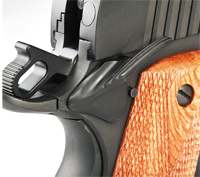 On my 1911s I like a an ambidextrous safety and I like the over-sized ones. Why? For a reason that may not be applicable to many people, but I carry my defensive pistol in an inside the waistband (IWB) holster worn at the three o’clock position. With the gun in that position, the safety is against my body so it’s not really easy for me to check, as I periodically do, to make sure the safety is still on. With a safety on the right side of the gun also, it’s very easy to check the safety to make sure the motion of my body hasn’t pushed it off.
 Rails – should your gun have a rail or not? I think that one depends on where you’re going to use the gun. I have an M&P in the bedroom with a Streamlight flashlight/laser combination, so the fact that gun has a rail makes it work. Some of my carry guns have rails and all they are good for as far as I’m concerned is making me choose a different holster. I personally will not have a light on a carry gun because I don’t intend to open carry and having a concealed carry rig big enough for a light or laser on the rail just isn’t feasible. Besides, I don’t anticipate the need in a defensive gun that I carry.
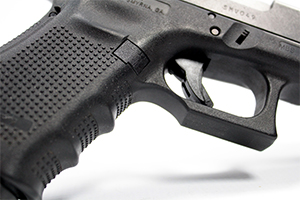 I could cover many more details that people either like or don’t like about guns, but I’ll stop with just one more. It’s something the writers usually call “undercut” and it applies to the trigger guard. The purpose is to allow you to get a higher grip on the frame which mitigates some of the recoil. I was reading about some of the new Sig Sauers the other day and the writer was talking about how they had an undercut trigger guard which was an improvement over earlier models. I started looking at my Sigs – an SP2022, a P226 and an M-11, which is really a P228 in military dress, and a couple of 1911s. All of them except the 1911s have an undercut to some degree or the other. The picture I’ve used as an undercut example here is actually on a Glock, but it’s not stock. It’s a gunsmith enhancement and you may notice, it was done by cutting a way a significant portion of the stock trigger guard. I’m for anything that mitigates recoil, so I’ll say that’s a good thing, but I’ll also tell you have guns I love to shoot that don’t have that undercut.
 David Freeman